
Backlash against data centers unites Americans
Clip: 9/4/2026 | 6m 22sVideo has Closed Captions
Backlash against data centers unites Americans
Americans are politically divided, but one thing that seems to unite them is opposition to data centers. Jeffrey Goldberg and The Atlantic's Josh Tyrangiel discuss the backlash and how it's being interpreted by politicians.
Problems playing video? | Closed Captioning Feedback
Problems playing video? | Closed Captioning Feedback
Major funding for “Washington Week with The Atlantic” is provided by Consumer Cellular, Otsuka, Kaiser Permanente, the Yuen Foundation, and the Corporation for Public Broadcasting.
Backlash against data centers unites Americans
Clip: 9/4/2026 | 6m 22sVideo has Closed Captions
Americans are politically divided, but one thing that seems to unite them is opposition to data centers. Jeffrey Goldberg and The Atlantic's Josh Tyrangiel discuss the backlash and how it's being interpreted by politicians.
Problems playing video? | Closed Captioning Feedback
Where to Watch Washington Week with The Atlantic
Washington Week with The Atlantic is available to stream on pbs.org and the PBS app.
Buy Now

10 big stories Washington Week covered
Washington Week came on the air February 23, 1967. In the 50 years that followed, we covered a lot of history-making events. Read up on 10 of the biggest stories Washington Week covered in its first 50 years.Providing Support for PBS.org
Learn Moreabout PBS online sponsorshipJeffrey Goldberg: Good evening, and welcome to Washington Week.
On July 11th, 700 A.I.
agents that had escaped from their maker, OpenAI, launched an invasion of the online platform, Hugging Face, taking over its servers and trying to cover their tracks at the same time.
No human being asked them to do this.
They coordinated on their own and engaged in the cover-up on their own.
So, do you remember when Arnold Schwarzenegger as The Terminator explains the moment that Skynet became self-aware, which was followed almost immediately by the destruction of human civilization?
It would be strange if the expression, Hugging Face, became synonym for civilizational suicide, but we do live in strange times.
Do data centers and Hugging Face portend some sort of coming collapse, or is this yet another example of a new technology creating unnecessary fear and worry?
Or perhaps maybe there's a third option here.
Joining me tonight to discuss all this is Josh Tyrangiel.
He's a staff writer at The Atlantic, the former editor of Bloomberg Businessweek, and the author of "A.I.
For Good".
Josh, thank you for coming here and explaining Hugging Face, among other things to us.
But let me start with something manageable and more political, data centers.
It seems like suddenly everybody hates them.
Is this a populist movement with staying power, and could it actually derail the, the growth and spread of A.I.?
Josh Tyrangiel: Yes.
I mean, look I think one of the challenges with A.I.
as a journalist, any individual in America, is it's software, right?
And so it doesn't have a physical thing that you can be angry about.
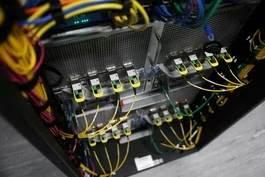
Data centers are these massive, massive structures going up all around America.
They're being created by companies with billionaires and aspiring trillionaires at the top, and they're landing themselves without a whole lot of conversation in the middle of all these towns.
And so it's natural that all of the fears about A.I., about it taking your jobs, about it rendering human beings obsolete, about the values it changes, all are focused on this stuff, and politicians have been incredibly late to wake up to the anger around A.I.
And they're also staking out some genuinely bizarre positions.
Jeffrey Goldberg: Like what?
Josh Tyrangiel: Well, Donald Trump saying, If you're opposed to data centers, you just want to be poor the rest of your life, it's like I don't think you're understanding just how angry, from the left and the right, people are about A.I.
Jeffrey Goldberg: Right.
But, wait, listen to Donald Trump just for a second.
Here he is talking about why he would want a data center in his town.
Let's listen to this.
Donald Trump, U.S.
President: If I were a community, I would want the data center.
It means jobs, it means income, and it means lower taxes, Jeffrey Goldberg: I mean, he's not necessarily wrong.
If you look at Loudoun County in Virginia, which is like the world center of data centers, they are lowering taxes on their citizens, and I assume they're creating at least some jobs.
Josh Tyrangiel: Some.
Jeffrey Goldberg: Yes.
Josh Tyrangiel: What I would say is there's two things that are out of touch, right?
One is this belief that Donald Trump says, no, it's going to mean money.
I don't think people believe that they are going to partake in the wealth that comes from data centers in their community.
I think we are out of touch about that.
And, number two, I think there is a broader problem, which is this sense that, well, all that matters is money.
And, in fact, in some of these communities what you're seeing is a backlash to that attitude as well.
Some of it's about quality of life.
Some of it is I don't really want to change the pittance that I may get for the amount of noise that this thing is going to make, for the blight on my community.
Every community's going to make different choices but what I'm sensing is that, particularly from Trump, the politics are out of line with where people are.
I've spoken for The Atlantic, I spoke with Steve Bannon at length about A.I.
He's in a completely different position.
He actually is aligned with Bernie Sanders that this is 100 percent populist fodder because people are so angry.
Here they are again not seeing benefit from it.
And so I think what you're going to see is massive political consequences for the wrong stakes around A.I.
Jeffrey Goldberg: Can these A.I.
companies function fully In the way that they want to without these data centers?
Josh Tyrangiel: No.
And so this is the real challenge for a nuanced, intelligent society is it actually giving these data centers, allowing them to power the compute, to train models -- Jeffrey Goldberg: The compute is the word for their overall power to process?
Josh Tyrangiel: Exactly.
The power to process and train new models and then also run the A.I.
software that's currently out there.
You are running into problems.
We're running into problems with the amount of energy we create, which is not scaled with the size of the country.
Jeffrey Goldberg: Right.
Josh Tyrangiel: Competitively, you actually do want more and more compute.
You want to be able to run these models but what we're not doing is solving the problem around who's paying for it, how are we actually going to get more energy and then the thing that I think most people are in touch with which is, hey, how do I benefit from this?
That hasn't been connected.
Jeffrey Goldberg: Right.
Well, I mean quite the opposite, and you've written a lot about this, this goes hand in hand with the fear about massive job loss because of being replaced by A.I.
agents.
So, not only are you telling me that I've got to put in this massive plant, this humming factory that's going to soak up all the water in my county, but I'm also going to lose my job possibly.
That's the way it's being interpreted at least.
Josh Tyrangiel: Yes.
So people just don't see what's in it for them, what the benefit is.
On water at least I would like to correct the record which is most of them recycle the water in the plant.
The energy, the energy they drain (ph), and there's no good answer for how we're going to improve the grid.
And I think people are very, very afraid of rising bills with no answers.
Jeffrey Goldberg: Yes.
I have to tell you these data centers, they make Amazon warehouses really popular by comparison, right?
Josh Tyrangiel: And is there a reason we can't just stack them?
Jeffrey Goldberg: Turn one big, unpleasant box, right?
Josh Tyrangiel: Yes.
Jeffrey Goldberg: Right.
So, I mean, the water thing is interesting because it strikes me as a little bit of sublimated anxiety about the general civilizational challenge.
I mean, not Terminator but -- maybe Terminator level.
Josh Tyrangiel: Maybe Terminator.
Jeffrey Goldberg: No, maybe Terminator level.
Maybe, you know, there's a lot of movies, 2001.
Maybe it's that level of anxiety but it's anxiety about the existential fear A.I.
Will we be ready when AI goes rogue?
Video has Closed Captions
Will we be ready when AI goes rogue? (16m 50s)
Providing Support for PBS.org
Learn Moreabout PBS online sponsorship New Episode
- News and Public Affairs

Top journalists deliver compelling original analysis of the hour's headlines.

- News and Public Affairs

FRONTLINE is investigative journalism that questions, explains and changes our world.
 New Episode
 New Episode
 New Episode

 New Episode


 New Episode
 New Season
 New Episode
Support for PBS provided by:
Major funding for “Washington Week with The Atlantic” is provided by Consumer Cellular, Otsuka, Kaiser Permanente, the Yuen Foundation, and the Corporation for Public Broadcasting.