
January 6, 2026 - PBS News Hour full episode
1/6/2026 | 56m 42sVideo has Closed Captions
January 6, 2026 - PBS News Hour full episode
January 6, 2026 - PBS News Hour full episode
Problems playing video? | Closed Captioning Feedback
Problems playing video? | Closed Captioning Feedback
Major corporate funding for the PBS News Hour is provided by BDO, BNSF, Consumer Cellular, American Cruise Lines, and Raymond James. Funding for the PBS NewsHour Weekend is provided by...
Support provided by:

January 6, 2026 - PBS News Hour full episode
1/6/2026 | 56m 42sVideo has Closed Captions
January 6, 2026 - PBS News Hour full episode
Problems playing video? | Closed Captioning Feedback
How to Watch PBS News Hour
PBS News Hour is available to stream on pbs.org and the free PBS App, available on iPhone, Apple TV, Android TV, Android smartphones, Amazon Fire TV, Amazon Fire Tablet, Roku, Samsung Smart TV, and Vizio.
Providing Support for PBS.org
Learn Moreabout PBS online sponsorshipGEOFF BENNETT: Good evening.
I'm Geoff Bennett.
Amna Nawaz is away.
On the "NewsHour" tonight: President Trump presses U.S.
energy companies to revive Venezuela's derelict oil industry, but barriers stand in the way of accessing the country's vast reserves.
The Venezuela operation puts a changing U.S.
foreign policy on full display, with threats of intervention and an effort to assert more influence in the Western Hemisphere.
And five years after the assault on the U.S.
Capitol, the fight continues over how that fateful day is remembered.
FMR.
REP.
DENVER RIGGLEMAN (R-VA): It was a multipronged attack of disinformation, radicalization and violence to overturn the election.
(BREAK) GEOFF BENNETT: Welcome to the "News Hour."
The divides opened by the Trump administration's weekend operation to remove Venezuela's leader, Nicolas Maduro, widened further today.
European leaders denounced increasingly aggressive statements by Mr.
Trump and top officials about an American seizure of Greenland, a territory of NATO ally Denmark.
Late today, the White House press secretary shared a statement with the "PBS News Hour," saying -- quote -- "Greenland is a national security priority of the United States.
The president and his team are discussing a range of options.
And, of course, utilizing the U.S.
military is always an option."
Meantime, as Nick Schifrin reports again tonight, in Venezuela, tensions and concerns are running high.
NICK SCHIFRIN: As Venezuela heads toward an unknown future, one family mourns the past.
Jose Gonzalez says his 80-year-old sister, Rosa, was a kind woman, impeccable in her conduct, and one of the few civilians killed in the Friday night raid to capture Nicolas Maduro.
The family says the attack destroyed her Caracas apartment and inflicted a fatal wound.
JOSE LUIS GONZALEZ, Brother of Civilian Killed (through translator): It caught us all by surprise.
We never thought it would be like this way.
But it happened, and it's something unavoidable now.
NICK SCHIFRIN: A now-unavoidable new future for Venezuela without Maduro, but his police state remains intact.
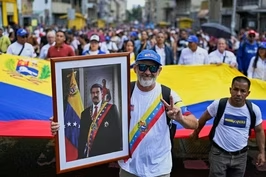
Today, we filmed these scenes in Caracas, where normally bustling streets are relatively quiet,busy neighborhoods are closing early, and police are everywhere.
Residents are scared, because, while Maduro is gone, Venezuela is still led by his lieutenants, new President Delcy Rodriguez, sworn in yesterday by her brother Jorge, at least publicly defiant, alongside Maduro's son, U.S.-sanctioned Nicolas Ernesto: NICOLAS ERNESTO MADURO GUERRA, Son of Nicolas Maduro (through translator): I am convinced that with unity and more unity, with unity and more unity, we will prevail.
They may have kidnapped Nicolas and Cilia, but they did not kidnap the conscience of a people who have decided to be free.
NICK SCHIFRIN: His father sits inside this Brooklyn detention center, and today was taunted by President Trump.
DONALD TRUMP, President of the United States: He gets up there and he tries to imitate my dance a little bit.
(LAUGHTER) DONALD TRUMP: But he's a violent guy, and he's killed millions of people.
NICK SCHIFRIN: But there is little laughing in Europe today, especially Greenland.
The world's largest island has been part of the kingdom of Denmark since 1721.
Today it's a self-governing territory inside the NATO ally.
It is also geographically in the Americas and a crucial missile defense site, the shortest route between the United States and Russia, not to mention rich in rare earth minerals and potential offshore oil and natural gas.
STEPHEN MILLER, White House Deputy Chief of Staff: The real question is, by what right does Denmark assert control over Greenland?
NICK SCHIFRIN: White House Deputy Chief of Staff Stephen Miller on CNN last night.
STEPHEN MILLER: The United States is the power of NATO.
For the United States to secure the Arctic region, to protect and defend NATO and NATO interests, obviously, Greenland should be part of the United States.
NICK SCHIFRIN: That drew a furious reaction from some of the U.S.'
closest allies.
Polish Prime Minister Donald Tusk: DONALD TUSK, Polish Prime Minister (through translator): No member of the North Atlantic Treaty Organization should attack or threaten another member of the North Atlantic Treaty Organization.
Otherwise, NATO would lose its meaning.
NICK SCHIFRIN: Danish Prime Minister Mette Frederiksen: METTE FREDERIKSEN, Prime Minister of Denmark (through translator): If the United States chooses to attack another NATO country militarily, then everything stops.
NICK SCHIFRIN: And, today, Frederiksen and Tusk, joined by France, Germany, Italy, Spain and the U.K., in a statement -- quote -- "Security in the Arctic must therefore be achieved collectively in conjunction with NATO allies, including the United States, by upholding the principles of U.N.
Charter, including sovereignty, territorial integrity and the inviability of borders."
MAN: The approval of the charter of the United Nations.
NICK SCHIFRIN: For 80 years, inviolability of borders has defined the post-World War II order.
But the Trump administration now suggests that might makes right.
STEPHEN MILLER: We live in a world, in the real world, Jake, that is governed by strength, that is governed by force, that is governed by power.
NICK SCHIFRIN: As for power in Venezuela, a person familiar confirms to "PBS News Hour" the CIA assessed opposition leader Maria Corina Machado would not be able to hold the country together.
To counter that administration's souring, last night on FOX News, she added a sweetener: SEAN HANNITY, FOX News Anchor: Did you at any point offer to give him the Nobel Peace Prize?
Did that actually happen?
MARIA CORINA MACHADO, Venezuela Opposition Leader: The Venezuelan people, because this is a prize of the Venezuelan people, certainly want to give it to him and share it with him.
NICK SCHIFRIN: But, for President Trump, the coveted Peace Prize appears no longer the focus.
Instead, it's extracting Venezuela's maximum value.
For the "PBS News Hour," I'm Nick Schifrin.
GEOFF BENNETT: President Trump says the U.S.
government could subsidize any effort by American companies to rebuild Venezuela's oil infrastructure, something he told NBC News could take as little as 18 months.
It comes as multiple outlets report the White House plans to meet with top U.S.
oil executives soon.
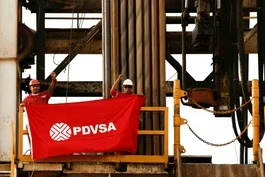
The president has made no secret that a major goal of this weekend's operation was to pry open Venezuela's vast oil reserves for foreign investment.
DONALD TRUMP, President of the United States: We're going to have our very large United States oil companies, the biggest anywhere in the world, go in, spend billions of dollars, fix the badly broken infrastructure, the oil infrastructure, and start making money for the country.
GEOFF BENNETT: Despite sitting on more crude than any country on earth, Venezuela produces just 1 percent of the world's supply.
And its total output has dropped some 70 percent since the late 1990s, a result in part of crippling U.S.
sanctions and internal dysfunction.
Right now, just one American oil company, Chevron, operates in the country under a special license that allows limited production despite U.S.
sanctions.
Venezuela first nationalized its oil industry in the 1970s and further consolidated control under then-President Hugo Chavez in the mid-2000s, when it forced international oil companies to transfer majority control of their operations to the state-owned oil company.
To help us understand the dynamics at play and what could come next, we're joined now by Francisco Monaldi, professor and director of the Latin American Energy program at Rice University.
Thanks for being with us.
FRANCISCO MONALDI, Director, Latin America Energy Program, Rice University: Thank you.
GEOFF BENNETT: So President Trump is pushing this idea of the U.S.
reimbursing American oil companies for expenses in Venezuela, and he says oil operations could be up and running in 18 months.
Is that the case?
FRANCISCO MONALDI: Well, I don't think that it's clear exactly what he means, but Venezuela would require about $100 billion of investment to go back to the levels of peak production, as you mentioned, by the end of the 1990s.
But that will require a complete overhaul of the institutional system.
It would require legitimate government.
It will require long-term horizons for investors.
Investors have been burned in Venezuela many, many times by contract reneging and changes in the tax system and this control by the national oil company.
So I think it will take some significant amount of time for those investments to come.
GEOFF BENNETT: So, on that point, is there genuine appetite among U.S.
firms for that kind of capital investment in Venezuela, given the political risk, given the sanctions history and the overall market dynamic?
FRANCISCO MONALDI: Well, I think we have to distinguish.
For example, Chevron is already in Venezuela.
And they have a profitable operation.
And if they can export to the United States with a license and use part of the cash flow that they generate to reinvest in Venezuela as they're doing now, they will continue to invest in Venezuela.
And that's sort of the easiest sort of source of increase in production.
But other companies that are not in the country, like, say, Conoco or Exxon, that are owed money by the Venezuelan government, they will have to, first of all, look for opportunities, see the contracts, how they are offered, what is the fiscal regime, a variety of things.
And then they will have to analyze if the political risks make it worth it to sink billions of dollars before they see the first revenue.
And, finally, there might be some smaller companies that are willing to go into fields that are currently operated by the national oil company and that already have all the infrastructure and just make a quick buck by investing in some -- in drilling some wells.
But that's not going to make the big difference that we're talking about, recovering the oil industry of Venezuela.
GEOFF BENNETT: And Venezuelan oil, as I understand it, is predominantly heavy crude.
How compatible is it with U.S.
refinery capacity, especially along the Gulf Coast?
FRANCISCO MONALDI: Actually, it's very compatible because the refineries in the Gulf Coast were optimized to process that type of oil because Mexico and Venezuela were supposed to be increasing production in the 1990s.
And so the U.S.
has mostly light oil.
And the other source of heavy oil, which is Canada, it cannot get easily to the Gulf Coast.
There is no infrastructure, because Keystone XL was never built.
So the refineries in Texas and Louisiana are really eager to get some of the heavy oil that Venezuela produces.
GEOFF BENNETT: A question about the president's rhetoric.
He so often says that Venezuela stole America's oil, so it's only fair that the U.S.
gets a piece of it now.
Here he is in his own words.
DONALD TRUMP: We built Venezuela oil industry with American talent, drive and skill.
And the socialist regime stole it from us during those previous administrations.
And they stole it through force.
This constituted one of the largest thefts of American property in the history of our country.
GEOFF BENNETT: Is there any basis to the way he frames that, whether legally or historically?
FRANCISCO MONALDI: Yes, well, it's hard to understand exactly what he refers.
If we talk about the nationalization of 1975, those were concessions that were going to expire in 1983.
And the government basically brought that change in the hands of the government by eight years.
And they were fairly compensated.
In fact, all of the countries did something similar.
Saudi Aramco is the result of a very similar process of nationalization of a much bigger oil industry.
So I don't think that that could be considered a theft in any way.
Then he might be referring to when Hugo Chavez forcefully negotiated contracts and made the national company the majority shareholder.
That's when two American companies, Exxon and Conoco, left the country, sued for arbitration.
And they were awarded some significant amount of money that Venezuela has to pay them.
And a lot of that debt is outstanding.
Venezuela hasn't paid it.
So what Venezuela has with the U.S.
companies is a debt of about $12 billion that has to be paid, as many other debts.
Venezuela owes $150 billion to a variety of creditors.
GEOFF BENNETT: Bottom line, if foreign companies, especially U.S.
firms, return in force, what would the domestic implications be for ordinary Venezuelans?
FRANCISCO MONALDI: Well, it depends a lot if it's successful in terms of bringing the necessary investment to recover the oil industry.
I don't think that will happen if there is no significant institutional change that brings credibility and legitimate legislation, et cetera.
And so, if that doesn't happen, there will be no sustained economic recovery.
There will be a minor recovery that will benefit a few firms, but will have very little impact on the average citizen.
GEOFF BENNETT: Francisco Monaldi of the Latin American Energy Program at Rice University, thanks again for being with us.
FRANCISCO MONALDI: Thank you.
GEOFF BENNETT: In the day's other headlines: President Trump warned his fellow Republicans today that if they don't put in a strong showing in this year's midterm elections, he will be impeached.
Mr.
Trump was addressing a meeting of GOP lawmakers at the recently renamed Kennedy Center.
He described Democrats as mean and smart, highlighting what he sees as the stakes in the upcoming vote.
DONALD TRUMP, President of the United States: You got to win the midterms, because, if we don't win the midterms, it's just going to be -- I mean, they will find a reason to impeach me.
I will get impeached.
GEOFF BENNETT: President Trump also urged House Republicans to be flexible in their push to block federal funds from going to Obamacare plans that cover abortion.
That's as he pressed Republicans to reach an agreement on the expired health insurance subsidies, saying it would strengthen the party's position on the issue of affordability.
Meantime, in Wyoming, abortion will remain legal after that state's Supreme Court struck down two laws it found unconstitutional.
That includes the nation's first ban on abortion pills.
The justices sided with Wyoming's only abortion clinic and others who argue that adults have the right to make their own health care decisions.
The ruling means the state remains one of more than two dozen states across the country, plus Washington, D.C., that allow abortions up to 20 weeks of pregnancy or later.
Wyoming's Republican governor says he will push for a constitutional amendment banning abortion that would go before voters this fall.
In Iran, at least 36 people have now been killed amid ongoing protests over the country's struggling economy.
That's according to an outside human rights group, which says that more than 1,200 others have been detained.
Video emerged today of protesters clashing with security forces in Tehran's Grand Bazaar, long a hub of Iran's economic and political life.
Authorities reportedly fired tear gas to disperse demonstrators who had been staging a sit-in.
Elsewhere in the city, business owners say they're scrambling to make ends meet as high prices scare off would-be customers.
KARIM HEIDARI, Shopkeeper (through translator): Sales have dropped off very badly.
Last year at this hour, my shop was packed with customers.
Now, sometimes, I wait one hour before a customer shows up.
Market conditions are not good at all.
GEOFF BENNETT: Activists say the protests have now spread to more than 270 locations across Iran since they erupted more than a week ago.
Ukraine's Western allies say they made progress today towards security guarantees for once a peace deal is signed with Russia.
Ukraine's President Volodymyr Zelenskyy signed a draft declaration alongside the leaders of France and the U.K.
following a day of talks in Paris.
The framework outlines NATO-style security guarantees, including a future deployment of multinational forces and cease-fire monitoring led by the U.S.
For the first time, U.S.
special envoy Steve Witkoff and President Trump's son-in-law Jared Kushner appeared in person for a meeting of what's called the coalition of the willing.
Kushner said today was, in his words, a very big milestone.
JARED KUSHNER, Former Senior Presidential Adviser: This does not mean that we will make peace, but peace would not be possible without the progress that was made here today.
If Ukraine is going to make a final deal, they have to know that after a deal they are secure, they have obviously a robust deterrence, and there's real backstops to make sure that this will not happen again.
GEOFF BENNETT: Important details, like specific commitments and troop numbers, have not been finalized.
President Zelenskyy has acknowledged in recent days that some support may come in the form of weapons or intelligence.
Also in France today, winter weather is causing havoc on the roads and in the skies.
The French capital may have looked pretty under a fresh blanket of snow, but French authorities say at least five people have died nationwide, most of them in road accidents.
The snow also closed six airports in France, while, in the Netherlands, Amsterdam's international airport grounded some 600 flights.
Meantime, temperatures plummeted in the U.K.
to well below freezing, closing hundreds of schools there.
On Wall Street today, stocks posted solid gains, thanks largely to technology stocks.
The Dow Jones industrial average rose almost 500 points, or nearly 1 percent.
The Nasdaq added around 150 points.
The S&P 500 also closed in positive territory.
Republican Congressman Doug LaMalfa of California has died.
The former rice farmer and state lawmaker was first elected to Congress in 2012.
He represented Northern California's First District along the Oregon border.
LaMalfa's death further reduces the Republican majority in the House to a margin of 218-213.
REP.
HAKEEM JEFFRIES (D-NY): We'd just like to ask for a moment of silence.
GEOFF BENNETT: Democratic lawmakers took a moment to remember LaMalfa at a panel today marking the anniversary of the January 6 attack.
No cause of death was immediately provided.
Doug LaMalfa was 65 years old.
And celebrated Hungarian director Bela Tarr has died.
Beginning with his 1979 film, "Family Nest," Tarr created his own distinct style, slow-paced, sprawling and darkly comic.
Some critics called 1994's "Satantango" his masterpiece.
It clocks in at more than seven hours.
Such works made him an icon of art house cinema.
In a statement, the Hungarian Filmmakers Association said Bela Tarr died after battling a long and serious illness.
He was 70 years old.
Still to come on the "News Hour": a look at the ongoing disinformation efforts five years after the January 6 assault on the U.S.
Capitol; and threats of U.S.
intervention place multiple countries in the Western Hemisphere on edge.
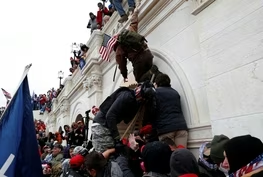
It has been five years since a mob of President Trump supporters stormed the U.S.
Capitol to try to disrupt the certification of the presidential election that he lost.
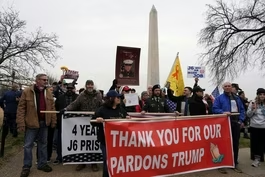
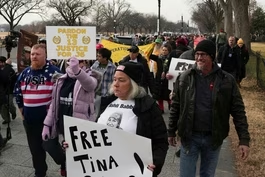
Today, a much smaller, but ardent crowd of his supporters returned to the site of the 2021 insurrection, marking the first January 6 since then with Trump back in the White House and most of those involved now fully pardoned for their actions on that day.
White House correspondent Liz lander spent the day covering the demonstration marking this milestone.
LIZ LANDERS: Hundreds of people reenacted parts of a day that ended in violence and bloodshed... MAN: Truth matters to this group!
LIZ LANDERS: ... followed by the prosecution and then pardoning of more than 1,500 participants.
Officially, this was a memorial event for Ashli Babbitt, the Air Force veteran shot dead while trying to enter through a broken window in the Capitol, and four others who were lost that day or in the weeks after, including a police officer.
Babbitt's mother, Micki Witthoeft, spoke to the crowd.
MICKI WITTHOEFT, Mother of Ashli Babbitt: So glad that people are not losing sight of the importance of that day.
It's a day Congress let us down and continues to let us down.
LIZ LANDERS: Just after 1:00 p.m.
exactly five years after President Trump concluded his remarks at the Ellipse, telling protesters to fight like hell, the crowd set off for the Capitol.
Among those taking part in the day's events was Enrique Tarrio, the former leader of the Proud Boys, sentenced to 22 years in prison for seditious conspiracy and other charges.
Would do you do January 6 over again?
I know you weren't here in D.C.
that day, but you were considered one of the masterminds of what happened.
Would you do it again?
ENRIQUE TARRIO, Former Proud Boys Leader: I would.
I would definitely do everything I did again, because I'm not guilty of that crime.
Again, I'm sitting here pardoned.
If I wanted -- if I told you, yes, I did it, I wouldn't face the repercussions.
But I'd be lying to you.
I'd be lying to you.
LIZ LANDERS: You were found guilty, though, by a jury of your peers, right?
ENRIQUE TARRIO: Well, they're not a jury of my peers.
I mean, they had bias, right?
They showed bias.
LIZ LANDERS: Outside the Capitol, they laid flowers for those who died.
Among those commemorating the day was Guy Reffitt and his wife, Nicole.
Guy was a member of the militia the Texas 3 Percenters seen here in 2021 on the steps of the Capitol being sprayed by police officers.
He was the first rider to go on trial, sentenced to more than 6.5 years in prison for civil disorder, obstruction of an official proceeding, and entering a restricted building with a firearm.
DONALD TRUMP, President of the United States: So this is January 6.
These are the hostages, approximately 1,500, for a pardon, full pardon.
LIZ LANDERS: On the first day of his second term, President Trump pardoned or commuted the sentences of everyone charged, whom he called hostages.
GUY REFFITT, Pardoned January 6 Rioter: I didn't really do anything worth what I got convicted of.
That four-year sentence wasn't justifiable.
So for going and standing on the steps of the Capitol Building and not going in the building, not breaking anything, not stealing anything... NICOLE REFFITT, Wife of Guy Reffitt: Not assaulting anyone.
GUY REFFITT: Getting assaulted by police officers that at the top of the stairs 15 feet away and then leaving and going home.
Was I trespassing?
I didn't see any barriers.
When I got there, there was over 100,000 people on the property.
Those barriers were nowhere to be seen.
LIZ LANDERS: What happened on January 6 became a family affair.
Reffitt's wife, Nicole, helped lead today's ceremony.
NICOLE REFFITT: Today is the day to honor those that died and to celebrate those Americans that stood up.
LIZ LANDERS: Guy's arrest and conviction has also caused rifts in his family, including with his son.
JACKSON REFFITT, Son of Guy and Nicole Reffitt: It's destroyed my family in a bunch of different ways.
LIZ LANDERS: Jackson Reffitt tipped off the FBI about his father's actions and told me, while he doesn't regret that difficult decision: JACKSON REFFITT: We're scattered and apart and it's been really hard to reconnect over these years.
LIZ LANDERS: Have you spoken with your father since he was released from prison?
JACKSON REFFITT: I have sent him birthday messages and happy Father's Day, but that's been about it.
The only time I have really talked to him was when I called him in prison.
And that was very brief.
But even then, it's just been scary.
It's not -- I'm not worried that he's going to break down my door or strangle me through the phone.
It's just a worry that things aren't ever going to get better at this rate.
NICOLE REFFITT: It's been quite a strain.
But like Guy said, we have been able to stay strong and we're able to start rebuilding our relationship with our son.
I'm waiting for him to be comfortable to come to holidays and things.
He was definitely -- we thought it was going to happen this year, but he had his nerves and everything about it.
But it is a work in progress.
I think a lot of families are, but there was a lot of love there.
So I know it's going to end up OK.
PROTESTER: Ashli Babbitt!
LIZ LANDERS: For the Reffitts, today's event was a reminder that many remained sharply divided over the false belief that the 2020 election was stolen, the actions on January 6 and what came after.
GUY REFFITT: I'm grateful to get out.
But I think there's problems with the pardon, but there's also good things with the pardon.
NICOLE REFFITT: The problem with the pardon, though, is that there were bad actors there that day.
Some people did really bad things.
I don't think everyone should have received the pardon.
And I believe there are still some people that are waiting on a pardon that deserve one.
GUY REFFITT: Yes, we're at 12 or 14.
JACKSON REFFITT: It's the washing of everything.
It's just completely validating all of these people.
I mean, all of these people, they more or less fell for something, a con, if you want to use that word, I would, with no -- nothing in return, no reward.
But these people have been endlessly validated with a pardon.
And that validation, they never really received before.
Like, imagine the kind of action that a lot of these people might feel now that they have been pardoned.
GEOFF BENNETT: In the five years since January 6, there has been a widespread fight over the story of that day.
Congressional correspondent Lisa Desjardins was inside the U.S.
Capitol and witnessed the storming firsthand.
She has this look at the half-decade battle over the narrative.
LISA DESJARDINS: In the crowd storming the Capitol on January 6, an unlikely character, an Idaho grandmother, has become one of the most well-known.
PAMELA HEMPHILL, Convicted January 6 Rioter: I was hoping we'd storm the Capitol.
LISA DESJARDINS: That's the voice of Pam Hemphill.
You can see her insecurity camera photos of the crowd and inside the Capitol.
Prosecutors said she egged on rioters.
PAMELA HEMPHILL: You just come in.
LISA DESJARDINS: Just days earlier, Hemphill posted on Facebook about the rally: "The fight for America is real."
In a photo, she posed with a gun and the caption: "On my way to Washington, January 6."
Now she sees all that as part of a lie.
PAMELA HEMPHILL: The brainwashing that happens to you, that the Democrats want to turn this into a communist nation.
They would always say the same thing.
Pam, don't listen to Democrats, whatever you do.
They will lie to you about everything.
So you start believing all that.
And I got pulled into all the propaganda.
LISA DESJARDINS: But five years out, the battle still rages about January 6, with recent comments like these from some on the right.
ERIC METAXAS, Host, "The Eric Metaxas Show": Most people in America are still buying the lie that like, oh, January 6 was a terrible thing.
Trump supporters did some bad stuff.
No.
MICHAEL KNOWLES, Conservative Commentator: You remember what we were told about January 6, January 6, January 6, that it was an insurrection, the worst attack ever on our sacred democracy.
LISA DESJARDINS: And last January 6, Georgia Republican Congressman Mike Collins said: "Thousands of peaceful grandmothers gathered in Washington, D.C., to take a self-guided, albeit unauthorized tour of the U.S.
Capitol Building."
Hemphill was that grandmother, part of the mob recording everything she saw, marching up the street, clashes with police, climbing the steps of the East Front, and walking through the halls of the Capitol.
There were a lot of people who, as we have gotten farther from January 6, have said things, including it wasn't violent, no one broke the law.
What did you actually see compared to what people are saying?
PAMELA HEMPHILL: We know they're delusional.
Of course it was violent.
They all had the attitude, it's our house.
We can do what we want.
We own it, this arrogant, violent attitude.
LISA DESJARDINS: The video is indisputable.
More than 140 police officers were seriously injured on January 6.
There were brutal battles on the steps and in the center of the Capitol.
Yes, some rioters followed the mob and mostly walked around.
But even they, and I spoke with them, were there for an illegal takeover of the Capitol itself.
Initially, some Republicans saw the event as a reckoning.
SEN.
MITCH MCCONNELL (R-KY): There's no question done that President Trump is practically and morally responsible for provoking the events of the day.
DONALD TRUMP, President of the United States: This is January 6.
LISA DESJARDINS: But in the years since, President Trump personally has worked to recast January 6, pardoning nearly all involved, including many who assaulted police, creating a narrative that they were patriots for believing his lie about the election.
DONALD TRUMP: We freed the people.
They were treated so badly.
The people from January 6 who were largely -- and there's always exceptions, but largely great patriots for this country.
LISA DESJARDINS: And Republican leaders now look the other way.
REP.
MIKE JOHNSON (R-LA): Everybody can describe this however they want.
If you could -- you would argue that those people didn't pay a heavy penalty, having been incarcerated and all of that, that's up to you.
But the president's made a decision.
We move forward.
FMR.
REP.
DENVER RIGGLEMAN (R-VA): I think it's as dangerous as any narrative we have ever had.
LISA DESJARDINS: Denver Riggleman was a Republican member of Congress until three days before the storming of the Capitol.
A former Air Force intelligence officer, Riggleman later served as a staff member on the January 6 Committee and wrote a book, "The Breach," uncovering and detailing what happened.
FMR.
REP.
DENVER RIGGLEMAN: I would say 30 to 35 percent of the population who believe the election was stolen, I think they will always be not like that.
And I really think, at this point, people like me, who are based in data and facts and who are an expert on January 6, we're trying to reach a smaller and smaller percentage of the population to make them see what happened that day.
It was a multipronged attack of disinformation, radicalization and violence to overturn the election.
LISA DESJARDINS: Why do you think so many Republicans support this idea that it wasn't that bad, however you want to cast that?
FMR.
REP.
DENVER RIGGLEMAN: Because they want to win elections.
I mean, there's a reason they're having hearings on space aliens, rather than looking at what happened that day or acknowledging what happened that day.
Plus, they're looking at fund-raising and polling in their districts.
Trump is probably still over 70 to 75 percent and more of the Republican-based districts.
It's simply that.
LISA DESJARDINS: Publicly, Republicans in Congress dispute this.
They say their view of January 6 is about gathering facts.
And, last year, House Republicans did launch a new subcommittee to investigate it.
But, privately, many Republicans admit to me that January 6 is something they see as a historic threat.
Today, at the Capitol, Democratic lawmakers who were there spoke to what they saw.
REP.
TERRI SEWELL (D-AL): If I close my eyes, I can still hear the thundering sound of the mob and the pounding of the door of the House chamber.
I can still feel the sense of sheer terror as we struggle to fit on our gas masks and crawl on our knees towards the only open door at the opposite end of the Gallery.
LISA DESJARDINS: But Republican Riggleman worries that too many are still ignoring the worst truths of January 6.
FMR.
REP.
DENVER RIGGLEMAN: What you're saying is that they want to look to the future.
The issue is, is that the past is an incredible indicator of what can happen in the future.
And if we're not looking at elections in 2026 and 2028 and what could happen based on these faulty belief systems or that violence can't happen again, you better damn well be looking at it.
STEPHANIE MCCURRY, Columbia University: This is not a minor example of political violence in American history.
It's the major one, I would say, after the Civil War itself.
How that's going to play out over the long term, I think, is very much still being contested.
LISA DESJARDINS: Stephanie McCurry is a history professor at Colombia University.
She says clashing versions of U.S.
history aren't uncommon, like narratives about the Reconstruction era of the late 1800s and the actions of the Ku Klux Klan.
STEPHANIE MCCURRY: When I think about that as a kind of cautionary moment for what we're in now, the thing I worry the most about is how I saw that Klan narrative offered as a raw, partisan position in defense of an incredibly violent, racist organization.
And then I saw it emerge in film and in written scholarly history.
The Klan version became the history of Reconstruction.
That narrative took hold until the civil rights movement displaced it.
LISA DESJARDINS: But McCurry sees something distinct with January 6.
STEPHANIE MCCURRY: I think we're in a dangerous moment because we have never seen a case before, I think, where one side of the contested narrative is being propagated by the president and who has made it a loyalty test for his regime.
LISA DESJARDINS: Which brings us back to the pardons Trump issued for those who stormed the Capitol, largely in his name.
Of the more than 1, 500 people whom he pardoned, Pam Hemphill rejected the offer.
PAMELA HEMPHILL: I would not be a part of that, no way.
It would be a slap in the face of the Capitol Police, that's for sure, the rule of law.
But I broke the law.
You don't pardon somebody that breaks the law.
LISA DESJARDINS: She has gone from MAGA-revered to MAGA-reviled.
On social media, Pam now pushes back at Proud Boy leaders who dispute January 6.
Some family have disowned her, but the memory of that day and her sense of responsibility have not changed.
PAMELA HEMPHILL: I spent two months in prison over Trump's lies that the election had been stolen.
I have been a little angry that this has even happened.
Hopefully, some other people will just maybe listen to my story and say, lookit, she's right.
I got to do some research and not just listen to what I'm hearing in media and on Twitter.
And it's part of my amends.
It's one thing to say you're sorry for being there, but you have to do the footwork to prove it.
LISA DESJARDINS: Today, Hemphill returned to Capitol Hill, testifying alongside Winston Pingeon, a former Capitol Police officer who defended the building five years ago.
WINSTON PINGEON, Former U.S.
Capitol Police Officer: I was called a traitor, violently assaulted in the line of duty, punched in the face, pepper-sprayed, and thought, I'm going to die here on the steps of the U.S.
Capitol.
LISA DESJARDINS: Hemphill addressed Pingeon directly.
PAMELA HEMPHILL: I am truly sorry from the bottom of my heart for being part of the mob that put you and so many officers in danger.
GEOFF BENNETT: And Lisa Desjardins and Liz Landers join us now.
Lisa, we will start with you.
The U.S.
Capitol is still living with the aftermath of January 6.
What does this latest effort by Republicans to minimize what happened on that day, what does that mean for lawmakers and for the Capitol Police officers who protect them?
LISA DESJARDINS: That's right.
The Capitol Police and the Metropolitan Police of Washington, D.C., are really those caught in this rhetorical crossfire.
A plaque honoring them and commemorating their fight to protect the Capitol on that day by law was supposed to be installed on the West Front of the Capitol.
And for years, it has not gone up.
Now, House Speaker Mike Johnson, through a spokesperson to us, said that now it cannot go up because of logistics.
They say some 3,000 names would have to go on it.
They haven't figured out how to do that.
And that may well be a real challenge.
However, why has it taken years to even acknowledge that there was a problem here?
Why hasn't there been a real effort under way to get that plaque up?
I don't need to remind viewers that Capitol Police faced real hand-to-hand combat for many of those hours on Capitol Hill, some of them by themselves.
National Guard backup did not come for a long time.
And now they also feel somewhat abandoned by some lawmakers here in the Capitol as well.
GEOFF BENNETT: And, Liz, as we saw, you covered that demonstration today.
Tell us more about what unfolded and what you saw.
LIZ LANDERS: Yes, Geoff, there are about 100 or 200 or so of these January 6 defendants, along with their family members and their supporters, who came to Washington today and kind of recreated what had happened on January 6.
They expressed gratitude to President Trump for pardoning them.
Of course, that changed many of their lives after some received quite long sentences.
Also, both Enrique Tarrio and Guy Reffitt said to me that they do not regret their actions of that day, that they would do it all over again.
And one theme we heard too over and over again, Geoff, is this frustration from these January 6'ers that the Department of Justice and the FBI has not gone after the Biden legal system to prosecute those people that had prosecuted them, a lot of talk of retribution.
GEOFF BENNETT: President Trump did not commemorate the day.
He mentioned January 6 only briefly in remarks to House Republicans.
What did he have to say?
LIZ LANDERS: Yes, he mentioned this only in passing today.
He did not officially commemorate January 6.
He mentioned this at the Kennedy Center while he was speaking to House Republicans, complaining actually about the media coverage around January 6.
The White House, though, did launch a new part of their official government Web site today that has a timeline recreation and trying to recreate the narrative around January 6, talking about things like calling the protest here peaceful, also saying that the participants were patriotic protesters, and repeating that false claim that the election was stolen.
GEOFF BENNETT: Lisa, how are Republicans on the Hill reacting to this disinformation from the White House, these lies about what transpired on January 6?
LISA DESJARDINS: I can tell you what they're doing today, which is trying to ignore it.
I spoke with the majority leader of the Senate, John Thune, as he spoke to reporters today.
He was asked twice, once by me, to react to that Web site, and, in particular, on that Web site, the claim by the Trump White House that Capitol Police were to blame for January 6, that Capitol Police provoked January 6.
He was asked first about it, and Senator Thune just said, well, we -- Capitol Police do a good job on a daily basis.
I asked him again, but what do you think about this claim that blames Capitol Police?
And he really did not respond to it, instead just saying, we support Capitol Police.
Capitol Police officers I speak to say, that is not support, ignoring that kind of accusation against them.
GEOFF BENNETT: Lisa Desjardins, Liz Landers, our thanks to you and the team there outside the U.S.
Capitol and inside the U.S.
Capitol.
Thanks.
Returning now to our top story tonight, the ongoing fallout from President Trump's decision to forcibly remove the president of Venezuela.
President Trump and his aides are now speaking of a foreign policy where pressure and the use of military might can be applied both to adversaries and potentially allies.
Nick Schifrin is back now with two conversations, looking at a pivot in America's place in the world.
NICK SCHIFRIN: President Trump has outlined a muscular, aggressive doctrine focused on the Western Hemisphere.
It refutes the restrained foreign policy, part of his winning campaign in 2016, and redefines America first in the context of a 19th century foreign policy of regional domination.
To discuss that, we get two views on this Trump doctrine.
We begin with Ambassador Todd Robinson, who served as ambassador to Guatemala and as the top U.S.
diplomat in Venezuela, before being kicked out of the country and was an assistant secretary of state in the State Department.
Thank you very much, Ambassador Robinson.
TODD ROBINSON, Former U.S.
Ambassador to Guatemala: Thanks so much for having me.
NICK SCHIFRIN: And welcome to the "News Hour."
Here's the Trump administration theory in Venezuela today, that now President Delcy Rodriguez can deliver an environment in which the U.S.
can invest in and benefit from a newly refined oil industry and that the opposition, Maria Corina Machado, Edmundo Gonzalez, are not capable of uniting the country.
Can that new U.S.
policy work?
TODD ROBINSON: I don't think so.
I think, first of all, Maria Corina Machado and Edmundo Gonzalez represent the will of the Venezuelan people.
People forget that there were elections not too long ago.
Ordinary Venezuelans went out and risked their lives to vote for change in Venezuela.
And I think it's incumbent upon this administration and the international community to respect the will of the Venezuelan people.
NICK SCHIFRIN: And can Delcy Rodriguez deliver the investments that the president is talking about in terms of U.S.
oil companies in Venezuela?
TODD ROBINSON: I think it's possible, but we seem to forget that it's not just about Delcy and her brother, Jorge Rodriguez.
Diosdado Cabello and Padrino Lopez, the defense minister, is also another major figure in the country.
So I think it's very -- we're rolling the dice.
The administration is rolling the dice.
NICK SCHIFRIN: The alternative argument, though, is that wouldn't it be rolling the dice worse if we -- the United States had done some kind of regime change with an occupation force to actually install democracy at the point of the gun?
I mean, that seems to me something that very few Americans would have supported.
TODD ROBINSON: Well, what I would say to that is Venezuela is a large country.
It's hard enough to control the whole country just from Caracas.
I think it's going to be virtually impossible to do, as the president has stated we're doing, run things from either a boat off the coast of Venezuela or from Washington, D.C.
NICK SCHIFRIN: Literally gunboat diplomacy, that's what we're talking about.
TODD ROBINSON: Literally.
NICK SCHIFRIN: Which broadens us out to the Donroe Doctrine, as the president has now embraced, his new version of the Monroe Doctrine, with direct military threats in the last few days against Mexico, Colombia, and even Greenland and a more general threat against the Cuban government.
The administration says it needs Greenland for national security and that, more locally, it needs neighbors who can better tackle drugs and migration.
What does the region hear when it listens to that language?
TODD ROBINSON: I think what they're hearing is, this is going to be more about what the United States wants than what the region wants.
And we seem to forget that we need countries like Mexico and Colombia if we're going to be serious about the fight against narcotics trafficking in the region.
More broadly, I think our partners in the international community have to be wondering what we're talking about when we're threatening Denmark and Greenland.
Denmark is a NATO ally.
They fought with us in Afghanistan.
I think they must be both confused and a little worried about what they're hearing.
NICK SCHIFRIN: And back in Latin America, the administration argues that it does need better partners.
It needs these governments to work harder on drugs and work with the United States.
Could there be a positive impact to any of this pressure?
TODD ROBINSON: Well, again, I don't think pressure works.
We -- during my time in international narcotics and law enforcement, we worked very closely with these countries.
Colombia has always been one of our closest partners.
For every dollar we spent on training and equipping the Colombians, the Colombians spent three.
They were net security providers in other parts of the world on our behalf.
Same with Mexico.
Because of the proximity, because of our historic relationship with Mexico, we need them to do more on the fight against narcotics trafficking.
But they have done a lot.
And I don't think pressuring them is going to make them do more.
NICK SCHIFRIN: Ambassador Todd Robinson, thank you very much.
TODD ROBINSON: Thank you.
NICK SCHIFRIN: Now, for a separate viewpoint, I'm joined by Andres Martinez-Fernandez, a senior policy analyst for Latin America at the Washington-based think tank The Heritage Foundation.
Thanks very much.
Welcome to the "News Hour."
Let me start with you where I started with the ambassador, and let's talk about the Venezuela approach.
Do you believe that this approach of relying on Delcy Rodriguez, the now-president of Venezuela, to deliver some kind of environment in which the U.S.
can go in, revitalize the oil industry, pull out that oil, do you think that can work and not relying on Maria Corina Machado and the opposition?
ANDRES MARTINEZ-FERNANDEZ, The Heritage Foundation: What President Trump did by capturing Nicolas Maduro was upsetting a status quo that had existed for years in Venezuela and favored continuity for the regime.
And now that he has been removed, this is a deeply weakened regime with which we can confront with a series of tools, as we have been using.
However, they're going to be much more effective, I think, in the aftermath of this operation.
And, eventually, I think -- I do think that we are going to be able to press this regime's remnants towards the direction of ending its weaponization of drugs and migration against the United States, and also confronting the fact that it has acted as a operating base for our most dangerous extra-hemispheric enemies, including China, Russia, and Iran.
And along that path, I do think that we're going to see the restoration of freedom, stability, and democracy for the Venezuelan people.
NICK SCHIFRIN: But how can you get democracy back when the president essentially disparaged Maria Corina Machado the other day, despite the fact that this administration has endorsed Edmundo Gonzalez as the rightful president of Venezuela?
ANDRES MARTINEZ-FERNANDEZ: I'm sure that this administration would be happy if Maria Corina could just tomorrow assume power with the wave of a wand in Venezuela, but that's just not possible and would likely require a significant force of U.S.
military personnel backing her and occupying Venezuela, which is not on the cards right now.
We need to press the remnants of the regime in that direction to the opening of a path towards democracy and stability, and Maria Corina could very well be a part of that at a certain point, when we are able to see that restoration.
But the reality is, we're not there yet.
NICK SCHIFRIN: Let's zoom out and let me ask a question about the region and Ambassador Robinson's last point, which is that pressuring Colombia and Mexico, the two countries that we need cooperation from in order to tackle drugs, is counterproductive.
What's your response to that?
ANDRES MARTINEZ-FERNANDEZ: When we contrast and look at the approach by the Biden administration to both of these countries, which was entirely hands-off and to look the other way at the degradation of the security environment and security capacities, pulling back -- particularly in the cases of Colombia and Mexico, pulling back operations against the cartels and guerrillas, all of this was done with the United States not putting any pressure on these governments, these leftist governments, and had destructive consequences for both countries.
And we're not going to continue that clearly.
NICK SCHIFRIN: Doesn't the region hear, when it hears the Donroe Doctrine, doesn't the region respond with thinking about the darkest days of U.S.
policy toward Latin America in the 19th and 20th century, and is therefore less willing to cooperate?
ANDRES MARTINEZ-FERNANDEZ: No, I don't think so.
I think the region, what we're seeing increasingly, particularly with the slate of elections over the past several months, is that voters and this new group of leaders across Argentina, Chile, Colombia - - Chile, Bolivia, Ecuador, Honduras, they are calling for U.S.
engagement and cooperation to confront these challenges, because, again, they are the people who have suffered in many ways most directly from that absence of U.S.
engagement in confronting these threats, which has allowed them to metastasize to these terrible proportions that we're facing now.
NICK SCHIFRIN: And, finally, in the time we have left, how does threatening a territory of a NATO ally, perhaps with the U.S.
military, serve U.S.
national security interests?
ANDRES MARTINEZ-FERNANDEZ: Yes, I don't know that this is a military threat.
I think what President Trump is expressing is the strategic importance of Greenland for the United States.
I think that there's a way to do that amicably, and if that's pursued, I'm sure it will be done so with that in mind.
NICK SCHIFRIN: Andres Martinez-Fernandez, thank you very much.
ANDRES MARTINEZ-FERNANDEZ: Thank you.
GEOFF BENNETT: Tailyr Irvine is a photojournalist from the Flathead Reservation in Montana whose work focuses on nuanced portrayals of life in native communities.
Her recent project examines the U.S.
government-imposed system that defines Native identity through fractional measures of ancestry.
Tonight, she shares her Brief But Spectacular take on questions of belonging.
TAILYR IRVINE, Photojournalist: For a long time, I was really hesitant at photographing Natives in regalia.
Seeing those images and seeing only those images really pushed me to tell the other side of the story, not the still life, not the satiric, not sad, not vulnerable, but just powerful communities that are doing great work and have amazing people in them.
I grew up on the Flathead Reservation.
It's in Northwest Montana surrounded by big mountains, a lot of forest, a lot of trees.
Growing up, I didn't think that you could be a photographer.
I didn't think that was like a career that you could actually make money and a living off of.
When I left home for college, I was in a class that was a prerequisite.
It was called Media History and Literacy, and there was a chapter on photography.
And when I'd seen those photos from 9/11, the impact those photos had on me decades later and how I felt when I had seen them really inspired me and made me want to do that too and tell stories from my home that reach people in the same way, the power of photography to connect people and to make us realize we're more alike than different.
One of my goals is just to photograph Natives being people.
I'm part of a community, part of a larger world.
And so showing the other side of what Native America looks like from somebody who's from Native America was really important to me.
My project Reservation Mathematics: Navigating Love in Native America focuses on how the government-imposed system of blood quantum affects who Natives marry, who they have kids with, who they choose to fall in love with, who they choose to spend their life with and how this number dictates one of the most intimate choices that we have.
Every Native, when they're born, they're assigned a fraction at birth.
And that fraction is called blood quantum.
It's how much Native they are.
And each tribe has an amount that you have to be to be involved in that tribe.
For my tribe, it's a quarter.
But it's tricky, because my parents are two tribes.
My mom is Crow.
My dad is Salish and Kootenai.
And so, when I was born, they had to pick which tribe to put me in.
They chose my father's tribe.
And that immediately cut my quantum in half.
And so I'm 7/16s, which means, if I want my kid to be enrolled, they have to be a quarter.
So I need to find someone from my tribe to date.
Otherwise, my kid won't be enrolled.
And so it's just kind of a unique pressure where, if I don't find someone to date within my tribe, then my tribe will -- then I'll probably be partly responsible for my tribe going extinct.
When I started this project, it was really hard because blood quantum is not a real number.
It's not a real thing that exists.
And so how do I photograph something imaginary was something that was really challenging for me?
I got really lucky, because my siblings were all expecting at the same time, my brother with a partner who's not from our tribe, my sister with a partner who's from our tribe, and my other sister with the partner who's from my tribe.
When people look at the photos, I want them to feel connected to the person.
I want them to think, oh, that could be me, that could be my sister, my brother.
Putting people in other people's shoes is kind of why I got into this and why I love photography.
I think you don't have to even speak the same language to understand what's going on in a photo.
And so I hope people are able to kind of put themselves into my culture for a second or two.
My name is Tailyr Irvine, and this is my Brief But Spectacular take on photographing blood quantum.
GEOFF BENNETT: You can watch more Brief But Spectacular videos online at PBS.org/NewsHour/Brief.
And that is the "News Hour" for tonight.
I'm Geoff Bennett.
For all of us here at the "PBS News Hour," thanks for spending part of your evening with us.

A Brief But Spectacular take on questions of belonging
Video has Closed Captions
Clip: 1/6/2026 | 3m 23s | A Brief But Spectacular take on questions of belonging (3m 23s)
European leaders reject Trump's demands for Greenland
Video has Closed Captions
Clip: 1/6/2026 | 4m 54s | After Trump's removal of Maduro, European leaders reject his demands for Greenland (4m 54s)
Fight over how Jan. 6 is remembered continues 5 years later
Video has Closed Captions
Clip: 1/6/2026 | 9m 12s | 5 years later, the fight over how Jan. 6 is remembered continues (9m 12s)
How the aftermath of Jan. 6 still challenges the Capitol
Video has Closed Captions
Clip: 1/6/2026 | 4m 17s | How the aftermath of Jan. 6 still challenges the Capitol (4m 17s)
Latin America analyst, ex-ambassador split on Trump Doctrine
Video has Closed Captions
Clip: 1/6/2026 | 10m 43s | Latin America analyst, ex-ambassador offer views on 'Trump Doctrine' (10m 43s)
Pardoned Jan. 6 rioters return to Capitol on 5th anniversary
Video has Closed Captions
Clip: 1/6/2026 | 6m 11s | Pardoned Jan. 6 rioters return to Capitol on 5th anniversary of insurrection (6m 11s)
Trump's push to access Venezuela's oil faces major barriers
Video has Closed Captions
Clip: 1/6/2026 | 7m 44s | Trump's push to access Venezuela's oil reserves faces major barriers (7m 44s)
Providing Support for PBS.org
Learn Moreabout PBS online sponsorship
- News and Public Affairs

FRONTLINE is investigative journalism that questions, explains and changes our world.

- News and Public Affairs

Amanpour and Company features conversations with leaders and decision makers.












Support for PBS provided by:
Major corporate funding for the PBS News Hour is provided by BDO, BNSF, Consumer Cellular, American Cruise Lines, and Raymond James. Funding for the PBS NewsHour Weekend is provided by...