
July 6, 2026 - Full Show
7/6/2026 | 26m 47sVideo has Closed Captions
Watch the July 6, 2026, full episode of "Chicago Tonight."
What’s in the bipartisan housing bill that’s sitting on the president’s desk. And remembering a legendary Black entrepreneur.
Problems playing video? | Closed Captioning Feedback
Problems playing video? | Closed Captioning Feedback
Chicago Tonight is a local public television program presented by WTTW
WTTW video streaming support provided by members and sponsors.
July 6, 2026 - Full Show
7/6/2026 | 26m 47sVideo has Closed Captions
What’s in the bipartisan housing bill that’s sitting on the president’s desk. And remembering a legendary Black entrepreneur.
Problems playing video? | Closed Captioning Feedback
Where to Watch Chicago Tonight
Chicago Tonight is available to stream on pbs.org and the PBS app.

WTTW News Explains
In this Emmy Award-winning series, WTTW News tackles your questions — big and small — about life in the Chicago area. Our video animations guide you through local government, city history, public utilities and everything in between.Providing Support for PBS.org
Learn Moreabout PBS online sponsorship>> Hello and thanks for joining us on Chicago Brandis Friedman.
Here's what we're looking at.
>> To me compared to Save America Act.
Just about everything is a big yawn.
>> A bipartisan effort to combat the country's housing issues.
But President Trump stalls on signing it.
A look at what the bill would do.
What do you hope people take away from your life story?
>> Help one another.
>> And remembering the pioneering Chicago businessman and founder of Johnson products company George Johnson.
>> First off tonight, 5 people were killed and 23 others were shot over the holiday weekend in Chicago making it the city's least violent 4th of July weekend in at least 7 years.
Police say a shooting on the city's west side early Sunday left 6 people, mostly teenagers injured.
Additionally, the Chicago Police Department says 2 officers were injured after being shot in the South Shore neighborhood through the first 6 months of the year.
Shootings and homicides in Chicago have been up slightly over last year's historic reduction.
But still well below the pace of other recent years.
an effort to increase transparency and accountability for the largest and most powerful artificial intelligence companies becomes law in Illinois.
Governor JB Pritzker joining state officials and lawmakers in Chicago today to sign the artificial intelligence Safety measures after Officials say the law requires developers to disclose safety practices report significant safety incidents and maintain compliance processes while providing independent oversight.
Pritzker says states must step in to fill the regulatory void left by the federal government and take the lead on overseeing a I.
>> So where the federal government has been unwilling to step up.
States must venture once more unto the breach.
We must protect our people from the dangers of AI while still harnessing the unique potential of the technology.
>> The legislation passed with overwhelming bipartisan support in the General Assembly.
The new law follows similar measures approved in New York and California late last year.
South side and south suburban neighbors could see more flooding if one of the area's 2 largest deep tunnel reservoir is tops its capacity.
The Metropolitan Water Reclamation District says the mccook important reservoirs are at 98 in 94% capacity respectively.
But before reservoir serving the south side and 13 suburbs is holding more than twice as much 7.3 billion gallons of water.
It is the fullest.
It's been since becoming operational in 2015 for the Mccook reservoir.
That's the one you're seeing here.
July 3rd was the 6th time this year that its reach reached capacity.
Sir municipalities reported 8 to 10 inches of rainfall over the wet weekend.
With more on the forecast later this week.
More sad news for fans of be endangered.
Piping plover is nesting at Montrose Beach.
Another chick has died.
Monitors say the chick given the name Tweety died over the holiday weekend with weather conditions fluctuating between extreme heat and thunderstorms, possibly playing a role.
This comes after sibling.
Mavis died last week just after the foursome were given names through a naming contest siblings buddy and Frankie remain at the beach with their parents money and see rocket the pair of endangered birds have nested in Montrose Beach for 3 years running.
A look at what's in Congress's bipartisan housing bill.
That's right after this.
>> Chicago tonight is made possible in part why the Alexander and John Nichols family.
The Pope Brothers Foundation.
And the support of these donors.
>> The 21st Century Road to Housing Act is bipartisan legislation meant to make housing more affordable for Americans.
It's already passed the U.S.
House and Senate and is just awaiting approval from President Donald Trump.
He, though, has so far refused to sign it.
Instead pushing for an unrelated voter ID bill called the Save America Act.
The housing bill would automatically go into effect July 10th, even without the president's signature or he could choose to veto it to break down what the bill could potentially mean for Illinois residents.
We're joined by David Boyd, president of the Real Estate Development group, Chicago neighborhood initiatives, Jeff Smith, executive director of the Institute for Housing Studies at DePaul University, Andorra CEO Mendez president and CEO of Woodstock Institute, nonprofit whose mission is to advance economic justice and racial equity within financial systems.
Gentlemen, welcome back.
Thanks for joining Let's start with the main provisions that are outlined in this bill.
It would increase the housing supply by mandating that the Department of Housing and Urban Development offer guidance to local communities on how to reform zoning and land use policies that would help reduce barriers to housing development, provide grants and loans to support the development of new housing or the improvement of already existing properties and increasing the limit for public welfare investment for certain banks.
Jeff, to you first.
Do you think these provisions are step in the right direction to fix the housing supply shortage?
Yeah, I mean, I think, you know, one of the key factors of the housing crisis is lack of supply.
I mean, we've tracked The mismatch between supply and demand.
>> Since the Great Recession and development stopped really around 15 years ago as it recovered, supply of housing generally recover in the same way.
On top of that, the type of housing that's needed in terms the changing demographics.
And one out also created a mismatch of spoke supply demand.
So this bill certainly attempts to address that issue.
Rossi over.
Do you think of this legislation?
If an attempt it's being described as one of the aggressive housing bills that we've seen in a long time.
But I think that simply because of the fact that the bar is really low, we haven't really had a federal housing bill here in decades since improvement permanency of the low-income housing tax credit.
So overall.
It is constrained by what the federal government is limited in what it can and can't do with regard to supply and demand and housing at the end of the day, it have to work through the local machinery of zoning building of construction, of labor, of the willingness of neighbors to feed their communities.
Change.
And that is a bit of a fragmented environment from which the federal government is hoping its nudges and the incentives that are in this bill might be able overcome that.
But that is yet to be seen will have to wait and see.
>> So as we know, Chicago itself is in the midst of an affordable and supply crisis.
David, what are the barriers that local developer space when building more housing developments?
>> Yeah, I think major challenge right now is construction costs.
And so if you look at the cost to build a new home, you're talking about, you know, anywhere from 400 to $600,000 a unit.
While the you know, the median home price is 400,000.
And so you've got, as Jeff described, this mismatch between what it cost to build and what you can sell or rent for.
And I think that's why you prices going up, whether it's home prices or rents.
It's a supply and demand issue.
And we just as a city have not been building just a few data points.
If you look at your Congo last year, the city permitted about 4200 units across the entire city of new residential housing this year.
It's expected to be even lower than that.
It will be one.
$3800.
3800 unit range.
Whereas, you know, Wall Street Journal article over the weekend, New York bill, 38,000 units of new Housing last year.
So 4,000 compared to 30 New York City, New York City, correct?
Bill, 38,000 and they're pace to do that again this year.
>> So how does how does the city of Chicago counter Well, I think that I think the city's got to do a number of things.
One it's got a look at the cost to belittle.
Lot of it is regulatory.
When you look at the cost of permits, the cost of >> of hiring zoning attorneys to the cost of labor.
All of those adding to the cost of the home on the home builders estimate that 20% of housing costs are directly related to government regulation.
And so you've got to find ways to strip down that regulation to drive down the cost.
>> Jeff, we know that a large portion, as we've said, lot of the mismatches between supply and demand.
But that hasn't always been the case.
How did we get here?
>> Yeah, I mean, to get you back to the Great Recession, you really saw that crisis effect demand for housing, which collapse because the crisis was really driven by and economic crisis.
Houston housing, you saw the mortgage lenders, the folks who finance housing stop doing that because they were Donatella portfolios.
New side development staff as well because builders also responding to that crisis.
Once the market started to recover on 2012, you saw them and grow.
But you can supply grow with it.
And then the pandemic hit and that continue kind exacerbate that mismatch of supply and demand by new drivers related preferences for people on the live exacerbated by like fighting interest rates and the fight against inflation, which locked in a lot of existing homeowners that prevented regular turnover.
You might see in the housing market.
So so when you add these, you know, these crises out on top of each other in the various government intervention, that you're creating the sort of ongoing crisis where the building and the development supplies really not matching the growing and the change in demand for housing the Chicago nationally.
>> co, you've said that we collectively need to start thinking about housing as a human right versus an asset or a commodity on.
How do we change that thinking and what has what has that thinking done to the market so far?
>> challenger and one of the things that isn't set out loud very often is the fact that people view their shelter is a commodity as an asset.
Therefore, there's an incentive to think about it.
terms of how much is it worth and how much of this is it going to appreciate so for those that already are blessed enough to be able to have a home.
They have a singular focus of seeing the value of that home.
Go up there for the mismatch between supply and demand works in their favor, all of us and they have an appreciating asset.
Irrespective whether or not it creates a problem or teachers of their kids can't afford to live.
There.
Policemen, firemen, are driving to affordability in our 2 hours away from that neighborhood.
So there needs to be a shift in mindset about what it means to actually have a community that thriving think a little bit between the balance of yes your home and is an asset.
Really sort of like holding stock?
No, it's not.
It's much more important than that.
So their their needs to be much more of a community conversation about what's needed in terms of creating a healthy fabric where, yes, you can experience some sort of shelter appreciation but you can't view it as your retirement.
You can't necessarily treat it as the tighter supply is the better for me.
But the worst for everybody else.
That's just not something that we're ready to really have an honest conversation about that can't be addressed through legislation, even though this country has a very long history of trying to legislate moral behavior.
That's really something about values and what we feel we need to do as a member of constructive and productive society, right.
That would require sort of a whole shift up what we call the American dream, right, which is home ownership being able to work to have that home?
>> Ok, let's do a little Median price for a home in Chicago's $375,000.
The income, as we've sort of like the mismatch and what it cost to build versus what it you know, what you can sell it for the income needed to purchase a home of that amount.
Is $95,000 and the median household income in Chicago?
$77,000.
David, what needs to happen to make homeownership attainable for middle income residents?
Yeah, I think it's it's again.
It's a combination of bringing those costs down.
I think certainly the current interest rate environment isn't helping when you've got interest rates of 6, 7%.
>> But I think there also needs to be more creativity around the housing types that were were approaching.
So things like manufactured housing, modular housing.
You know, we don't have the big home builders here in Cook County in the city of Chicago.
These are the people that are building America and there are literally not in our city.
And so we've got to find incentives to get national home builders.
The build its scale that build a pace that we don't have here in Chicago.
So I think it's it's a combination creating a lot more supply when you create more supply, you you you push prices down, whether that's apartments where that's new homes.
But we've got to be committed to to driving more supply.
And then I think when you created models, whether that's relaxing the building code or thinking about different housing types, all that's needed, if we're going to housing become more affordable again.
>> Jeff, if this housing act is going to affect what kind of material changes might we see?
>> I mean, think it'll probably take a while for any anything to really manifest itself in terms of day-to-day affordability because it requires, you know, the bill to be enacted one to the snack that requires local governments to adopt changes to their building, code zoning, et cetera, cars, builders, to actually build stuff.
Those that those house house and hit the market and then in the market to respond.
So realistically.
The timeline for it to actually affect the day-to-day house prices that we see are probably in a few years down the line.
But but theoretically, it is addressing a kind of fundamental and foundational challenge that we need to address.
It is building more housing.
So so big picture.
It's probably worthwhile effort, but it may not be an immediate return.
Also require some patience.
David, you're part of a group called Reclaiming Chicago.
The goal is to build 1000 new homes on the West side, thousands outside in some cases, communities that have not seen that new construction in decades.
>> How significant is it for community like Roseland, for example, to see that development?
Yeah, I think there are 3 kind of key elements here.
One is obviously creating affordable options for local residents.
The second is building that generational wealth with the racial wealth gap.
Can begin to solve some of those issues around equity?
>> And then finally, I would say one of them may be under looked his repopulation.
I mean, a place like Rose and we've lost 60 70,000 people.
We've got to bring back residents if we're going to have quality retail, if we're going to have Colin skills and build that kind of community that feel was talking about.
So we've got we've got to really focus on building new housing around affordability, density generational wealth building for the chicken and the egg thing, right.
Like if you build it, then have people who move into it.
But yeah, that'll help your retail.
It'll help your schools.
Actually, crime goes down when neighborhoods repopulate.
So all of these social issues will not fundamental housing at to that kind of community.
There's been an effort co and some unit municipalities across the U.S.
to build more government housing.
How can people benefit from the government getting involved and housing supply?
>> Well, lot of that have to me.
It's a bit of an indictment of the private market simply not being able to do to solve the problem.
But it's also a bit of an indictment of government itself.
When you insert politics and a housing >> usually good things don't happen.
You may have a good idea.
But at last for a political election cycle and when you think about some of the bests initiatives I've seen around the country envision Utah, which is a 50 year plan that started in the 1990's, Minneapolis 2040, which is equally a longstanding initiative, which has already shown tremendous benefit in terms of development of housing.
What they did was they actually tried to make it.
I'm not sure of this is the right way putting it.
But politician proof so that way somebody knew that comes in as the mayor of the head of that area politically doesn't just discarded out of hand because it belonged to the previous administration of it.
And that idea 5 years ago, it's a good idea.
Now the house and as a result, now what you're seeing that with some of appellate ease that are taking this in the up privately and really building it on their crime.
All right.
That's where we'll have to leave Thanks to the 3 of you for joining us.
David join Jeff Smith, an arrest and a statement.
Thank you.
Thank >> Up next, we revisit our conversation with the pioneering entrepreneur, George Johnson.
Legendary Chicago entrepreneur George Johnson.
A pioneer in the black haircare industry died today at 99.
His Johnson products company revolutionize the black hair care market with products like overweight and after Sheen, Johnson founded the multi-million dollar company in 1954.
On Chicago's South Side and he continued to break racial barriers to become one of the most successful black entrepreneurs in the country by the late 1960's.
He joined us last year along with his co-writer, Hillary Beard to talk about his book Afro Sheen, how it revolutionized in industry with the Golden Rule from Soul Train to Wall Street.
We revisit that conversation tonight.
What made you want to write this book now?
You sure you want to I am sure.
Okay.
I'm never intended write a book.
>> I didn't like talking about myself.
And every time I started talking about myself to my grandkids, tears would just float.
So I decided that I wasn't going write a book.
Friends, Ask me people who knew me ask me for 30 years.
What am I going to tell my story?
And I always told him I'm not going to do it without don't like talking about myself.
However.
On November, 21st Sunday morning 2021. sitting in my family room.
And all of a my room concluded.
Got warm.
I tried to get up out of my chair.
I couldn't get up out of my chair.
And I clearly heard 5 words.
You tell your story.
And I believe both the Lord tell me, do I have to tell my story?
It scared me.
It scared me to death.
I immediately change my mind 180 degrees and decided to look for professional writer and we know the rest is history because we know that that clearly led you to Hillary Beard.
But I want to back up into some of that story a little bit because imagine it was.
>> Probably an emotional process for you if the tears were flowing when trying to express this to your kids.
But you became a pioneer in the black here here industry at a time when, of course, blacks are still facing all sorts of obstacles in this country with segregation.
Among them, chief, among them, what led you to create those products at the time.
>> I got on the elevator on the 5th floor at for-profit company where I work.
And elevators stopped on the 3rd floor.
Jonah gets on well, dress and look at it and it started out of my mouth without thinking.
I said what the is wrong with you?
And he told me that he came to pull about because it was a black company and the Heat needed some help.
And he asked Mr.
Fuller to make him a better product.
happen trouble with the product using in his barbershop.
You his name was Nelson and he was the house of Nelson Mr.
Fuller told him that he was not interested.
And Bob isn't didn't have time to be involved with that.
He had too much of his own things going.
And so I said to him, I don't know what you're talking about.
But I work in the lab if you if you have a card, give me a card and how come by and see if I can do something for you.
Show.
I told him I helping.
And that was the beginning of junction.
Proud Okay.
>> Hilary.
You helped chronicle nearly, you a century of history.
That is Mister Johnson's life.
What drew you to this project and what was it like?
>> Well, I received a call out of no nowhere which I also viewed as a gift from God.
There's an African proverb that says when elder dies, it's like a library burned down.
And here was this very much alive.
94 year-old elder, who is incredibly accomplished, a trailblazer pioneer with a library of stories that have not been documented and also black history that has been not been documented and some of which has been actively suppressed.
So I felt to responsibilities.
One, he's 94.
So we needed to move quickly to reflect.
Remember catalog and condense all these memories into a book quickly and then second, secondly, wanted to can text to allies in history.
So the 2 days leaders visionary strive ERs and entrepreneurs can understand the magnitude of his accomplishments with in the history and the Times with with with in which they took place, which really similar to what's happening now?
Mr.
Johnson in the book it's included in the title how you revolutionize an industry with the Golden Rule, something that you have lived by.
>> How has the golden rule treating others as you would want to be treated?
How has that guy did your life?
>> made me what I am and what I've been.
The golden is grounded in love.
And trying to love people.
You can't being.
First of all, you help them and they help you.
It.
Well, came up on that.
I was taught that talked about Mr.
Fuller.
I worked with us to time.
I was 17 years old until I was 24.
Well, actually get 24.
And just to follow the very devout man and good businessman.
And he live by the golden people, not mental.
his encouragement.
Looking at what he did and what it did for him.
I just I you know that I'm going to try to live.
And believe my life my business.
>> you know, whenever she came into the market, black haircare industry was not as big as it is today, which is a multibillion dollar industry black people didn't have a lot of options with regards to their hair care was Mr.
Johnson ahead of his time, Mr.
Johnson was a pioneer and the creation of ultra Sheen relaxer, which was the first product that allowed African-American women to Kimberly to permanently straighten their hair.
It allowed them to access the mainstream labor market in ways that they have been unable to access before.
>> So it was revolutionary and opening those opportunities up to black women at a time when work excluded oftentimes from mainstream jobs and often not seen as human in part because of texture of our hair.
He was a pioneer in terms hiring people within the city of Chicago.
He hired a diverse workforce before anybody did.
He had 11 work environment.
He offered above market wages to African-Americans.
He offered jobs to African-Americans all people of color and women from the factory for it to the C-suite before that was done.
He offered profit sharing to everybody in the company way before that was an industry.
Norm, he had health care benefits and on site health care, available tuition reimbursement, maternity leave benefits that people still want.
Today, Mister Johnson was offering in the 1960's and >> what do you hope people take away from your life story?
>> Help one another.
All right.
That that is a good lesson.
think I'm gonna have to leave it there.
Congrats on the book to both of you.
Thanks again for joining us.
George Johnson.
>> And Hilary thank you.
>> Reflecting the people and perspectives that make a buck This story is part of Chicago tonight.
Black Voice.
>> that's our show for this Monday night.
Stay connected with our reporters and what they're working on by following us on Instagram at W T Tw Chicago and join us tomorrow night at 5, 30 and at 10, 30 now for all of us here at Chicago tonight.
I'm Brandis Friedman, thank you for watching.
Stay healthy and safe and have a good night.
>> Closed captioning is made possible by Robert a cliff and Clifford law, offices of personal injury, law firm, working to preserve the
 New
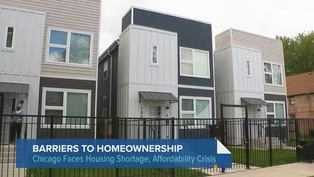
NewBipartisan Bill Aims to Address Housing Issues. Here's What It Would Do
Video has Closed Captions
The bill is awaiting approval from President Donald Trump, who has thus far refused to sign it. (12m 28s)
Providing Support for PBS.org
Learn Moreabout PBS online sponsorship New Episode
- News and Public Affairs

Top journalists deliver compelling original analysis of the hour's headlines.

- News and Public Affairs

Today's top journalists discuss Washington's current political events and public affairs.

 New Episode
 New Episode
 New Episode
 New Episode
 New Episode

 New Episode
 New Episode
 New Season
Support for PBS provided by:
Chicago Tonight is a local public television program presented by WTTW
WTTW video streaming support provided by members and sponsors.