
June 16, 2026 - Full Show
6/16/2026 | 26m 47sVideo has Closed Captions
Watch the June 16, 2026, full episode of "Chicago Tonight."
What a former spokesperson for ICE has to say about current immigration enforcement. And displacement fears on the South Side as the Obama Presidential Center prepares to open.
Problems playing video? | Closed Captioning Feedback
Problems playing video? | Closed Captioning Feedback
Chicago Tonight is a local public television program presented by WTTW
WTTW video streaming support provided by members and sponsors.
June 16, 2026 - Full Show
6/16/2026 | 26m 47sVideo has Closed Captions
What a former spokesperson for ICE has to say about current immigration enforcement. And displacement fears on the South Side as the Obama Presidential Center prepares to open.
Problems playing video? | Closed Captioning Feedback
Where to Watch Chicago Tonight
Chicago Tonight is available to stream on pbs.org and the PBS app.

WTTW News Explains
In this Emmy Award-winning series, WTTW News tackles your questions — big and small — about life in the Chicago area. Our video animations guide you through local government, city history, public utilities and everything in between.Providing Support for PBS.org
Learn Moreabout PBS online sponsorship>> Hello and thanks for joining us on Chicago tonight.
I'm Nick Blumberg.
Brandis Friedman is on assignment.
Here's what we're looking at.
One-on-one with the former ICE spokesperson on the agency and Immigration Enforcement changes under the Trump administration.
everybody spike.
And Southside residents renew gentrification concerns as the Obama presidential center opens this week.
>> First off tonight, Governor JB Pritzker signs.
The budget just passed in Springfield into law, touting it as the 8th consecutive balanced budget under his watch.
Pritzker and other state officials say the spending plan prioritizes working families, including making up for lost SNAP benefits.
New funding for affordable housing efforts and investments in K 12 schools Pritzker also responded to comments last week from Illinois Attorney General Kwame Raoul arguing his office was underfunded by 10 million dollars in the budget.
The governor applauded rivals efforts on behalf of Illinois ends, including frequent suits against the Trump administration, but says there's revenue coming into the AGS office from other sources.
>> In addition to the budget for the attorney general's office, the attorney general's office also benefits from settlements that occur.
And so that actually increases the amount of money that they get from sources that have nothing to do with the state budget itself.
And so the adjustment that was made to the budget comes out of Springfield was really a response to the idea that there's money coming in from other sources >> former Alderman George Cardenas is running for mayor of Chicago.
Cardinals now serves as a commissioner on the Cook County Board of Review.
He says he and some of his advisors have been doing an independent audit of the city's books and argues that heavy spending failure to collect debt, poor fiscal controls and other missteps Chicago wins are bearing the brunt of mismanagement.
>> Some say it's always been this way.
I disagree.
My work tells me.
It is a management problem.
It is a governance problem.
A competence problem.
Because with city government is it's organize.
Families pay the price.
>> Cardinals joins an already crowded field, including Illinois Comptroller Susana Mendoza and businessman Joe Hoburg as well as expected bids from Congressman Mike quickly and Cook County Treasurer Maria Pappas.
Chicagoans gathered to mark this week's Juneteenth holiday and celebrate gains in the city's life expectancy.
Mayor Brandon Johnson and a group of community leaders were on hand for a Juneteenth flag-raising ceremony in Daly Plaza.
But the mayor touted that Chicagoans now live an average of 79.5 years.
The city's highest ever with black Chicagoans seeing an improvement of the year and a half and the gap between black and white, Chicago and shrinking Johnson says that despite improved conditions for black Americans, progress requires continued work.
>> As our country prepares celebrate one of 50 years of history, we must be honest in this moment.
White supremacy still wants to rent our next with this ugly hands.
But as long as we remain together, we can continue to break free and experience liberation as our ancestors dreamed >> Up next, one on one with the former spokesperson for ICE.
That's right after this.
>> Chicago tonight is made possible in part by the Alexander and John Nichols family.
The Pope Brothers Foundation.
And the support of these donors.
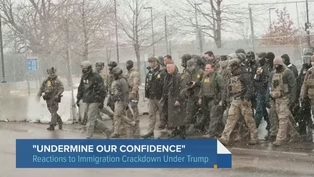
>> President Donald Trump signed a 70 billion dollar Republican backed funding bill for immigration enforcement last week.
The move means Immigration and Customs Enforcement and Border Patrol will be funded through the end of Trump's term.
It comes as many Chicago communities are still dealing with the fallout from Operation Midway Blitz and ongoing enforcement efforts.
And amid concerns from Democrats that the long-range funding takes away Congress's oversight power.
Joining us to discuss the state of immigration enforcement in the U.S.
is Gail Montenegro, who worked as a spokesperson for ICE and its predecessor INS from 1996, to 2017.
And then for the Justice Department's immigration courts until last year.
Welcome to the program.
We appreciate it.
Thank you very much.
So Chicago area, as we mentioned, been a major priority for immigration enforcement.
Obviously extremely high profile with Operation Midway Blitz.
What was your reaction to the of the crackdown from ICE and other immigration agents that we've seen locally?
My first reaction is that it was shocking.
>> And it actually took place in my own neighborhood in the northern suburbs.
we saw at first hand, it was unlike anything I had ever seen.
And this was an agency that I had represented and spoken on behalf for 15 years and it had it became unrecognizable.
Most of the enforcement norms and policies that guided the agents.
One I was there spanning numerous administrations all seem to go away.
For example, when I was there.
Arrests were never ever conducted based on how somebody and now racial profiling is at the forefront in my neighborhood.
Cbp agents were driving around just looking for.
Landscapers and pulling him out of their vehicles.
Now enforcement is being Done Inc in sensitive locations like churches and schools, places that were off limits always before.
And and the driving force between behind immigration enforcement.
While I was there was to conduct it with humanity.
And I'm not seeing that anymore.
One, of course, after the detention, you know, there.
>> These folks have to go somewhere.
There have been allegations of abuses and rights violations in detention centers in the U.S., of course, prisons that some people have been deported to in places like El Salvador.
What's your reaction to the conditions that detained migrants are facing?
>> I concern great concern.
>> If the >> removal process is a civil legal process, it's not punitive in nature.
It's not a criminal proceeding.
So to remove individuals to a 3rd country and to put them in prison there.
I just don't understand what they're in prison for.
They have not committed a crime.
There.
They should not be serving a criminal sentence in another country's prison.
So that is very concerning to me.
I've been inside Broadview many, many times.
That is a location that's called a processing facility.
It's not intended for long-term detention and it just seemed like so many arrests are being made, that that those rules and norms that previously guided the detention process were not being put into place.
Well in in in your introduction, outlined the various positions that you held, the agencies where you work.
>> But briefly, for folks who may not know what were your day-to-day roles like, I'm sure.
Well, I started in 96.
I was the sole media person for the immigration Naturalization Service in the Midwest.
And then when the DHS, the Department of Homeland Security was created, I was put into ice and I was also a media spokesperson for 3 states that sometimes it expanded to 6 states, but always based in Chicago and day-to-day.
My job was to respond.
2 media increase and there were many regarding enforcement efforts by ICE.
I would sometimes take reporters out on ride Alongs when we would conduct targeted enforcement.
That's another thing that I'm that I'm noticing.
Everything that we did was targeted.
It was based on surveillance and a lot of investigation that went into things behind the scenes, whereas now it looks like to me the enforcement is just all encompassing and they're really not conducting much of that surveillance.
You know, when you left your post last year that came after these so-called doge efforts to push civil servants to resign or retire early.
>> What was your reaction when you when you open that now?
>> The fork in the road email it was shock and horror it was to me a shot across the bow that nothing was going to be as it ever was.
>> it >> was the first time that we have ever received a government wide communication typically in the government you receive clear guidance from your specific agency.
It doesn't come from a nameless, faceless email with the subject line like for can the road it was basically giving people 10 days to make a life changing decision without really knowing who it was coming from, what it meant.
Fortunately, for me, I was one of the lucky people that I was close enough to getting my full retirement benefits that I was able to take it and take an early retirement and kind of hold on to most of what I had earned throughout my career.
But many people didn't have that choice.
And I remember reading in one of fake use that it that basically said you should take this deal and you'll get paid for 9 months and you can go sit on the beach and have a nice little vacation.
And it was just a very condescending way for my employer to speak to me.
I have given everything to this job.
Everything weekends, late nights I had earned all kinds of accolades.
The highest honors you can get from an agency.
And then all of a sudden.
It was like my employer had turned against me and nobody understood why.
Why that was happening.
It really just didn't make sense.
And when I opened up that email, I was at home alone.
And I ran to the bathroom and I was physically ill that had never.
Happened to me.
It was that disconcerting.
Yeah.
We mention some of your concerns on the enforcement side.
But of course, you also worked with immigration court system.
>> You know, there have been on mass firings of immigration judges.
The Trump administration looking for, quote, deportation judges.
Are you concerned about the direction of that court system?
100%?
>> One of my dear friends.
She was the chief immigration judge of the immigration courts at the time was fired within one hour of the inauguration on a federal holiday while she was working on a federal holiday.
The 4 the 4 people fired during that hour from my agency were all women.
And and then many of my friends have are part of the hundreds of immigration judges who have been fired since then without cause.
has never happened before now they are hiring new deportation judges to fill those positions.
Now, the term deportation judge.
is troubling and that it sends the message that remove all.
>> Instead of due process is the intended result of this proceeding.
>> And that is an erosion of justice.
Yeah.
Feeling as though there's a conclusion already reached before correct chases heard.
Absolutely.
There's a PBS NewsHour PBS News.
Npr poll earlier this year that found.
>> 60% of respondents disapprove of ICE's actions.
Of course, we've seeing the refrain abolish ice, you know, become common among many of its opponents.
Do you think there is a way to repair ices reputation, its relationship with with the public?
>> that's a hard question.
I feel like so much damage has been done and this is an agency that really had to fight.
For its place.
It had to sort of reinvent itself and create a new identity when the when DHS was created, it combined.
The customs authorities with the immigration enforcement authorities under the INS and merge to those into ICE.
And as with any merger, there's going to be some bumps along the way and ice really worked hard and had become a professional.
Law enforcement agency that deserved respect.
And I was proud to go out there and represent them.
I mean, you're always going to have your critics when it comes to immigration enforcement and, you know, half the people think you're not doing enough and half think that you're doing too much.
But that came with the territory.
But I I'm really saddened to see.
What has become of ICE's reputation and it's going to be very difficult to.
To repair it.
I hope it's possible.
>> All right.
Well, Gilman's, very interesting insight perspective.
We really appreciate you.
Thank you for having me.
Thank you.
Up next, efforts to prevent displacement near the Obama presidential center.
We're just days away from the official opening of the Obama presidential center.
But not everyone is ecstatic about the Jackson Park development.
Some South side residents living near the campus have been concerned about displacement and gentrification ever since the center's location was announced even with ordinances in place meant to prevent current residents from being forced out.
Advocates argue the protections don't go far enough.
Joining us to discuss the issue are Shannon Bennett, executive director of the Kenwood Oakland Community Organization here, a heart member of the Obama community Benefits Agreement, coalition Dixon, Romeo executive director of Southside.
Together.
We thank you all for joining So like to get your reaction just, you know, all these years ago when you first learned that the Obama presidential center coming Jackson Park, Shannon Bennett.
>> With a look, a lot of folk long-term residents in the area community surrounding area that center, we were concerned.
About the process about how the actual thing came about.
So when we talk about it, we talk about way that we need to make sure something isn't right.
So we came up with the process of community benefits agreement which is known Muse were alive when major developments or activities impact local communities.
The residents need to have a and things like housing, economic development.
Education.
This right across street from Haifa, High School.
So we rolled our sleeves up for years we've help town hall meetings with hundreds of residents.
We continue to get input on what we want.
It.
>> what is that?
You know, experience been like talking with, you know, folks in the communities around the center.
>> It's been very enlightening other people.
Experience seen, you know, the higher cost of like property taxes, which means is going to be also increasing just like, you know, the challengers, the company development, especially large scale development.
Yeah.
About that takes an army unit that the reaction you heard from folks and your own reaction overall folks are not against the center, but how do we make sure the city of Chicago?
>> The state of Illinois to county are doing things to make sure that the center doesn't turn into like Disneyland, right?
It doesn't replicate what the Clinton the Clinton presidential library did in New York region find a black neighborhood route.
Had all the folks who made the first black president I present it to stay in benefit from the Senate.
>> You know, Shannon, Benny mention rolling up your sleeves.
You know, all these listening sessions, all the work that you when you were putting together that community benefits agreement, calling for that with center.
What were people interested in seeing in such an agreement there to make use of the city Chicago.
you're the University of Chicago and the Obama Foundation.
Put some skin in the game.
My skin in the game we commit to what you heard coming from communities.
Solutions against displacement.
Displacement is always the concern of the folks head of their voices of marginalized.
So they were asking for.
>> What happens to Hyde Park High School?
You know, they were talking about what happens long-term renters.
Core tenants who've been really active in this fight saying we want to stay, but we know it a where we live.
If taxes go up, iris going to court.
So we've large increases rent.
So we really have heard from the people about solutions because we don't just complain thought about.
And we strategize this can fix it.
Frees the taxes.
You know, talk about rent, control, concrete plan, Dixon.
What kind of reaction have you gotten from Obama Foundation officials?
Well, initially a preemie being involved the collision.
We were trying to get that actually listen and mentioned the actual CBA and >> the foundation commit to that have ever.
What we have been able to do is really organized to make sure the city council is now past 2 ordinances for housing protections in the area in the most recent one in Jackson Park 1000 pilot ordinance covers all over the lawn.
nice portion of South Shore and also greater grand crossing and as things in there like we got 84 city-owned vacant.
Lots that have been set up for affordable housing development.
Both ownership and rental.
Some of them like to pass certain Maryland girl stations.
Already prices are even developed right on that.
We need more of those developments happen, particularly we've got a plethora of tenant protections like expand.
If know this amongst an option to purchase to give people the opportunity to to purchase the building is is is going to be so and also the case, fair notice if they're going to know is it doesn't use have rate increases.
Yeah, I mean care heard.
How about those efforts from from the city Council?
What was your reaction to be able to get that kind of support from other people.
>> Yeah, it was here.
But coming there's no way is great to be able to be supported.
But there's still more work to I get there's a that past year that, you know, need to be a like Atlanta registry and things like Yeah.
What rental registry, any other major items that you think need to happen dove major force is a state issue.
And do you feel like there is, you know, with the local representatives, the folks on the council that there is an understanding of why these issues are important.
Yeah, I think their housing across the board, that thing that Chicago is focusing on right now, the affordability is increasing across the city.
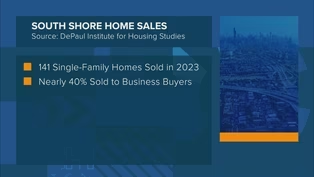
>> And I think that all of the otters are experiencing some some level of support didn't happen So data from the DePaul Institute for Housing Studies sideshows investors have been buying up larger shares of property in South Shore, then and surrounding communities report from 2023 says of 141 single family homes.
>> Close to 40% were sold to these business buyers.
Shannon Bennett, is that something that the community should be concerned about?
Very concerned.
Because you take away local control, you take away folks to reside where they desire to resign.
>> And we do know police get cities are.
So that's where government and residents and citizens partner because we see elected officials as possible partners.
But that's what we have to guard against land Bank.
happened when Chicago was announced their bid for the 2016 Olympics and our position coming the communication others.
We fall for CBA.
At that time.
We've gotten more from the standing to protect in case we have got that bit.
But it's the same thing that always happens to our community.
we're not in the room, were on the menu and that's a prop.
>> There was also some reporting from the Illinois answers project that said some of these anti displacement efforts put in place by the City council.
You haven't all lived up to expectations are having all done as much as they could that some people are, you know, in fact, being displaced, you know, care, Hartnett.
Is that something that you've seen?
Have you seen the community change?
Yes, absolutely.
I think significant change would include like the pricing of housing.
>> When I purchased my house, it was very reasonable price and now literally a block away from me.
You have a house that's like $800,000.
Who with the House quick not the people that live there currently.
Yeah, yeah.
About that.
Expressing acceleration of displacement.
yeah, I think the the result is a lot that they want answers piece was about the 2020 with housing Preservation ordinance and a lot.
we did get.
>> Incidence trends.
And in the 2025 or was a Guinness.
We're continuing to do that work.
But ultimately of the Lightfoot administration propose and we took a compromise on some public private partnerships that didn't pan out.
Right.
And so that is why things aren't put this on the city, not putting money into quantum facilities.
Data centers but putting it into.
They started by developing that says Affordable housing folks unable to putting that into make sure all of us can benefit from something that up the energy of the neighborhood.
But the Obama son of center as stated where it's going to we have a debate about how much money we should give that there's we have.
Chicago is getting evicted.
was the number-one eviction neighborhood in the city.
Still.
And that's only accelerating and we're going to fight to stop it.
But we're going to need the city to put some money into that and not it's a football.
with the Obama center about to open, are there, you know, positive benefits that you hope that it can bring to the community, things you're looking forward to.
I think one thing that I've noticed is that a lot of folks who have had concerns about this leaves.
Many folks are complaining about dish on up to our meetings, right?
We a CDA summit.
June 27th at Bryn Mawr Church at 11 o'clock and to to attend.
And we have hundreds of people.
Thousands of people come to events with those folks.
No, they need to step up.
And when the city has had many come in the without housing preservation on is home owners of so number, they have won a city now and all that money and use of so quickly because folks know they need it.
So one thing I'm seeing is that people are coming together and fighting to make sure that you can say and of the next community benefits agreement, It's slated for next week Cure heart and what's on the agenda for that one?
>> Conversations about what's to come when we have achieved a, you know, the good work that must continue.
you know, what are we going to do to keep people in their homes?
just about 30 seconds left the channel.
what are you looking for just about generational.
>> it's also about full cool or indigenous residents being able stay in place yet.
>> So the next generations should be able to enjoy the neighborhood starts and then chose to go to other amenities like the Obama center.
But their presence and their survival in their neighborhoods has to be top priority.
>> Well, it's been a conversation going on for many years.
I know it's not done tonight, but it's all the time we have for right now.
Shannon Bennett here, Harden and Dixon Ramiah.
Thank you all for sharing your thoughts.
Thank thank you.
We're back to wrap things up right after this.
>> Reflecting the people and perspectives that make a buck This story is part of Chicago tonight.
Black Voice.
>> And that's our show for this Tuesday night.
You can stream Chicago tonight on our W T Tw YouTube Channel every evening.
Catch up on any programs you may have missed.
Join us tomorrow night at 5, 30 10.
Now for all of us here at Chicago tonight, I'm Nick Blumberg.
Thank you for watching.
Stay healthy and safe and have a good night.
>> Woes caption is made possible by Robert a cliff.
And quickly, question Ka personal injury and wrongful death that serves the needs of
 New
NewFormer ICE Spokesperson on Immigration Enforcement Policies
Video has Closed Captions
Gail Montenegro offers a rare glimpse inside ICE operations. (9m 51s)
 New
NewSouth Side Residents Renew Gentrification Concerns Around Obama Presidential Center
Video has Closed Captions
The Jackson Park development officially opens this week. (10m 6s)
Providing Support for PBS.org
Learn Moreabout PBS online sponsorship New Episode
- News and Public Affairs

Top journalists deliver compelling original analysis of the hour's headlines.
 New Episode
- News and Public Affairs

Today's top journalists discuss Washington's current political events and public affairs.

 New Episode
 New Episode
 New Episode
 New Episode
 New Episode
 New Episode
 New Episode
 New Episode
 New Episode
Support for PBS provided by:
Chicago Tonight is a local public television program presented by WTTW
WTTW video streaming support provided by members and sponsors.