
Here and Now
Kieran Furlong on Realta Fusion's Energy R&D Deal in Madison
Clip: Season 2500 Episode 2503 | 5m 46sVideo has Closed Captions
Kieran Furlong on a research and development facility focusing on nuclear power tech.
Realta Fusion CEO Kieran Furlong discusses the company's plans to establish a research and development facility focusing on nuclear power technologies at the long-vacant Oscar Mayer plant in Madison.
Problems playing video? | Closed Captioning Feedback
Problems playing video? | Closed Captioning Feedback
Here and Now is a local public television program presented by PBS Wisconsin
Here and Now
Kieran Furlong on Realta Fusion's Energy R&D Deal in Madison
Clip: Season 2500 Episode 2503 | 5m 46sVideo has Closed Captions
Realta Fusion CEO Kieran Furlong discusses the company's plans to establish a research and development facility focusing on nuclear power technologies at the long-vacant Oscar Mayer plant in Madison.
Problems playing video? | Closed Captioning Feedback
Where to Watch Here and Now
Here and Now is available to stream on pbs.org and the PBS app.
Providing Support for PBS.org
Learn Moreabout PBS online sponsorshiphazardous, meaning the outside air is unhealthy for anyone, as electricity use tips up between staying indoors with air conditioning due to smoky air and heat.
The issue of energy and where to get it is a hot topic here and around the country, and this week it was announced that a massive nuclear fusion research center is coming to Wisconsin.
Realta Fusion, a company spun out from research done at UW-Madison, will build a 200 zero zero zero square foot research and development facility at the long vacant Oscar Mayer plant on the north side of Madison.
The move means the company will be headquartered there, and the workforce is expected to increase from 50 employees to 600, along with $60 million from private investors.
The state of Wisconsin gave nearly $40 million in tax exemptions, with the City of Madison kicking in nearly 3 million in financing.
Realtor CEO Kieran Furlong joins us now to explain the project.
And thanks for being here.
>> Thank you very much for having me.
dogs to futuristic generation of energy, what is the promise of nuclear fusion energy in this increasingly kind of electricity hungry world?
>> Yeah.
I mean, I think fusion really is the future for humanity, right?
It's the source of energy that we need if we're going to provide enough food, water, materials, mobility for 10 billion people, we need fusion.
We're not going to dig or drill our way out of this.
And, you know, we can build all the renewables plants we we can manage, but we're still going to need more energy.
And fusion holds that promise.
>> Well, give us kind of the nuclear fusion for dummies description.
>> Sure.
Yeah.
So fusion is another form of nuclear energy as it involves reactions with the nuclei of atoms.
But it's the opposite process from what most people will think of when they think of conventional nuclear fission.
That's where you take a large, heavy atom, like a uranium atom, and split it.
With fusion, we take very small light atoms and fuze them together, basically smooshing them together, and we take different flavors of hydrogen, push those together, and form helium, the same stuff that you would find in party balloons.
But when we do that, you get a small amount of the energy.
Our small amount of the mass gets converted into a massive amount of energy.
>> So I read that researchers have been trying since the 1930s to generate electricity through nuclear fusion, described as the same process that powers the sun.
Why is it so hard?
>> Correct.
So it was first postulated back in the early 20s by researchers looking at what powers the sun.
And so fusion is what powers the sun and all the other stars in the universe.
So in many ways, it's the it's the energy that we have in the universe.
The sun has the advantage of massive, massive scale.
So it's just so large and its density gets us to the conditions that you can have fusion occur.
So infusion, we have something that's known as the, you know, you basically need something called the triple product.
We basically need to get those elements.
We want to fuze together hot enough, dense enough for long enough.
We don't have the advantage of the sun's density.
So we need to get them very, very hot, hotter than the center of the sun.
And that itself is quite challenging.
>> Do you feel as though your scientists have cracked the code to generating electricity through fusion?
>> We're on the way there.
And in fact, just recently we announced an experiment we did where we demonstrated we could pull electricity directly from the plasma that we're operating in the WHAM machine at the University of Wisconsin-Madison.
So plasma is the fourth state of matter.
So you think, you know, ice, water, steam.
And the next step up would be plasma.
So we need to get a plasma.
We can hold that in a magnetic cage essentially, because we temperatures much hotter steel vessel, for example.
But we're making great progress with it.
There's still some work to do, and that's why we'll be doing our R&D in this new facility.
it with all this money and the retrofit involved?
>> So I think the first thing is we're not trying to defy any laws of physics.
So I've got great I'm a great believer in the ingenuity of humans.
We will find a way forward.
There's an old joke about fusion that folks will say, oh, it's 20 years in the future and always will be.
That kind of ignores the effort that's needed to get there.
And now we're making the effort so there's more investment coming into fusion.
We've got more people working on the problem.
I'm 100% convinced humanity will solve fusion.
The question is when.
>> What do you think about when?
>> So we're targeting the 2030s.
So you know, early to mid 2030s is when we intend to have a first commercial operation based on our technology.
>> Does this project put Wisconsin on the map for fusion in a major way?
And why Wisconsin?
>> Yeah, I think so.
In terms of putting it on the map.
And that's really been kind of one of our intentions from the start.
So the University of Wisconsin-Madison is already one of the top institutions for research in this field of plasma physics and fusion.
The state is a, you know, very well placed from a manufacturing standpoint, the ability to, you know, do precision and advanced manufacturing fusion industry is essentially bringing those two things together.
We've got the scientific research to show, well, here's the kind of machine we need to build, and then we need to know how to build those and demonstrate that we can do that cost effectively.
I think Wisconsin is very well placed to do that.
That was one of the factors in deciding to set up our R&D facility and corporate headquarters here.
And I think Wisconsin absolutely will be one of the main hubs for fusion in the 21st hubs for fusion in the 21st
 New
New2026 Candidates For Governor Release Midyear Finance Reports
Video has Closed Captions
Clip: S2500 Ep2503 | 10m 2s | Primary candidates in Wisconsin's 2026 race for governor release campaign funding reports. (10m 2s)
 New
NewHere & Now opening for July 17, 2026
Video has Closed Captions
Clip: S2500 Ep2503 | 1m 15s | The introduction to the July 17, 2026 episode of Here & Now. (1m 15s)
 New
NewIt's a Crowded Republican Race for Wisconsin's 7th in 2026
Video has Closed Captions
Clip: S2500 Ep2503 | 10m 2s | Wisconsin's 7th Congressional District Republican candidates make their cases to voters. (10m 2s)
 New
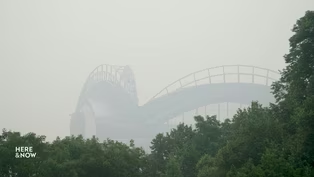
NewWildfire Smoke from Canada and Minnesota Smothers Wisconsin
Video has Closed Captions
Clip: S2500 Ep2503 | 26s | Smoke from wildfires leads to air quality advisories at the highest alert category. (26s)
 New
NewWisconsin 7th District Democratic Candidates Make Their Case
Video has Closed Captions
Clip: S2500 Ep2503 | 2m 31s | Democratic candidates in the 7th Congressional District debate before the 2026 primary. (2m 31s)
 New
NewZac Schultz on Rodriguez Ending her 2026 Run for Governor
Video has Closed Captions
Clip: S2500 Ep2503 | 5m 9s | Zac Schultz on what Sara Rodrigues dropping out of the 2026 race for governor means. (5m 9s)
Providing Support for PBS.org
Learn Moreabout PBS online sponsorship New Episode
- News and Public Affairs

Top journalists deliver compelling original analysis of the hour's headlines.
 New Episode
- News and Public Affairs

Today's top journalists discuss Washington's current political events and public affairs.

 New Episode
 New Episode
 New Episode
 New Episode


 New Episode
 New Episode
Support for PBS provided by:
Here and Now is a local public television program presented by PBS Wisconsin