
News Wrap: Judge orders Trump's name off Kennedy Center
Clip: 5/29/2026 | 5m 46sVideo has Closed Captions
News Wrap: Judge orders Kennedy Center to remove Trump's name from building
In our news wrap Friday, a federal judge ordered the Kennedy Center to remove Donald Trump’s name from the building, the U.S. and Iran appear to still be far apart on a potential deal to end the conflict and Romania says that a Russian drone crashed into an apartment building near its border with Ukraine, the first known time that's happened on NATO soil since Russia invaded Ukraine.
Problems playing video? | Closed Captioning Feedback
Problems playing video? | Closed Captioning Feedback
Major corporate funding for the PBS News Hour is provided by BDO, BNSF, Consumer Cellular, American Cruise Lines, and Raymond James. Funding for the PBS NewsHour Weekend is provided by...
News Wrap: Judge orders Trump's name off Kennedy Center
Clip: 5/29/2026 | 5m 46sVideo has Closed Captions
In our news wrap Friday, a federal judge ordered the Kennedy Center to remove Donald Trump’s name from the building, the U.S. and Iran appear to still be far apart on a potential deal to end the conflict and Romania says that a Russian drone crashed into an apartment building near its border with Ukraine, the first known time that's happened on NATO soil since Russia invaded Ukraine.
Problems playing video? | Closed Captioning Feedback
Where to Watch PBS News Hour
PBS News Hour is available to stream on pbs.org and the PBS app.
Providing Support for PBS.org
Learn Moreabout PBS online sponsorshipGEOFF BENNETT: Good evening.
I'm Geoff Bennett.
AMNA NAWAZ: And I'm Amna Nawaz.
On the "NewsHour" tonight: A race to contain the spread of Ebola in Central, Africa as a Kenyan court blocks U.S.
plans to open a quarantine facility.
GEOFF BENNETT: Former Attorney General Pam Bondi faces congressional scrutiny over the Justice Department's handling of the Epstein files.
AMNA NAWAZ: And a grieving father on how a family tragedy inspired him to speak out about rising antisemitism around the world.
DANIEL LISCHINSKY, Father of Yaron Lischinsky: We look for peace, but we look for understanding, one with the other, that we love other people.
We are not people that are seeking for war.
(BREAK) AMNA NAWAZ: Welcome to the "News Hour."
In Central Africa, officials and health workers are still struggling to get control of a spreading and deadly Ebola outbreak.
There are now more than 900 suspected cases and over 220 suspected deaths.
Authorities fear the real numbers may be significantly higher.
GEOFF BENNETT: And, today, a Kenyan court temporarily blocked the Trump administration's plan to open a quarantine facility there to treat Americans exposed to or infected with the virus.
William Brangham has more.
WILLIAM BRANGHAM: That's right, Geoff.
Kenyan officials had initially approved this plan for an Ebola facility requested by the Trump administration.
But local backlash spurred a legal challenge to halt that project.
Under today's ruling, that facility must remain closed until the court hears the case next week.
For more on all of this, we are joined again by Dr.
Craig Spencer.
He's an associate professor of public health and emergency medicine at Brown University.
He worked in West Africa during the 2014 outbreak and survived Ebola himself.
Craig Spencer, so good to have you back on the program.
About this Kenyan quarantine facility, you wrote that this was an abdication of American responsibility to possibly send Americans there.
How so?
DR.
CRAIG SPENCER, Brown University School of Public Health: Well, over the last year, we have seen an abdication of U.S.
leadership on the global stage.
And I think we're seeing the ramifications of that in terms of the response in Eastern Congo right now.
But this detail, not only that it's a quarantine facility, but that the U.S.
also planned on treating American citizens who are infected with Ebola in this facility that they're creating in Kenya right now, is an abdication, because I'm worried that there is no way that, in the span of a few weeks or even a few months, they're going to be able to stand up the quality of care that is necessary to really take care of a very sick Ebola patient.
And I'm also concerned, because, over the past decade, the only real good thing to come out of my illness was the fact that we built and sustained a system of specialized treatment centers all around the United States that are capable of managing patients exactly like this.
Right now, those are sitting empty, and I would be saddened if those continue to sit empty when we have Americans that needed this type of treatment, this type of specialized treatment.
As opposed to having them treated in some new facility abroad, I think that they should be provided that treatment here at home.
WILLIAM BRANGHAM: So, given that, I mean, is it your sense that this move was more about public fear than medical necessity?
DR.
CRAIG SPENCER: My concern is that, over the last few weeks, we have seen the priorities of this administration, unfortunately, inverted in terms of what I think we need to be focusing on to truly end this outbreak.
We have heard that the first priority is to keep Ebola out of the country at all costs, and the second priority is to end the outbreak in Congo.
The problem is, of course, is, is that we're not going to be able to truly prevent Ebola from coming to the U.S., even with all travel restrictions, any other type of ban, if we're not able to actually end the outbreak on the ground in Congo.
WILLIAM BRANGHAM: This Kenyan facility is really just for the few Americans who might get exposed, again, wholly separate from the much bigger population of people who are wrestling with this epidemic right now.
What is your sense about how things are going there today?
DR.
CRAIG SPENCER: I will say there's been a lot of focus on this Kenya treatment facility and access for Americans, but my biggest worry about all of this is actually the attention and the resources it's taking away from the quality of care that we're actually able to offer to the hundreds and likely eventually thousands of patients that will be treated and will need high quality of care for Ebola over the coming weeks and months.
I would like us to focus our attention, our resources, financial, logistical, and human resources, on making sure we're able to not just create a third-tier system between what we can offer in the U.S., what's offered on the ground currently, and what might be offered for American citizens.
I would like us to focus on raising the floor and improving the quality of care for everyone that is impacted by Ebola in the region.
That is the only way that we're going to get people to trust that they can go to these facilities and get good-quality care.
That is the only way to make sure that communities are going to be on board with our response activities.
And, ultimately, that is the only way that we end this outbreak, which not only decreases the suffering in the region, but also lowers the risk of importation of cases, not just in countries surrounding Congo, but in the U.S.
as well.
WILLIAM BRANGHAM: You mentioned all the criticisms about the cuts to CDC and USAID and getting out of the WHO.
The CDC argues they are doing and are on the case now.
Do you believe that that is true?
DR.
CRAIG SPENCER: We have seen over the last two weeks the U.S.
response has dramatically scaled up in terms of sending people, money and resources.
However, I still think it's a fraction of what we needed and what we would have sent in previous outbreaks.
And I still think that our priorities are inverted.
I would like us to be focusing more on ending the outbreak right now at its source, primarily in D.R.
Congo, than what I have seen as the number one priority of this administration, which is doing everything it can to keep Americans out, including, unfortunately, if that means Americans who might be infected with Ebola and need access to our treatment centers here at home.
WILLIAM BRANGHAM: Dr.
Craig Spencer of Brown University, always great to hear from you.
Thank you.
AMNA NAWAZ: The day's other headlines begin with the war in Iran.
President Trump huddled in the White House Situation Room for roughly two hours today to, in his words, make a final determination about a potential deal to end the war.
The president made no announcement and that meeting has ended.
U.S.
officials describe the possible agreement as a memorandum of understanding that would open the Strait of Hormuz and then kick-start a second phase of negotiations over limiting Iran's nuclear program and lifting U.S.
sanctions.
But today, in public, Tehran insisted that current negotiations did not include the nuclear issue.
And a key negotiator, Mohammad Bagher Ghalibaf, struck a hard-line tone on X, saying: "No step will be taken before the other side acts."
A federal judge has temporarily blocked the Trump administration's so-called anti-weaponization fund, a $1.8 billion fund to compensate people who claim they have been targeted by the justice system.
The order stops the fund's formation and any potential payouts for at least the next two weeks.
Since it was announced last week, the fund has been challenged in at least three lawsuits.
It's also drawn bipartisan criticism on Capitol Hill, including from Senate Majority Leader John Thune.
Meantime, in another legal setback for the president, a federal judge has ordered the Kennedy Center to remove Donald Trump's name from the building.
Judge Christopher Cooper ruled that the venues board violated the law, writing -- quote -- "Congress gave the Kennedy Center its name, and only Congress can change it."
In response to the judge's ruling and in a major concession, President Trump said he will pursue a full and complete transfer of responsibility for the Kennedy Center to Congress.
In Louisiana, Republican state lawmakers have approved a new congressional map that could help the GOP pick up another House seat in the upcoming midterms.
Just one month ago, the U.S.
Supreme Court struck down the state's current map as an illegal racial gerrymander.
The new boundaries would eliminate one of the state's two majority-Black districts, leaving just one Democratic stronghold around New Orleans.
The state's U.S.
House primary was postponed until the summer so the map could be redrawn.
Turning overseas to Lebanon, Israel says its troops have pushed deeper into Lebanese territory, widening its offensive against Hezbollah, in spite of a cease-fire that's had little effect.
Israeli forces entered the village of Dibbin today, crossing the Litani River, a longtime cease-fire boundary between the two countries.
The IDF's advance came as Israeli airstrikes killed at least six people across Southern Lebanon, according to state media.
Prime Minister Benjamin Netanyahu told troops on a visit to the northern border that the fighting will remain relentless.
BENJAMIN NETANYAHU, Israeli Prime Minister (through translator): We are operating in Beirut, in Bekaa, across the entire width of the front, and we are both eliminating Hezbollah and causing them to flee.
AMNA NAWAZ: In the midst of all of this, dialogue continues.
Delegations from Lebanon and Israel met in Washington today for the first direct military talks between the two countries in decades.
More talks are expected next week.
Romania says that a Russian drone crashed into an apartment building near its border with Ukraine, injuring several people in the NATO country.
Last night's stray drone is not the first to fall inside Romania, but was the first to cause injuries.
President Putin questioned that the drone was of Russian origin.
Romania responded by closing the Russian consulate there.
NATO allies condemned the incident, including Secretary-General Mark Rutte, who vowed to -- quote -- "defend every inch of allied territory."
Back in the U.S., in Texas, an ICE agent was arrested today.
He was wanted for the nonfatal shooting of a Venezuelan man during the Trump administration's immigration crackdown in Minnesota earlier this year.
Hennepin County officials had charged 52-year-old Christian Castro with assault and falsely reporting a crime.
Castro was one of two federal agents to face charges related to the Minnesota crackdown, which raised concerns about officer conduct, especially after two U.S.
citizens were shot and killed.
On Wall Street, the major stock indices kept adding to their record gains.
The Dow Jones industrial average ticked up 0.7 percent, posting another record high.
The Nasdaq also reached new heights with a 55-point gain.
The S&P 500 ended with a ninth strait weekly gain.
And 14-year-old Shrey Parikh spelled his way to victory last night in the Scripps National Spelling Bee, which ended in a rapid-fire tiebreaker round.
AMNA NAWAZ: Letter by letter, he zipped through a record 32 words in just 90 seconds.
Fellow finalist, 12-year-old Ishaan Gupta, correctly spelled 25 words.
It's the third time a spell-off has decided to bee since it was introduced in 2021.
Parikh's win marks an astounding comeback.
Just last year, an illness and shaky performance at his school spelling bee knocked him out of competition.
Our congratulations to Shrey, who we are very confident can spell redemption.
Still to come on the "News Hour": a massive rocket explosion casts doubt on the future of NASA's moon mission; Jonathan Capehart and Matthew Continetti weigh in on the week's political headlines; and journalist Martha Raddatz on her new book featuring inspiring stories of U.S.
military service members.
GEOFF BENNETT: Former Attorney General Pam Bondi defended the Justice Department's handling of the Jeffrey Epstein investigation today during a closed-door interview with lawmakers.
Over nearly four hours of questioning before the House Oversight Committee, Bondi said the department, under her leadership, was committed to securing justice for Epstein's victims.
She declined to answer questions about President Trump.
Bondi also acknowledged mistakes in the release of investigative records, saying -- quote - - "There were redaction errors.
But since day one of this process, this department has been committed to accountability and transparency."
Some survivors of Epstein's abuse waited outside of the interview room today and called for Bondi to take accountability.
DANI BENSKY, Jeffrey Epstein Survivor: I just hope that she does have a moment where she remembers her own humanity and our humanity and finds her compassion and remembers that this is a bigger story than political rhetoric.
GEOFF BENNETT: For more on the Epstein investigations, we're joined now by our justice correspondent, Ali Rogin.
Ali, it's good to see you.
So what more do you know about Bondi's appearance today?
ALI ROGIN: This interview today, Geoff, was neither a sworn deposition, nor was it videotaped.
We will eventually get a transcript, but, today, the top Democrat on the committee said that it was a shame and disservice to the American people that it wasn't recorded or oath, as -- as previous depositions have been.
Bondi was also represented today by DOJ attorneys, including the head of the Civil Rights Division, Harmeet Dhillon, which Democrats said was unusual, given that she is no longer employed by the Department of Justice.
And, Geoff, the only Republican present today was the committee's chairman, James Comer, who took some questions before the interviews began, including from some survivors.
REP.
JAMES COMER (R-KY): The one thing that we can say with confidence thus far is, the survivors were failed by the government.
And I hope that we can do the best that we can do in getting answers and getting the truth to the American people.
GEOFF BENNETT: So what did Bondi say?
ALI ROGIN: Not much, according to Democrats in the room.
She answered many questions by saying she did not know or did not recall.
She deferred many questions to Todd Blanche, saying that he handled the documents, including all the mistakes of failing to redact some of the survivors' names and images.
In her opening statement, she said she -- quote - - "delegated oversight over this process" to Blanche.
She also refused to comment on her conversations with President Trump.
GEOFF BENNETT: And Blanche, now the acting attorney general, who used to be President Trump's personal attorney.
ALI ROGIN: That's right, Geoff.
And he's been very involved in this investigation.
He met with co-conspirator Ghislaine Maxwell in 2025, after which she was transferred to a minimum security prison.
Bondi said she was unaware that that meeting was happening.
And as acting attorney general, Blanche has said that he said the Epstein files -- quote -- "should not be a part of anything going forward at the DOJ."
Whatever his role was, Blanche is now the head of the department and Democrats said they will subpoena him to testify.
For their part, survivors say that the most important thing for them is that the DOJ follow through on some of the investigative leads that are revealed and some of the names that have been released in the Epstein files.
GEOFF BENNETT: And, as we have reported on this program, President Trump's own relationship with Epstein has come under scrutiny.
The president has gone after media outlets, news organizations that have chosen to report on it.
So what's the latest on that front?
So, earlier this week, President Trump refiled a defamation lawsuit that he had filed against The Wall Street Journal over a report that he had written a letter to Epstein for his birthday in 2003 which featured an illustration of a naked woman silhouette.
Trump denied he wrote the letter or drew the picture.
And he sued The Journal for defamation.
The judge threw out the case, saying he had not proved that the reporters deliberately reported false information.
He said Trump could file a new complaint.
We have seen that today.
He -- there's not very much new in this new complaint, except there's an anecdote that he spoke with Rupert Murdoch, the chairman, before this article was released.
Murdoch said he would handle it.
We don't know how this judge is going to respond to this, and The Wall Street Journal stands by its reporting, Geoff.
GEOFF BENNETT: On a separate matter, Ali, the Justice Department is pursuing investigations targeting Mr.
Trump's perceived enemies.
There's now a new development, in that the DOJ is reportedly focused on a private citizen, in this case, E. Jean Carroll.
Bring us up to speed.
ALI ROGIN: That's right.
Carroll was the author whom Trump was found liable for sexually abusing in 2023.
There was reporting earlier this week that the U.S.
attorney in Chicago was investigating Carroll.
That attorney denied that was the case.
Instead, today, several outlets are reporting that the investigation actually focuses on LinkedIn founder and Democratic donor Reid Hoffman, whose nonprofit did pay for some of E. Jean Carroll's legal fees.
We should also mention Hoffman had what he calls a fund-raising relationship with Jeffrey Epstein, although this investigation does not seem to have anything to do with Epstein.
Hoffman posted on social media today, saying that Trump is -- quote -- "investigating me because I supported E. Jean's lawsuit" and that the president -- quote -- "hopes that these fraudulent investigations will silence those who stand up to him.
He is wrong.
I will not bend the knee" -- Geoff.
GEOFF BENNETT: All right, Ali Rogin, our thanks to you.
ALI ROGIN: You bet.
AMNA NAWAZ: Last night, Blue Origin's New Glenn rocket exploded on the launchpad during a test in Cape Canaveral, Florida.
The company, owned by Jeff Bezos, said no one was injured and all personnel were accounted for.
But the rocket has a crucial role in NASA's Artemis program to return American astronauts to the surface of the moon.
Here to walk us through what happened and its significance is our science correspondent, Miles O'Brien.
Miles, it's always good to see you.
This was a massive explosion, though.
The company said there was an anomaly during a test.
What happened?
MILES O'BRIEN: You might call that a euphemism, Amna, anomaly.
Yes, that was a major malfunction, for sure, and quite an impressive sight.
First of all, let's be clear.
Nobody got hurt.
Everybody was a long way away from this rocket as they were conducting what they call a hot-fire test, which is light up the engines, but don't release the rocket.
See how everything goes.
Obviously, things did not go well.
They will investigate it.
They will figure out what it is.
Was it one of the engines?
Was it something else?
A lot of plumbing has to work well on a rocket in order for it to fly safely.
But crucially here, Amna, the issue is the destruction of the launchpad.
That is a big deal, because they are complicated structures.
It takes time to build them and to certify them, at least a year, maybe 15 months to build a new one.
And this is the only launchpad that the New Glenn rocket has to get to space.
AMNA NAWAZ: And we should remind folks this was a Blue Origin rocket.
The head of its competitor, SpaceX, Elon Musk, posted on X: "Sorry to see this.
I hope you recover quickly."
But, also, SpaceX's Starship program had its own problems recently, right, Miles?
Tell us about that.
MILES O'BRIEN: Yes, a week ago.
Space is hard.
Amna.
We have said this many times.
The Starship flew its 12th flight and underperformed yet again.
In this case, the booster, which carries the ship to, in this case, near-orbit, as it came down, it basically lost control.
And the FAA gets very concerned about that, because they're concerned about public safety.
And if engines do not fire, and if it does not return in a controlled way, they declare it a mishap, which is what happened in this case.
And so the Starship vehicle is also nonoperational now.
So these two big vehicles that the commercial players are trying to build right now can't do anything for NASA.
AMNA NAWAZ: So what does all this mean for that Artemis program we mentioned, NASA's effort to return astronauts to the moon?
MILES O'BRIEN: Well, as you know, the astronauts are flying on the government rocket, the Space Launch System, which we saw fly around the moon not too long ago and enjoyed that.
But once the astronauts get into space, they are relying on the Starship and the New Glenn to get cargo down to the surface of the moon and ultimately get astronauts down there.
The Starship will be modified to be a lunar lander, and New Glenn will carry a lander called Blue Moon, which will carry cargo and eventually, it is hoped, people.
So these are integral to the Artemis program and, in this case, could really slow down the process of getting Artemis back on track.
AMNA NAWAZ: We have seen big setbacks here.
They have -- NASA's been talking about another spaceflight mission, the next Artemis III mission, in 2027, and even talking about a sustained presence on the moon, a lunar base.
What do these setbacks mean for those plans?
MILES O'BRIEN: Yes, big plans, tight deadlines, and now not an operational heavy-lift vehicle in sight.
So this is not a good equation.
Artemis III is supposed to fly about a year from now.
It's going to take at least a year, probably more, just to build a new launchpad for that New Glenn rocket, which is supposed to loft into space a lander, a moon lander, built by Blue Origin, which would rendezvous with the Artemis III Orion capsule.
Meanwhile, Starship not operational either.
They have a lot of work to do before they're going to be ready for that rendezvous mission as well, so a setback right there.
But when you think about it, they're talking about building a moon base there.
And, ultimately, this would involve hundreds of launches of these heavy-lift rockets, and nothing is operational right now.
So, thinking about a moon base right now seems a little bit like the cart before the horse.
AMNA NAWAZ: That's our science correspondent, Miles O'Brien.
Miles, thank you so much.
Great to speak with you.
MILES O'BRIEN: You're welcome, Amna.
GEOFF BENNETT: Well, this week's midterm primary elections showed more signs of strength for President Trump within the GOP.
That unfolded as Jill Biden spoke up for the first time about the former president's health while he was running for a second term.
For analysis of all of this and more, we turn to Jonathan Capehart and Matthew Continetti, Capehart of MS NOW, and Continetti, a Wall Street Journal opinion columnist and scholar at the American Enterprise Institute.
David Brooks is away this evening.
It's always good to see you, gentlemen.
JONATHAN CAPEHART: Hey, Geoff.
GEOFF BENNETT: So, the biggest political story of the day came out of Texas, where Attorney General Ken Paxton routed longtime Senator John Cornyn in the Republican primary there.
You have got Cornyn, who represents the Republican establishment, Paxton, who was backed by President Trump.
He's faced securities fraud charges dating back a decade.
He was impeached for purportedly misusing his office.
There had been accusations of infidelity.
Jonathan, what does a nearly 30-point margin tell us about where the GOP is right now?
JONATHAN CAPEHART: Well, what it says, you take Cornyn's loss by almost 28 points, you take Cassidy's loss in Louisiana, coming in third, another sitting Republican senator losing by 20 points, to me, what it says is that President Trump is king of MAGA in that specific, core base.
But it also says he is the ruler of the Republican Party.
And if you are a Republican running for office, you fear not getting the president's endorsement.
The question is, does that translate to the general?
Now, the president's approval numbers are in the 30s, depending on which survey you look at.
In Texas, he is underwater by three points, and it went for him by 14 points in the 2024 election.
Democrats have always wondered, ooh, Texas, this is the cycle we're going to do it.
This might be it.
But the test is going to be, does the popularity of the president within his own party translate to the general ballot?
GEOFF BENNETT: And, Matthew, as you well know, Cornyn voted almost in lockstep with President Trump in terms of his priorities.
If someone with that sort of profile, his establishment backing, the fact that he has supported the president's priorities, if he loses by 30 points, what message does that send to other incumbents?
MATTHEW CONTINETTI, The Wall Street Journal: Well, I think the message it sends is that the Republican Party under Donald Trump is a conservative populist party that is extremely suspicious of incumbency.
You used the word establishment.
That is a curse word in today's Republican Party.
If you have ties to the Republican establishment in town, the non-MAGA establishment, then you're liable to bring in one of these primary challenges from a Trump-endorsed nominee.
The Trump endorsement is the most valuable commodity in politics.
Whether it translates to the general, I think we're looking for a contest between Paxton's biography and James Talarico's ideology.
And in a red state like Texas, that blue wave is going to have to be mighty high to overcome the partisan tilt toward the Republican Party.
GEOFF BENNETT: Well, what about that?
Does this put Texas in play potentially, or is that more theory than reality?
JONATHAN CAPEHART: Well, I mean, if you look at The Cook Political Report, the moment Cornyn lost, they switched it to no longer -- I think, from toss-up to lean Democratic.
But, again, as I said before, Texas has been the whale that the Democrats have been hoping to turn for at least 20 years.
This might be it.
But, to Matthew's point, this race is going to be ugly between the two of them.
It's already starting to be ugly with some of the innuendoes about James Talarico.
The question in my mind is, will Talarico -- how will he take the punch, and then how will he respond to the punch?
And that's something that Democrats nationally will be looking at, but I bet something Texans of all sorts who will go into the voting booth will be watching for to see, is he Texas-tough?
MATTHEW CONTINETTI: And no matter what, it's going to cost a lot of money... MATTHEW CONTINETTI: ... money that I think Republicans would have preferred to spend in other battleground states, but now they will have to spend it in Texas as well.
GEOFF BENNETT: Well, say more about that, because you have Republicans defending congressional majorities in this political environment that includes concerns about inflation and gas prices and voter fatigue over President Trump.
What do Republicans see as their strongest argument to voters heading into midterms?
MATTHEW CONTINETTI: Well, I think the strongest case they can make is that they're trying to address voters' concerns on affordability, on the price of energy.
And they also have an argument that Trump addressed one of the main causes of his election in 2024, and that was the crisis at the southern border.
But, of course, voters are always asking, what have you done for us lately?
And unless the president can show real gains in the Strait of Hormuz and on the price level and income growth, it is an uphill climb for Republicans in the fall.
JONATHAN CAPEHART: Well, it's not helpful when the president is out there seemingly every day saying, I don't care about -- I don't care about how all of this is hurting Americans' financial situation.
Oh, it's peanuts.
You cannot tell people they feel economic pain when they are feeling it every day.
And if they're not feeling it, they're seeing it when they drive by a gas station.
GEOFF BENNETT: Yes.
Well, former first lady Dr.
Jill Biden, she's out with a new memoir.
And, of course, you know how this goes.
In order to gin up publicity and interest in the book, there has to be a headline.
The headline in this case is that she was frightened after her husband, obviously, President Joe Biden's 2024 debate performance, and she thought that he might have been having a stroke.
Here's what she said on CBS.
JILL BIDEN, Wife of Joe Biden: I wasn't horrified.
I was frightened, because I had never, ever seen Joe like that before or since, never.
QUESTION: Or since.
JILL BIDEN: Yes, or since.
QUESTION: You have never seen him like that?
JILL BIDEN: Never, no.
(CROSSTALK) QUESTION: What happened?
JILL BIDEN: I don't know what happened.
I mean, when -- as I watched it, I thought, oh my God, he's having a stroke.
GEOFF BENNETT: So the issue of Joe Biden's health has been litigated in public exhaustively.
We're talking about it again because she's talking about it.
But the fact that she was so concerned and thought that there might have been a serious problem, that is not what top figures in the Democratic Party were saying at the time.
So, Jonathan, does this undercut their credibility?
JONATHAN CAPEHART: That's not what she even said.
JONATHAN CAPEHART: The day after, said, you answered every question, Joe.
This is not helpful.
This is not helpful, certainly for Democrats, who have a unique ability to circle the wagons and then just fire at each other while Republicans watch with glee.
This is a sort of a second self-inflicted wound on the party, the first one being earlier last week with the draft of that autopsy that was released.
To my mind, to your point, Joe Biden's health has been litigated up and down, even when he was in the White House, which stands in stark contrast to what is happening today with the current sitting president, who went in for yet another physical at Walter Reed.
He's only been in the job for 18 months.
Three visits to Walter Reed?
Why are we, as a profession, not talking as extensively and exhaustively and urgently about the health of the sitting president of the United States, when we did that to Joe Biden for four years?
GEOFF BENNETT: What level of disclosure should the public reasonably expect from any president, especially this president, who is the oldest president to ever be sworn in?
MATTHEW CONTINETTI: I think they should expect a reasonably high level of disclosure.
I mean, you have the two oldest presidents back to back, right?
But, I mean, you mentioned earlier what is the Republican argument going to be in the fall.
One of the biggest arguments is going to be, don't look at me, look at the alternative, exactly as Joe Biden campaigned in 2022.
The one thing that the Republicans are banking on is the Democratic Party failing to learn from its mistakes in 2024, including the way in which the Democratic Party establishment handled questions about Joe Biden's capacity to run for a second term.
And it is quite striking to hear the former first lady make these comments.
It is not true.
There were signs before that debate.
There were signs on the trip to Europe.
There were signs at the Juneteenth celebration.
There were earlier signs.
And it wasn't until it was exposed to the entire world that we had those three weeks of panic until finally he relinquished the nomination to Kamala Harris.
GEOFF BENNETT: Does all of this point to a bigger problem, not just having to do with any one president, but a system that gives presidential administrations strong incentives to disclose as little as possible to the public?
JONATHAN CAPEHART: Yes, I mean, it is a problem.
And it's only made worse by this current administration, where, on any policy, I question, am I being told the truth?
And I think I mentioned this last week when we were talking about the possibility of a deal between the United States and Iran.
And I don't know, because I don't trust the administration.
And I certainly don't trust the Iranians.
So if that's my mind-set on something as important as war, then you can imagine my mind-set when it comes to the president's health, the president's economic plans, the president's plans to beautify Washington and all sorts of other things that he's doing and saying.
MATTHEW CONTINETTI: I think Jonathan is expressing exactly how Republicans felt during the four years of the Biden administration.
(LAUGHTER) GEOFF BENNETT: Matthew Continetti, Jonathan Capehart, good to see you both.
Have a good weekend.
JONATHAN CAPEHART: Thanks, Geoff.
MATTHEW CONTINETTI: Thank you.
AMNA NAWAZ: The Anti-Defamation League recently announced a decline last year in antisemitic incidents, like vandalism and harassment, but physical assaults against Jews in America reached their highest level since 1979, with over 200 such attacks reported.
One of the highest-profile cases was in the nation's capital.
Nick Schifrin has more on that story and the father fighting to preserve his son's legacy.
NICK SCHIFRIN: One year ago, a gunman approached an event for young diplomats at the Capital Jewish Museum in Washington, D.C., and killed two young employees of Israel's U.S.
Embassy.
Yaron Lischinsky was 30 years old.
Sarah Milgrim was 26.
They were about to become engaged.
This month, the Department of Justice announced that it would seek the death penalty for their alleged killer.
And I'm pleased to welcome Daniel Lischinsky, Yaron Lischinsky's father.
Thank you very much for being here.
DANIEL LISCHINSKY, Father of Yaron Lischinsky: Thank you.
NICK SCHIFRIN: What do you want people to know about your son?
DANIEL LISCHINSKY: Yaron was a peacemaker.
He was a person that he tried to bring together.
And, also, if you knew him, he was approaching every person like a human being, never looking for your title, your position, your -- if you are rich, poor, or Black or white or Jewish or Gentile.
He was simply a human being, like most of us Israelis.
So... NICK SCHIFRIN: He was born in Israel.
You moved to Germany when he was very young, and you moved back to Israel when he was 14.
And he had been working at the embassy since September of 2022.
And that is where he met Sarah.
What did he hope for his future?
DANIEL LISCHINSKY: I think he would have stayed one year more here and then to decide maybe to get married in that year with Sarah and together to decide.
They wanted to live in Israel and I think to work for the understanding between the people.
That was her heart's desire, yes.
NICK SCHIFRIN: The American Jewish Committee recently said this of your son's death and Sarah's death.
"The attack spread fear throughout the Jewish community across the world."
Do you think that's true?
DANIEL LISCHINSKY: I think it's no doubt that the antisemitism is growing.
Yesterday, we were in the U.S.
Holocaust Memorial, where they also honored Sarah and Yaron.
And you go through the museum, and you see how it began.
And it began with the lies that we hear today in the news and in the media.
And it began with propaganda.
And, sadly, it's what we are seeing today.
NICK SCHIFRIN: The Anti-Defamation League measures antisemitic incidents.
And it said that, in 2025, there were 6,274 antisemitic incidents in the United States.
That's actually 33 percent lower than the 9,354 incidents from 2024, but it is five times higher than one decade ago.
What do you think the cause is of that kind of hate?
DANIEL LISCHINSKY: Well, what we hear is that the cause is the war in Gaza, the Gaza war.
But antisemitism is an old virus.
It's an old demon that sometimes awake and begin to make the bad work.
NICK SCHIFRIN: The prosecutors who are pursuing your son's alleged killer released some of the language that he wrote.
And he wrote -- quote -- "The atrocities committed by the Israelis against Palestine defy description and defy quantification.
Nonviolent protest has not amounted to much.
There are many Americans for which my action will be highly legible and in some way the only sane thing to do.
Free Palestine."
Do you see a connection between how the state of Israel acts and antisemitic violence?
DANIEL LISCHINSKY: I see that people make a connection, but I don't see any connection.
There is no other country that, if you attack a neighborhood or something, first, you ask the people to leave the neighborhood because you will attack, because you know that terrorists start hiding in that neighborhood, that if you will attack a building, you will knock on the roof first, yes, with these kinds of knocking on the roof, before giving time to the people.
There is no other country that will do something like this.
It's like in the Nazi time.
The lies that they came about the Jewish people, the lies that they tried to put in the minds of the people, I see the same that is happening today, sadly.
NICK SCHIFRIN: The Justice Department recently said it would seek the death penalty in the person who allegedly killed your son.
And you recently gave an interview where you said that that made you conflicted.
Why?
DANIEL LISCHINSKY: My wife, she says that he deserved it.
He cannot -- he premeditated.
He planned it.
He came from Chicago to kill her son and Sarah and maybe more people if he would have had that.
For me, it's still difficult to want the death of somebody.
Of course, like I said in that interview, thank God that I am not the person that needs to decide that.
NICK SCHIFRIN: For Jews, memory carries responsibility.
And so how will you not only remember, but honor your son's legacy?
DANIEL LISCHINSKY: We are publishing a book with his pictures.
Personally, I want to engage also in speaking in churches against antisemitism.
So I will dedicate part of my life also to that in memory of Yaron to try to -- he was a peacemaker.
He was a person bringing people together.
I would like to -- in that way, also to bring people together to try to teach about Israel and against antisemitism.
NICK SCHIFRIN: You have brought, if I may say, grace and compassion to this moment of your grief.
How do you think you have maintained that grace and compassion, despite what you have been through?
DANIEL LISCHINSKY: We know that the grace and compassion comes from God, comes from above.
So we try to be ambassadors of him in this earth and to try to be compassionate with other people.
We -- to try.
It's not easy.
We are human beings.
And -- but if we get grace and compassion from God, we can give to others.
NICK SCHIFRIN: Daniel Lischinsky, we appreciate your being here.
Thank you very much.
DANIEL LISCHINSKY: Thank you very much for having me.
GEOFF BENNETT: For three decades, Martha Raddatz has reported from the front lines of America's wars, bearing witness to extraordinary acts of courage under unimaginable circumstances.
In her new book, the ABC News chief global affairs correspondent turns her attention to the service members, families and everyday Americans whose resilience and sacrifice often go unnoticed.
I spoke with her recently about her book "The Hero Next Door."
Martha Raddatz, welcome to the "News Hour."
MARTHA RADDATZ, Author, "The Hero Next Door: Stories of Patriotism and Purpose": Great to be with you.
Thank you.
GEOFF BENNETT: This book is filled with people who reject the label hero, even as they have shown extraordinary sacrifice, extraordinary courage.
Why do the people who sacrifice the most, why are they often the least willing to talk about it?
MARTHA RADDATZ: Well, I think you have hit on exactly what I found, and that is really the way to find a true hero is the ones who don't think they are.
So I think they're always the ones who's like, it's the other guy or it's the team, or it's somebody else.
I was just there doing what everybody would do.
And I'm not sure everybody would do what they do.
GEOFF BENNETT: There's a striking moment early in this book when an elderly Korean War veteran, he mistakes Sal Giunta for this ordinary tourist in Normandy, only to discover he's a Medal of Honor recipient.
The lesson becomes that there's no sure way to spot a hero.
Why was that story the right entry point into the book?
MARTHA RADDATZ: It was an amazing day for me.
We were in Normandy, and everybody was in civilian clothes.
All the military people I was with were in civilian clothes.
It's called an Army staff ride.
The Army historian goes with you to explain these incredible battles.
And it's sunset.
And we're at the American Cemetery, which is so solemn anyway.
And Sal was going to help fold the flag when it came down that evening.
And I spotted that Korean War veteran.
And Sal is about 5'8''.
He's in khakis and a check shirt.
No one -- he looks like a college kid.
And I see that guy come over and put a finger on Sal and say, "Young man, don't you know how to fold a flag?"
because he was watching us with the protocol officer.
And Sal just kind of freezes and stops.
And then General Carter Ham, also in civilian clothes, came over and said: "I'm General Carter Ham from European Command.
And I'd like you to meet Sal Giunta, who President Obama is just about to award the Medal of Honor."
Sal's the first -- then the first living Medal of Honor recipient in -- since Vietnam in the Iraq and Afghanistan conflicts.
That Korean War veteran, it was just such a moment, straightens up, says, "Whoa," and salutes Sal.
And Sal saluted back.
And that moment of a Korean War veteran and Iraq, Afghanistan veteran, and all these American graves from World War II was just such a moment of power, of solemnity, but also told me, if this Korean War veteran can't spot a hero, no one can.
It was just this moving, powerful moment, especially for this 9/11 generation that gets so, so little coverage.
And they get respect, but they get no attention at this point.
GEOFF BENNETT: One of the strongest undercurrents in the book is your concern that the country has been disconnected from the military, culturally, geographically, even emotionally, and you cite the shrinking percentage of Americans with military experience.
What do you think we lose as a nation, as a society when there are fewer people who have a personal connection to those who serve?
MARTHA RADDATZ: I think we lose a lot.
I think, first of all, we lose the fact that this is a human story, that our service members are the women and men next door who one day were in a minivan dropping their kids off of school, but have volunteered to go into battle for us as they support and defend the Constitution.
They are the ones taking on this responsibility.
And they're not G.I.
Joe and G.I.
Jane.
They're human beings.
And that's what I wanted to show, this 9/11 generation.
And the other thing that is so important is, you have got to pay attention to this.
You have got to -- you're voters.
You're the electorate.
You're Americans.
You have got to decide and help decide about why we go to war.
If you don't know who's fighting those wars, I think that's a real problem when you start deciding that.
GEOFF BENNETT: And we should say, in the book, you honor the people who fight these wars without arguing for or against any war in particular.
How did you navigate that?
MARTHA RADDATZ: Well, I mean, look, these wars are controversial.
Look at the horrendous way the Afghanistan war ended and the tragedy and the loss there.
So I navigated that by saying, no politics, whatever you feel about war, again, these are human beings.
These are the people who volunteered.
And whether they're in battle or it's peacetime and they're planning to protect our country, that is something we should respect, we should remember.
This 9/11 generation is no less great than the Greatest Generation of World War II.
And I just think we have to remember.
I have been around this my entire career.
I have a book out.
Obviously, I want people to buy that book.
But I want the people to read that book.
It's really from my heart.
These people are extraordinary human beings.
They have found purpose even after their service.
And that's what's so wonderful.
That's why anybody can relate to it.
GEOFF BENNETT: After decades of covering war and the military, Martha, what have you learned about what courage actually looks like in real life?
MARTHA RADDATZ: I think it is doing the best you can in circumstances that you don't expect.
It is thinking of others, not just yourself.
And I think that is a theme with all these people as well, whether it be the mother who's still caring for her son who was injured 20 years ago or any of the people who want to do the best they can.
And it's something we can all learn from, truly.
I find these people a gift, to me.
Their courage makes me more courageous.
Their service makes me want to contribute in some way in my job.
I just think we can all find lessons in this.
If I have a challenging day, I think of their courage, and I think this day is just fine for me.
GEOFF BENNETT: Martha Raddatz.
The book is "The Hero Next Door: Stories of Patriotism and Purpose."
Always great to speak with you.
MARTHA RADDATZ: Thank you, Geoff.
Appreciate it.
AMNA NAWAZ: Once seen as an old-fashioned pastime, the Chinese game of mahjong is having a moment.
In recent years, new players of all ages are strategizing and socializing over mahjong tables from coast to coast.
Deema Zein reports on the tile game's resurgence.
DEEMA ZEIN: At Lucky Danger, a restaurant in Washington, D.C.
's, Chinatown, past the diners and the bar, you will find customers hunched over tables covered not in food and drink, but in tiles.
TIM MA, Owner, Lucky Danger: The really good players will memorize all the tiles that have come out and who put it down.
The strategy around mahjong is to set yourself up to be lucky.
DEEMA ZEIN: This hidden mahjong parlor is in part an ode to chef and owner Tim Ma's family.
He was born in Arkansas in the '70s, the son of Chinese immigrants.
TIM MA: It was the Sunday activity.
There was mahjong.
We would make dumplings.
We would eat as a family.
So, yes, it's a very visceral memory, yes.
DEEMA ZEIN: When you set out to make this room, did you think it was going to kind of go where it went?
TIM MA: This room was very selfish.
Me and my friends would come.
We'd put a bottle of bourbon down and we'd play mahjong on it.
DEEMA ZEIN: But what began as a passion project has paid off.
TIM MA: We started to see this room have more reservations than the restaurant.
That's when we started to realize, OK, like, there's still a lot of steam picking up.
DEEMA ZEIN: In fact, mahjong is having a moment.
WOMAN: Anybody play mahjong in the house?
WOMAN: Yes, there's a couple.
DEEMA ZEIN: Celebrities count themselves fans.
JULIA ROBERTS, Actress: I play mahjong with my girlfriends once a week.
That's probably my... DEEMA ZEIN: It played a pivotal role in 2018's smash hit "Crazy Rich Asians."
ACTRESS: My mom taught me how to play.
She told me mahjong would teach me important life skills.
DEEMA ZEIN: And according to review site Yelp, searches for mahjong clubs and lessons were up more than 4000 percent last year.
At Talk Tiles to Me, a mahjong studio in Falls Church, Virginia, beginners came to socialize.
WOMAN: Really fun game and just beautiful and nice way to meet other people.
DEEMA ZEIN: And for the mental workout.
MAN: We have parents with dementia, and we read that mahjong is good for brain health.
TORI RITTINGER, Owner, Talk Tiles to Me: You want to get rid of the least helpful tiles.
DEEMA ZEIN: Like many, owner Tori Rittinger discovered mahjong's magic during the pandemic.
TORI RITTINGER: I took a lesson and then I just started teaching friends and it grew so fast.
And people come in like, oh, boy, I don't know if I'm going to be able to do this.
And then they leave and they love it.
DEEMA ZEIN: Mahjong originated in China in the 1800s and spread across the world, evolving into at least 40 variations.
Businessman Joseph Park Babcock brought the game to the United States in the 1920s.
That developed into American mahjong, which surged in popularity, eventually becoming a staple in Jewish communities around the country.
TORI RITTINGER: I take my tile and I rack it.
DEEMA ZEIN: Rittinger and some of her instructors showed me the basics.
Players draw and discard tiles with characters and symbols, including three suits.
The goal?
TORI RITTINGER: You want to be the first person to have the tiles that you're going to get match a line on this card.
DEEMA ZEIN: The card unique to American mahjong is updated annually by the National Mahjong League and lists more than 70 hands players can collect to win.
TORI RITTINGER: It sounds easy, but you're going to get tiles and we're going to switch them.
We're going to switch them some more.
DEEMA ZEIN: Despite the initial overwhelm... TORI RITTINGER: You know what you say now?
DEEMA ZEIN: No.
TORI RITTINGER: Mahjong.
DEEMA ZEIN: Mahjong.
(CHEERING) DEEMA ZEIN: This national trend has a deeper meaning for some new players.
It's a way to connect to their heritage, says author Nicole Wong.
NICOLE WONG, The Mahjong Project: I think there's a lot of people, like me, who kind of were aware of the game, but maybe didn't fully actually learn how to play as kids.
DEEMA ZEIN: Wong learned what's called old-style mahjong from her grandparents one summer after college.
She details that version and many others in her book "Mahjong: House Rules From Across the Asian Diaspora."
NICOLE WONG: Mahjong really makes people think about certain family members or a physical place, so, like, their grandparents House or going to their Lola's house in the Philippines.
And it is the game that really builds this sense of connection and community, which I think people are really craving today as well.
DEEMA ZEIN: Mahjong's resurgence has come with some controversies.
In 2021, a Texas company faced accusations of cultural appropriation after releasing a line of tiles without Chinese symbols, some sets costing more than $400.
NICOLE WONG: If it's accompanied with a framing of like, oh, there's so much better now or they have been refreshed or they have been modernized, like, that's where it gets inappropriate, I would say.
DEEMA ZEIN: Tori Rittinger says she takes care to give a lesson on the game's origin at the start of every class.
TORI RITTINGER: It's really important that people know where it came from, how it started and how it's changed, because it changed in the 1930s, the American version was born, and it's grown so much.
So, to me, I think that's a wonderful thing.
DEEMA ZEIN: Yes.
TORI RITTINGER: It's great.
DEEMA ZEIN: Back at Lucky Danger, three generations of the Ma family play a traditional mahjong style inherited from their elders.
MAN: Oh.
Oh, mahjong.
TIM MA: What?
DEEMA ZEIN: But the automatic tables here can deal both Chinese and American style.
TIM MA: Even though my older generation family members don't consider American mahjong, mahjong, it's still mahjong.
And it's still from our cultures.
Seeing something that was like in our back rooms, only in our living rooms and our culture now become just like this almost like global phenomenon is just nice to see, because it comes from your culture and you're proud of it.
DEEMA ZEIN: A cultural imprint that continues to grow.
For the "PBS News Hour," I'm Deema Zein in Washington.
GEOFF BENNETT: Well, if you want to learn how to play mahjong yourself, you can check out Deema's how-to video to get started.
That's on our YouTube page.
AMNA NAWAZ: And be sure to tune into "Washington Week With The Atlantic" later tonight right here on PBS.
Moderator Jeffrey Goldberg speaks with longtime foreign affairs columnist David Ignatius about the global consequences of America's unpredictability.
GEOFF BENNETT: And don't forget, you can watch both "Horizons" and "Compass Points" on our YouTube channel or wherever you get your podcasts and on your local PBS station.
Check your local listings for Saturday and Sunday.
Well, that is the "News Hour" for tonight.
I'm Geoff Bennett.
AMNA NAWAZ: And I'm Amna Nawaz.
On behalf of the entire "News Hour" team, thank you for joining us, and have a great weekend.

Blue Origin rocket explosion could impact NASA moon mission
Video has Closed Captions
How a Blue Origin rocket explosion could impact NASA's moon mission (4m 52s)
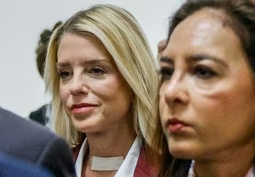
Bondi defends handling of Epstein investigation
Video has Closed Captions
Bondi defends handling of Epstein investigation but admits 'redaction errors' (5m 39s)
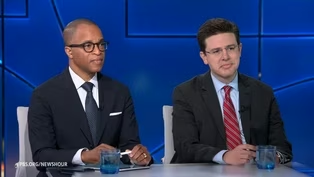
Capehart and Continetti on the Texas Senate battle
Video has Closed Captions
Capehart and Continetti on Talarico’s chances against Paxton in Texas (10m 1s)

Kenyan court halts U.S. plan to open Ebola quarantine center
Video has Closed Captions
Kenyan court blocks U.S. plan to open Ebola quarantine center to treat Americans (5m 51s)

Mahjong thriving as players embrace community and connection
Video has Closed Captions
Mahjong thriving as players embrace community and connection (5m 50s)
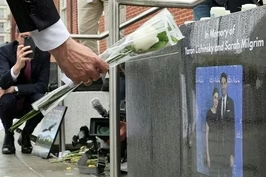
Son's murder inspires father to confront rising antisemitism
Video has Closed Captions
Killing of Israeli embassy workers inspires father to confront rising antisemitism (7m 25s)

‘The Hero Next Door’ highlights service members' sacrifices
Video has Closed Captions
‘The Hero Next Door’ highlights overlooked sacrifices of service members (6m 43s)
Providing Support for PBS.org
Learn Moreabout PBS online sponsorship New Episode
- News and Public Affairs

Today's top journalists discuss Washington's current political events and public affairs.
 New Episode
- News and Public Affairs

FRONTLINE is investigative journalism that questions, explains and changes our world.
 New Episode
 New Episode
 New Episode
 New Episode
 New Episode
 New Episode
 New Episode
 New Episode
 New Episode
Support for PBS provided by:
Major corporate funding for the PBS News Hour is provided by BDO, BNSF, Consumer Cellular, American Cruise Lines, and Raymond James. Funding for the PBS NewsHour Weekend is provided by...