
October 8, 2026 - PBS News Hour full episode
10/8/2026 | 57m 46sVideo has Closed Captions
October 8, 2026 - PBS News Hour full episode
October 8, 2026 - PBS News Hour full episode
Problems playing video? | Closed Captioning Feedback
Problems playing video? | Closed Captioning Feedback
Major corporate funding for the PBS News Hour is provided by BDO, BNSF, Consumer Cellular, American Cruise Lines, and Raymond James. Funding for the PBS NewsHour Weekend is provided by...
October 8, 2026 - PBS News Hour full episode
10/8/2026 | 57m 46sVideo has Closed Captions
October 8, 2026 - PBS News Hour full episode
Problems playing video? | Closed Captioning Feedback
Where to Watch PBS News Hour
PBS News Hour is available to stream on pbs.org and the PBS app.
Providing Support for PBS.org
Learn Moreabout PBS online sponsorshipAMNA NAWAZ: Good evening.
I'm Amna Nawaz.
Geoff Bennett is away.
On the "NewsHour" tonight: Hurricane Isaias rapidly intensifies as it approaches the Gulf Coast, prompting evacuations across multiple states.
Death row prisoner Christa Pike is now able to walk after a botched execution.
How the case has renewed the debate over capital punishment.
And our series on GLP-1s examines how the weight loss drugs are influencing cultural views on obesity.
CHARLOTTE MARKEY, Clinical Health Psychologist: What we don't have is any data that actually shows that taking these weight loss medications will improve body image.
(BREAK) AMNA NAWAZ: Welcome to the "News Hour."
Millions of Americans along the Gulf Coast are on high alert due to life-threatening conditions as Hurricane Isaias gains power and moves closer to land.
Isaias rapidly intensified overnight from a tropical storm to what is now a Category 2 hurricane, making it the first one in the Atlantic this year.
Residents are securing their homes and gathering supplies.
Local and state officials are issuing evacuation orders.
And forecasters are warning of heavy rain, damaging winds, flooding, storm surges, and the possibility of tornadoes.
Florida Governor Ron DeSantis said his state will be ready.
GOV.
RON DESANTIS (R-FL): And I will just say we have got everyone mobilized, the full monty for the storm.
We're taking it very seriously.
I hope it weakens.
I think there's conditions where it could.
But our assumption is that it's going to hit strong as a probably lower-end category 3.
AMNA NAWAZ: Joining us now is Michael Brennan.
He's director of the National Hurricane Center.
So, Michael, knowing the path could still change here, let's just start with the latest you know on the potential path of this hurricane and when it could make landfall.
MICHAEL BRENNAN, Director, National Hurricane Center: Well, the storm has strengthened over the last several hours, now a Category 2 hurricane on the Saffir-Simpson scale.
It's going to continue to move off to the northeast over the next several hours overnight and then turn more towards the north.
Right now, we're thinking that the center is going to make landfall somewhere in the Alabama or Florida Panhandle coastline, but where the exact center crosses land is not as important as the impacts.
You're going to see impacts all along the Northern Gulf Coast from this system.
AMNA NAWAZ: You mentioned how rapidly it intensified.
It's already a Category 2.
Is there any way to tell just how powerful this storm could be when it makes landfall?
Could it possibly reach Category 3 or more?
MICHAEL BRENNAN: Over water, yes.
There's a small window of opportunity for it to continue to intensify tonight, potentially taking it close to Category 3 strength overnight.
But we think weakening will commence later tonight or tomorrow as it approaches the coastline.
So we're really looking at maybe a Category 1 or 2 as it makes its approach, final approach, to landfall.
But, regardless, a lot of people get really hung up on the intensity and the categories.
I think the hazards are largely baked at this point, meaning that, no matter what intensity the storm comes ashore as, the hazards are largely going to be unchanged, We're going to see a lot of storm surge, rainfall, flooding, and potential for strong, impactful winds moving inland over some of these Southern Tier states with long-duration power outages.
AMNA NAWAZ: We know those residents are being urged to prepare.
What kind of preparations should they be making?
How far inland should they be preparing, and when and how do people make that decision to evacuate?
MICHAEL BRENNAN: So, first and foremost, I'm glad you mentioned the evacuations.
There are a number of mandatory or recommended evacuations along the Northern Gulf Coast here, especially coastal Alabama, portions of Mississippi and even Florida Panhandle.
If you've been ordered to evacuate, you need to go ahead and do that right away.
Don't assume that you'll have the entirety of tomorrow to make necessary preparations or evacuate.
You can see in the satellite imagery here the conditions are already spreading well out in front of this storm, so we're not going to have all day tomorrow to prepare or evacuate if ordered to do so.
AMNA NAWAZ: That is Michael Brennan, director of the National Hurricane Center, joining us tonight.
Michael, thank you for your time.
MICHAEL BRENNAN: Thank you.
AMNA NAWAZ: We start the day's other headlines in Washington, D.C.
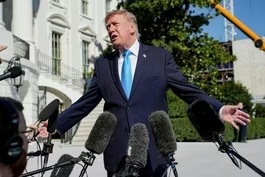
A federal judge briefly extended White House access for three news outlets until a final ruling on President Trump's press ban is reached.
Attorneys for CNN, MS NOW, and Politico returned to court today as the judge's initial restraining order against the ban was set to expire.
The president barred the three organizations last month, complaining that their coverage was unfavorable to his administration.
Outside the courthouse, a lawyer for the outlets said he expects a ruling by next week.
THEODORE J. BOUTROUS JR., Attorney For Media Outlets: We believe that President Trump's ban on the free press violates the First Amendment and the due process clause, and it's an effort to deprive the American public of information about their government.
AMNA NAWAZ: We should note PBS News is one of over 70 news organizations that signed an amicus brief in support of the preliminary injunction.
Separately, the Trump administration is suspending Microsoft from a green card program, accusing the tech giant of abusing the system.
The program allows employers to sponsor H-1B visas for highly skilled foreign workers.
This morning, Vice President J.D.
Vance announced the suspension, which also includes Adobe and several large I.T.
outsourcing firms.
J.D.
VANCE, Vice President of the United States: Our message to Microsoft is, you're a great American company, but you have got to hire great American workers.
AMNA NAWAZ: In a statement, Microsoft clarified that the vast majority of applications are for existing employees, not to hire new people, adding -- quote -- "Microsoft only files H-1B petitions for those who meet the rigorous standards of this visa category."
Also today: MAN: The National Medal of Technology and Innovation to Satya Nadella of the Microsoft Corporation.
AMNA NAWAZ: Microsoft's CEO was awarded one of the nation's highest science and technology awards by President Trump.
Satya Nadella was one of several immigrant tech leaders to be honored alongside Elon Musk and Google's Sergey Brin.
At the same ceremony, Trump himself was presented with the framed National Medal of Science that was awarded to his late uncle back in the 1980s.
John G. Trump was an electrical engineer and longtime MIT professor.
The USS Abraham Lincoln is finally home after a record-setting deployment in support of the Iran war.
Sailors lined the aircraft carrier's deck as it docked in San Diego earlier today.
Family members and loved ones cheered its arrival from shore.
The Lincoln's return marks the end of a turbulent deployment, which included more than 260 uninterrupted days at sea, a modern record.
During that time, reports emerged of stress among the crew and poor living conditions.
In Ukraine, authorities say a Russian-guided bomb killed at least 33 people on public buses in the eastern city of Kramatorsk.
Footage from the scene shows a burned-out vehicle and bodies in the street from one of the deadliest single attacks this year.
Also today: ED MILIBAND, British Foreign Secretary: We are announcing more sanctions on Russia, on the war machine of Putin.
AMNA NAWAZ: British Foreign Secretary Ed Miliband joined Ukraine's President Volodymyr Zelenskyy at the site of a separate strike, saying the U.K.
would step up its pressure on Russia.
And, in Portugal today, U.S.
Secretary of State Marco Rubio said that the war had reached a dangerous phase.
MARCO RUBIO, U.S.
Secretary of State: Stalemates only end one of two ways.
Number one, you have a negotiated settlement, one in which each side have to give up something in order to get peace.
The other way that stalemates end is through escalation.
One side or the other or both escalate what they are doing in order to try to break the other side and break the stalemate.
AMNA NAWAZ: In the meantime, President Zelenskyy says his mediators plan to visit the U.S.
in the coming days for further talks.
He is urging the Trump administration to put more pressure on Russia to end the war.
Democrats in Congress say they want U.S.
Ambassador to Greece Kimberly Guilfoyle to address a report that she asked a Trump donor to pay off her $100,000 credit card bill.
According to messages reviewed by The Wall Street Journal, Guilfoyle offered conservative media personality Eric Deters access to top administration officials in exchange for the funds.
This is said to have happened days before her Senate confirmation hearing last year.
In a statement provided to the "News Hour," Congressman Robert Garcia said it -- quote -- "would be a brazen abuse of power and a stunning addition to Guilfoyle's existing record of scandal and corruption."
Guilfoyle's lawyers deny The Journal's reporting.
Canadian poet and essayist Anne Carson is this year's winner of the Nobel Prize in Literature.
The committee cited her bold and inventive works for creating what it called new forms of contemporary literature.
One of her best-known works is "Autobiography of Red," which turns a piece of Greek poetry into a tale of a teen love affair.
The Nobel Prize team posted this photo of her learning about the win, which she later described as insane.
When asked how she would celebrate, Carson said she's going out for a walk in the woods to avoid the phone, and as she put it, hear the quiet.
On Wall Street today, stocks ended mixed after the latest rise in oil prices.
The Dow Jones industrial average managed a slight gain of about 50 points.
The Nasdaq dropped 1.25 percent.
The S&P 500 also closed lower.
And four astronauts returned to Earth today after nearly eight months aboard the International Space Station.
WOMAN: Splashdown.
On behalf of SpaceX, welcome home, Crew-12.
WOMAN: We are we are so excited to be back on planet Earth after an incredible mission on the International Space Station.
AMNA NAWAZ: The team of American, French, and Russian astronauts touched down off the coast of California this morning.
They had been dispatched to the station in February after an astronaut on the previous mission was evacuated for medical reasons.
Capsule repairs then briefly delayed their return.
Seven astronauts remain on board the station.
And from NASA present to past.
Margaret Hamilton, a computer scientist who helped NASA land on the moon, has died.
As a young mathematician at MIT, Hamilton was the first female programmer to work on the Apollo project in the 1960s.
She went on to lead the 100-person team that wrote software for the moon mission.
In recent years, a 1969 photograph of the 5'4'' Hamilton standing next to the printed code for the lunar landing went viral on social media.
In 2016, President Barack Obama awarded Hamilton the Medal of Freedom, saying her work -- quote - - "set the foundation for modern software engineering."
Her death was announced yesterday by MIT.
Margaret Hamilton was 90 years old.
Still to come on the "News Hour": we examine the many issues Israeli voters are considering ahead of a contentious election; how Democrats are betting on pastors and ministers on the campaign trail; and a new documentary chronicles Elon Musk's rise to power and his embrace of right-wing politics.
Christa Pike, the Tennessee woman who survived a botched execution, has reportedly taken a few steps in her hospital room six days after she received two lethal injections.
Pike was convicted of the 1995 murder of Colleen Slemmer, and it's now unclear how that case will proceed.
Justice correspondent Ali Rogin has more on the questions surrounding the state of capital punishment.
ALI ROGIN: In response to the failed execution attempt, the governor has paused all pending executions through the end of the year, and a judge has ordered Tennessee to preserve evidence of what went wrong.
To discuss, we're now joined by Austin Sarat, author of the book "Lethal Injection and the False Promise of Humane Execution."
Austin Sarat, thank you so much for joining us.
You have been covering executions and failed executions for a long time.
How unique, if at all, is what happened to Christa Pike and how often do executions either fail or get botched like this?
AUSTIN SARAT, Author, "Lethal Injection and the False Promise of Humane Execution": What happened to Christa Pike was shocking but not surprising.
To anyone that's followed the American death penalty, we know that executions are frequently botched, and the method of execution which is least reliable, most frequently botched, lethal injection.
But I don't think anyone was prepared for an execution in which the lethal drugs actually reach the condemned person, and that person lives to tell about it.
So it's really an unprecedented event in the recent history of capital punishment.
ALI ROGIN: It certainly also seems unprecedented in terms of what policymakers do now.
What options are the leaders in Tennessee who would make these decisions thinking through right now in terms of, do they try again?
How does Christa Pike's legal status change?
AUSTIN SARAT: Well, the first thing that they are doing, as Governor Lee has announced, is, they're going to do an investigation to try to find out what actually went wrong in the execution chamber.
Next, the governor will have to make a decision about whether or not that this governor wants to commute Christa Pike's sentence.
If the governor doesn't do that, and the state decides to go forward with a second execution attempt, we will be entering somewhat uncharted territory.
A second execution is very rare in the United States.
It happened in 1947 in the state of Louisiana.
It's happened a couple of times in Alabama more recently.
And the arguments will be made, and I think they're persuasive arguments, that to subject Christa Pike to a second execution attempt would be a cruel punishment, in violation of the Eighth Amendment, and would be a form of double jeopardy prohibited by the Constitution of the United States.
ALI ROGIN: In your research, you have found that lethal injection fails more often than any other method in American history, including hanging and the electric chair.
Why is that?
AUSTIN SARAT: Well, no method of execution is foolproof.
Every method of execution that we have used in the United States, whether it's hanging, the electric chair, the gas chamber, now lethal injection, has run into problems.
Lethal injection runs into more problems because, paradoxically, it's a very complicated way to try to put someone to death.
You have to find a usable vein.
You have to secure an I.V.
You have to make sure that the drugs that you are using are up to date and potent.
So it's not surprising that a complicated procedure like lethal injection would run into problems of the kind that it has.
And, of course, the problems of lethal injection have not been helped by the desire of states, including the state of Tennessee, to keep what happens in the execution chamber as secret as possible, so that the problems of lethal injection, when they occur, often don't make the headlines that Christa Pike's execution attempt made.
ALI ROGIN: And certainly this execution attempt has made a lot of headlines, but you have opined that it's not likely to change the dial in terms of public perception around the death penalty.
Where is public sentiment today and why don't you think something like this might shift it?
AUSTIN SARAT: I think the United States is in a period of national reconsideration of capital punishment.
Support for the death penalty is down from what it was three decades ago, and even people who support capital punishment tend not to support it as intensely as they once did.
The number of death sentences in this country is way down from what it was three decades ago.
And if we look at the states that have the death penalty, many of them that have it on the books don't use it in practice.
They don't execute anyone.
ALI ROGIN: Austin Sarat, expert on the death penalty and capital punishment, thank you so much for joining us.
AUSTIN SARAT: My pleasure.
Thanks for having me.
AMNA NAWAZ: Israel yesterday observed the solemn and terrible anniversary of the October 7 attacks.
The nation is now barreling toward elections in less than three weeks, which could extend Benjamin Netanyahu's already record tenure as Israel's leader.
The Trump administration has worked in near lockstep with Netanyahu since the president's return to office.
But an exclusive in today's New York Times reports that a top official in the U.S.
Embassy is often rewriting cables that alter the picture on the ground in Israel, Gaza, and the West Bank.
To explore that and the wider picture in Israel, I'm joined now by Ambassador Dan Shapiro, who served as an American envoy to Israel during the Obama administration.
Ambassador, welcome back to the "News Hour."
Thanks for joining us.
DANIEL SHAPIRO, Former U.S.
Ambassador to Israel: Thanks for having me on.
AMNA NAWAZ: So I want to start with that New York Times exclusive in which they said they talked to 15 U.S.
officials, reviewed dozens of cables and documents and internal communications.
And the characterization there is that this top aide was altering information making its way back to Washington in a positive light, in other words, not reflecting accurately some of the things that were making their way up in memos and getting that to D.C.
What's your reaction to that reporting?
DANIEL SHAPIRO: Well, I don't know the details of this particular case.
What I can tell you is that my experience as an ambassador and with an embassy staff is that what Washington policymakers need is clear and unvarnished reporting about what's happening in the country you're serving in.
That means that, in a case like Israel, Israel is a security partner and there are aspects of the things that happen in Israel that certainly serve U.S.
interests.
Certainly, with the case of the current government, which includes very extreme members of the Israeli political system, advocates for mass settlement expansion in the West Bank, people who are looking away from a wave of violence by extremist Jewish settlers against Palestinian civilians, that should also be part of the reporting.
So, that's, I think, what an embassy's obligation is, an ambassador's obligation is and those who work for the ambassador.
AMNA NAWAZ: One of the pieces of information The New York Times cites specifically is a memo that staff members in the embassy drafted about Israel expanding some of its West Bank settlements very quietly.
They say, according to sources, that memo never made it to Washington.
And I should share with you what the ambassador to Israel, Mike Huckabee, said in response to their reporting.
He called it a hit piece.
He said: "I personally and categorically refute the elements of this proposed story," as he put it.
I have to put to you, since you have served in the role.
Some will say, isn't it the ambassador's job to gatekeep that information, to edit cables before they go back to D.C.?
Do you have any concerns about this reporting?
DANIEL SHAPIRO: A good embassy and ambassador gives clear and unvarnished reporting, but there's always judgment calls.
And, in the end, the embassy's reporting should reflect what the ambassador believes and the views that he wants to share with the Washington policymakers.
AMNA NAWAZ: As we noted, we're now speaking the day after Israel marked three years since those Hamas terrorist attacks, and we know the shadow of those attacks has loomed large over these upcoming elections.
You're there on the ground.
We know Netanyahu's faced a lot of questions about what he knew before the attacks.
How big a role are those attacks playing in this election?
DANIEL SHAPIRO: Yes, I have been here just about 24 hours, and it's very clear that this is the central issue in the closing phase of this election.
Who bears responsibility for the October 7 attacks?
The opposition candidates led by Gadi Eisenkot as part of a coalition of parties are saying that Netanyahu was asleep at the wheel, had policies that underestimated what Hamas' intentions and capabilities were in Gaza, didn't respond in real time, nor were they prepared before the case for that -- attacks.
And they are making that case to try to cement the case against Netanyahu continuing in office.
Netanyahu, for his part, and his allies are saying, no, it was the fault of security and intelligence chiefs, generals in the military.
They were the ones who were asleep at the switch.
They did not share information with him.
They didn't wake him on the morning of the attack in time to make key decisions.
And he is trying to rally his traditional supporters to say he's still the person that can be trusted to deal with the various security threats that Israel still faces.
It looks like it's a very close election, and it may be that neither side will really be able to form a coalition government coming out of it, in which case it's entirely possible that Netanyahu will remain in office as a caretaker while another election is run a few months from now.
AMNA NAWAZ: We have seen Netanyahu say that he has no greater partner than U.S.
President Trump, but we did see President Trump sort of sidestep a question recently about endorsing Netanyahu.
What have you noticed about relations between the two?
Have they taken a hit recently?
DANIEL SHAPIRO: They certainly have cooled.
There was certainly a period earlier this year when it was fully expected, and I know Netanyahu was expecting it, that President Trump would give him a fulsome endorsement.
I think it's possible that Trump has concluded, or certainly some of his advisers have concluded that some of what he wants to achieve in the Middle East in the last two years of his presidency, trying to advance his 20-point plan to rebuild Gaza, trying to get Saudi Arabia to take a step toward normalization of relations with Israel, trying to expand the Abraham Accords, would actually be easier with a prime minister other than Benjamin Netanyahu and the very extreme right-wing coalition that he leads.
AMNA NAWAZ: That is the former U.S.
Ambassador to Israel Dan Shapiro joining us tonight.
Ambassador, thank you so much for your time.
Good to speak with you.
DANIEL SHAPIRO: Thanks very much.
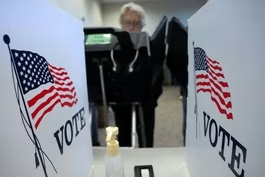
AMNA NAWAZ: Well, with just a few weeks to go until Election Day, Democrats are hoping to flip some seats in deep red states.
And some are doing that by talking about religion.
Our Lisa Desjardins has more.
LISA DESJARDINS: Fusing faith in politics is almost a no-brainer for many Republicans hoping to hold public office.
But this election cycle, 12 pastors, seminarians, and former clergy ran as Democrats, with about half managing to secure their nominations.
Coming from the pulpit to the political stage, these candidates have used their experience as religious leaders to talk about their call to run.
JAMES TALARICO (D), Texas Senatorial Candidate: I want to speak to you this morning, not as a candidate, but as a fellow Christian.
FREDERICK HAYNES III (D), Texas Congressional candidate: But this Republican Party has demolished and torn down.
It's time for us to reconstruct this nation and make it truly one nation under God, indivisible, with liberty and justice for all.
ADAM HAMILTON (D), Kansas Senatorial Candidate: Jesus himself, there were times he turned over the money changers' tables in the temple, and he still taught us to love our neighbor and even love our enemy.
LISA DESJARDINS: For more, we are joined by NPR's religion correspondent, Jason DeRose, who recently spent time on the campaign trail with several of these candidates.
Thank you for joining us, Jason.
JASON DEROSE, NPR Religion Correspondent: Happy to be here.
LISA DESJARDINS: This is a small, but noteworthy group.
On the ballot in November, there will be five Democrats in congressional races who are clergy or in training to be clergy.
Of those candidates, four of them are in competitive races that could determine the fate of the House or the Senate.
Now, we have seen Republican clergy run before.
We have seen that this year also, but what's new here is this Democratic cohort.
Why do you think this is emerging now?
JASON DEROSE: Well, for many years, as you said, Republicans really had the market cornered on this.
And I think that Democrats finally figured out a way to have clergy, the people best trained and most trained and most used to talking about their faith and how it -- how they use it in public life.
And these people emerged through state legislatures.
Three of these candidates serve in state legislatures right now.
So they realized, this is our moment, I think.
I don't think there was a big campaign to get them to run, say, from the Democratic Party.
It was much more -- these were people serving their neighbors in state legislatures who said it's now time for a larger stage.
LISA DESJARDINS: There is news regarding one of these candidates.
That's Adam Hamilton in Kansas.
The Cook Political Report rated that Senate race in Kansas a toss-up, which is rather incredible for a state that has not voted for a Democrat for Senate in decades.
What can you tell us about that race?
What does it tell you about what's happening?
JASON DEROSE: Well, what's interesting to me there is that, when I first started this reporting, it was a pretty solidly Republican race, and this has moved very quickly from solidly red to leans red and now to toss-up, a very big deal.
Hamilton is the pastor of a very large, one might call it a megachurch, a Methodist megachurch.
He's written many, many books.
But he was actually a Republican for many years who, in fact, thought of running as an independent, but decided to run as a Democrat.
And it seems to be working out for him, becoming a toss-up.
LISA DESJARDINS: How do these candidates thread this needle -- we have separation of church and state here -- between talking into a secular crowd and then also speaking of their faith to a religious one?
JASON DEROSE: Well, it's a really difficult needle to thread for clergy because they're so used to talking about their faith.
But, again, these people, some of them have spent time in legislatures talking about their -- how their faith influences their politics, but not how it dictates their politics.
And I think that, for James Talarico in particular, he came to prominence talking out against Christian nationalism while being a seminarian, while being a politician.
So he's figured out how to do it as well.
I think part of what he says and part of what Sarah Trone Garriott in Iowa and Lindsay James in Iowa also do is, they say that their faith influences their politics, it doesn't dictate their politics, and they don't dictate other people's faith.
LISA DESJARDINS: Republicans are countering some of these candidates by questioning if they are true Christians.
I want to play some sound from one of those opposing Republicans.
This is Joe Mitchell in Iowa.
JOE MITCHELL (R), Iowa Congressional Candidate: I call them PINOs, pastor in name only.
That's what I call them, pastors in name only, because they're not real pastors, right?
They don't profess the truth, Gospel of Jesus Christ.
LISA DESJARDINS: In our last-minute or so, these are ordained or to-be-ordained members of clergy.
That is a fact.
But are these attacks working?
And what does this say about kind of the battle to define Christianity?
JASON DEROSE: Well, I don't know that they're working because throughout -- all of these candidates are being attacked that way for not being true Christians, and they have all gained ground.
They have all been moved from either solidly Republican to toss-up or in that direction.
I think it might actually be backfiring a bit.
People say, these aren't people who we might question their religiosity.
They have served for 20, 30 -- one of them even served for 40 years in a congregation with 13,000 people.
How can you question whether that person is a real pastor?
LISA DESJARDINS: Jason DeRose of NPR, thank you so much for sharing your reporting.
JASON DEROSE: Happy to be here.
AMNA NAWAZ: Roughly 12 percent of Americans are now taking the blockbuster set of weight loss medications known as GLP-1s.
And while their popularity continues to skyrocket, new concerns have emerged around the societal impacts, especially around body image.
Correspondent Stephanie Sy and producers Mike Fritz and Sam Lane have that story for the last installment of our series GLP-1s: Reshaping America.
GABRIELLA CORO, Former GLP-1 Patient: You're not going to tell me?
Why?
STEPHANIE SY: When Gabby (ph) Coro became a mom in 2021, the joy of having her son, Charlie, was soon overshadowed by what came next.
GABRIELLA CORO: It was very hard to shed the pounds.
I had gone through pretty severe postpartum depression that lasted roughly three years, and nothing was really working.
So some of the side effects include weight gain or, like, really hard to lose weight.
STEPHANIE SY: The 35-year-old college professor lives in Miami with her husband, Raul.
She says, despite repeated efforts, she struggled to lose about 30 pounds from her pregnancy.
GABRIELLA CORO: I just didn't like how I would look in pictures, I didn't want any pictures taken of me during this time.
My husband can attest he had a family member ask him if we were separated or divorced.
He's like, I don't see Gabby in any of our -- the pictures with you and your son.
And that's how I was just like, don't take a picture of me.
I don't want to be seen.
STEPHANIE SY: But, late last year, she was prescribed a GLP-1.
GABRIELLA CORO: And I took my first injection after Christmas and my birthday, so I could have birthday cake and enjoy myself.
SERENA WILLIAMS, Professional Tennis Player: Thirty-four pounds down on GLP-1s.
STEPHANIE SY: With ads fronted by celebrities flooding airwaves and social media feeds.
KENAN THOMPSON, Actor: Maybe we don't need a pill for everything, but for managing weight, there's Wegovy.
STEPHANIE SY: The health benefits beyond weight loss from GLP-1s have also fueled their growing popularity.
Besides treating diabetes, which they were originally developed for, the drugs are proving to lower the risk of heart attacks and stroke and improve a range of cognitive and behavioral health outcomes, reducing seizures, sleep apnea, and arthritis.
But for Gabby Coro, who after just three months on a GLP-1 lost nearly all her post-pregnancy weight, the decision to take them felt fraught.
GABRIELLA CORO: I felt like I was almost a traitor to everything I stood for in regards to body positivity.
The only beach body is a body on the beach, those slogans that we say, and I do believe, and here I am taking the meds.
And I was just -- I felt really shameful about it.
STEPHANIE SY: Since 2019, the number of overweight adults in the U.S.
prescribed a GLP-1 has skyrocketed by nearly 600 percent.
CHARLOTTE MARKEY, Clinical Health Psychologist: These drugs are marketed as a way to change your body and feel better about yourself.
And I think they're being oversold somewhat.
STEPHANIE SY: Charlotte Markey is a clinical health psychologist at Rutgers University and the author of several books on body image.
CHARLOTTE MARKEY: Body image is linked with depression, anxiety, substance use disorders.
When people don't feel comfortable in their own skin, then the consequences are really vast.
And it's no wonder why advertisements that suggest you can take a medication to fix your body image are compelling.
But what we don't have is any data that actually shows that taking these weight loss medications will improve body image.
STEPHANIE SY: She also worries GLP-1s may fix one issue, while creating others.
CHARLOTTE MARKEY: And I do see in my practice that there are people who have been prescribed these drugs, and they're not eating enough, and they are essentially developing eating disorders as a result of the medication.
WOMAN: Real.
WOMAN: Beautiful.
STEPHANIE SY: She says it wasn't that long ago that bodies of all sizes were gaining new acceptance.
CHARLOTTE MARKEY: We really saw people embracing body diversity, body acceptance, and enjoying seeing themselves in the images around them.
And then weight loss medications came on the scene, and there was less diversity.
STEPHANIE SY: There's also research that larger-body people who use GLP-1s to lose weight are facing new stigmas.
A study published earlier this year found they're viewed negatively for taking a shortcut.
Meanwhile, another study found that women's chances of being hired and finding a spouse increase after more than a year-and-a-half on the medication.
RUTH MCCLELLAND-NUGENT, Former GLP-1 Patient: So I went from a 3X, 3XL T-shirt, to a medium.
I'm wearing a medium today.
And it's weird to get these compliments about how great you're looking, and you know that you're very sick inside.
STEPHANIE SY: Fifty-year-old Ruth McClelland-Nugent started taking a GLP-1 last year to address diabetes.
And, for that, the medication has worked.
She also lost roughly 100 pounds.
But the Georgia resident says it's also led to a cascade of health problems.
RUTH MCCLELLAND-NUGENT: Certainly, having a lower blood pressure, a lower weight, and a lower A1C, those are very good.
But I'm not able to be very active.
I'm not able to control my emotions.
I have this hunger thing going on.
I'm weak.
I'm having trouble.
I get up and down the stairs.
I'm having trouble getting back used to walking.
STEPHANIE SY: Even though McClelland-Nugent was only on a GLP-1 for seven weeks and got off them in November, the side effects, she says, have persisted.
RUTH MCCLELLAND-NUGENT: That's the laxative.
STEPHANIE SY: And now she has to take a bag full of medications to address a variety of symptoms that she traces back to her time on GLP-1s.
RUTH MCCLELLAND-NUGENT: These are two different versions of what makes me able to eat.
STEPHANIE SY: She initially was diagnosed with gastroparesis, a rare side effect that impacts digestion and can lead to poor appetite and nutrition.
RUTH MCCLELLAND-NUGENT: When you lose muscle there, it really messes with your balance.
So... STEPHANIE SY: She also says she suffered rapid muscle loss and occasionally needs to use a cane.
RUTH MCCLELLAND-NUGENT: My goal was to reduce my blood sugar, not necessarily to lose weight.
So this has all been really weird and it wasn't expected.
DR.
TRO KALAYJIAN, Chief Medical Officer, Toward Health: I remember being 350 pounds going on an airplane and, when I asked for a seat belt extender, the flight attendant turned around and said: "We need a hog strap."
STEPHANIE SY: Dr.
Tro Kalayjian, who calls himself a contrarian to the medical establishment, can empathize with the patients he sees at his obesity medicine practice outside New York City.
DR.
TRO KALAYJIAN: I couldn't fit on rides at carnivals with my kids.
I couldn't experience life.
I couldn't go clothes shopping.
I never felt comfortable in my skin.
STEPHANIE SY: Ten years ago, Dr.
Kalayjian began a strict ketogenic diet and exercise routine.
He lost 150 pounds, weight he's been able to keep off, he says, without the use of GLP-1s.
DR.
TRO KALAYJIAN: I think these drugs are amazing.
They're an amazing tool for people with diabetes and obesity, but without a holistic approach, we are literally setting up people to fail.
Our diets have not meaningfully changed to accommodate these medications.
We didn't all of a sudden start eating nutrient-replete diets.
We didn't all start exercising, meaning we're not mitigating the side effects that we know these cause.
STEPHANIE SY: And while he does prescribe them to some of his patients, he also touts a GLP-1 off-ramp on his Web site for people suffering physical or mental side effects.
DR.
TRO KALAYJIAN: I think the biggest harm that docs can do right now is take somebody who struggled with obesity their entire life, doesn't know how to eat food to actually nourish themselves, is nutrient-depleted, has never had their psychological or emotional issues evaluated, and just give them a GLP-1 and have them eat less.
I think it's a recipe for disaster.
STEPHANIE SY: For Gabby Coro back in Miami, it's been a recipe for success.
She's comfortable seeing herself in photos again, even though she still feels conflicted.
GABRIELLA CORO: It works.
So I would say I'm so happy I did it.
I really am.
STEPHANIE SY: Would you be willing to go back on it if you needed to?
GABRIELLA CORO: I would probably feel really guilty if I did.
STEPHANIE SY: Why would you feel guilty?
GABRIELLA CORO: I would feel like I was a failure, that it's like, wow, you didn't have enough self-discipline, self-control.
You lost that weight.
I have always kind of had an issue with my appearance, and I don't think I'm alone in that.
I think most people would see something they would like to change.
STEPHANIE SY: For the "PBS News Hour," I'm Stephanie Sy.
AMNA NAWAZ: And you can watch our full GLP-1 series online covering everything from access to cost and addiction.
You can find that on our YouTube page or our Web site, PBS.org/NewsHour.
Elon Musk remains one of the more powerful and controversial figures in business, science, tech, and politics.
President Trump paid tribute to Musk earlier today, awarding him one of the nation's highest science awards.
Musk played a central role in the early days of the second Trump administration.
And a new documentary about him opens in New York and Los Angeles this weekend, then nationwide next week.
William Brangham has our look.
WILLIAM BRANGHAM: Elon Musk is one of the most consequential and controversial figures in the world today.
Several of his companies, Tesla, Starlink, SpaceX, have revolutionized their industries and made Musk the richest man on Earth.
His political influence is also vast.
He owns the social media site X, gave nearly $300 million, the biggest donor by far, to President Trump's reelection.
And as the short-lived head of DOGE, Musk oversaw the gutting of major parts of the U.S.
government, including the dismantling of USAID.
The new documentary "Musk," directed by Alex Gibney, tries to take stock of this gigantic, troubled figure, chronicling everything from his innovations to embrace of far right politics.
Academy Award-winning director and producer Alex Gibney joins us now.
Alex, thank you so much for being here.
ALEX GIBNEY, Director, "Musk": Great to be here.
WILLIAM BRANGHAM: You say at the beginning of this film that you wanted to answer this essential question, which is, how did Musk amass all this power and how did we collectively give it to him?
And before we get to that answer, I wonder if you would just remind us a little bit of the scope of his reach and his influence.
ALEX GIBNEY: Well, I mean, he has this massive international car company, Tesla, which is now making robots.
He owns SpaceX, which means he basically has cornered the market on rockets going into orbit and beyond.
Out of that grew Starlink, a kind of alternative satellite Internet service that is -- now means he has these tentacles spreading all over the world in a kind of cyber way.
And then he has X, a kind of propaganda platform which he can loan to powerful despots when he wants favors from them.
So it's a pretty integrated empire, which also he shuttles assets and resources back and forth.
WILLIAM BRANGHAM: Right.
ALEX GIBNEY: So he has enormous financial power, mostly based on the price of stock, which he wields in political ways.
And he bought the president of the United States, and I think he did so because he knew he would be a transactional figure.
And now he has this kind of symbiotic relationship with him that gives him enormous political power, as well as access to all sorts of money that is taxpayer dollars.
So that's a lot of power.
WILLIAM BRANGHAM: A lot of power.
This exact point is made by Ashley St.
Clair, who was a former girlfriend of Musk's and one of the many women who have had multiple children with him.
Let's play a little bit of what she said.
ASHLEY ST.
CLAIR, Former Girlfriend of Elon Musk: If you were to ask someone on the right what they think of Elon, he's a free speech God.
And someone on the left, he's just someone who sends hateful tweets and he's lost his mind.
Both are very comforting, but both are completely insufficient to the immense amount of power and influence he has.
WILLIAM BRANGHAM: I mean, you give Musk in the film a fair amount of credit for his business acumen, but you also stressed his canny ability to scoop up government contracts.
How much -- when you look at the scope of his career, how much of it is reliant on federal government contracts?
ALEX GIBNEY: Billions of dollars.
I mean, I'm not going to remember the exact figure right now, but it's inconceivable that Tesla would have succeeded without federal subsidies, mostly carbon credits.
And also SpaceX on its face is basically a socialist enterprise.
It just goes to the government for money to do launches.
Now, Starlink is more of a private portion of SpaceX.
So it's inconceivable to think that Musk would have obtained the power and influence and success that he had without the generosity of the federal government, our taxpayer dollars.
WILLIAM BRANGHAM: People who have watched Musk's over his entire career are somewhat confused by his rightward turn.
A lot of people first got to know him as this innovative guy who was running an electric car company.
He seemed to be concerned about climate change.
And now we have this person who has embraced some of the darkest hard right policy prescriptions.
Do you have a sense as to how he made that journey?
ALEX GIBNEY: I think it was pragmatism.
I mean, I think the one thing that he can't abide is constraints on his power.
And the more power he got, the more offended he was by constraints.
I think really what it was about was he was in a lot of trouble with federal agencies, civil and also criminal.
And they were investigating him hard.
And I think he felt that, if he didn't get behind Donald Trump, he might be in prison.
And so it was very pragmatic, I think, on his side.
He didn't want constraints, but also didn't want to go to prison.
WILLIAM BRANGHAM: The embrace of Trump led him to then being appointed to the head of DOGE, this -- the Department of Governmental Efficiency.
And he cut all manner of programs, as I mentioned, including USAID.
When you look back at the legacy of DOGE and what it did, how do you measure its legacy?
ALEX GIBNEY: I think you measure it two ways.
One is, it wasn't at all about, waste fraud and abuse.
In fact, for all sorts of reasons, it probably -- if you project out about five or 10 years, it's added $500 billion to the deficit.
But I think it really had a different purpose.
And the purpose was to really destroy government as we know it, and particularly the regulatory aspects of government, particularly the regulatory aspects of government that were looking at his businesses.
They would fire people recklessly without having any idea.
But they were very sophisticated about how they accessed the data, the electronic data that is basically the information that the government has on all of us.
And my understanding is, and based on sources, that they had super admin status, which meant they had total access to this digital data.
Now, the question is, and it's the question we pose in the film, if you have access to all of the federal data on American citizens, where did you put it?
Is it at SpaceX?
And if it's at SpaceX, is it training in AI that might be for use in, say, the upcoming midterm elections?
Those are some of the questions we ask.
WILLIAM BRANGHAM: You have multiple people in this film testifying to this.
You even say as much in your own narration that you view Elon Musk and his rise to power and his influence as a threat to democracy.
Make that case.
ALEX GIBNEY: I think, if you destroy the checks and balances, if you help to destroy the checks and balances that basically steer private enterprise toward public good, you're eliminating the essential feature of a democracy.
He eliminated those checks and balances, and by effectively giving us Trump, who has now eviscerated in many ways the independence of the Department of Justice and the FBI, we're veering toward a society that's power and for power's sake, without any tether to the popular will.
WILLIAM BRANGHAM: The film is called "Musk."
Alex Gibney, thank you so much for being here.
ALEX GIBNEY: Thank you.
AMNA NAWAZ: And, for the record, during the height of DOGE's operations, President Trump denied that he ceded too much power to Musk tied to his political contributions.
The "News Hour" has also requested an interview with Elon Musk.
We have not yet received a response.
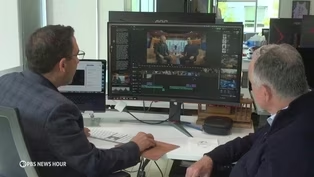
As artificial intelligence continues to reshape arts and entertainment, it's also creating a new type of producer and content provider.
Special correspondent Mike Cerre reports on a Silicon Valley start-up launched by a YouTube co-founder that could change video storytelling as dramatically as he changed video distribution.
It's part of our arts and culture series, Canvas.
AI ACTOR: The secret to a successful gathering is excellent food and at least one person upon the verge of emotional ruin.
MIKE CERRE: No real actors, no real locations or sets, and certainly no real horses, because no major production company would commit the millions it would cost to produce it.
GILLIAN, Writer and AI Producer, EyeTell: Well, I'm not stranger to coming up with film ideas and having like a really big backlog of ideas that I want to see on screen.
MIKE CERRE: Gillian, a screenwriter with film production experience, was able to produce this period drama episode on her own in a week with only basic computer skills and a shared WeWork office space of the Silicon Valley start-up EyeTell.
CHAD HURLEY, Founder and CEO, EyeTell: With EyeTell, well, this is something I have been thinking about since I have left YouTube, where I felt like there's a lot of creators, but there's even more people that want to create, but don't know how.
And I wanted to give them the structure to do that.
MIKE CERRE: Just as Chad Hurley, the co-founder of YouTube changed video distribution, he now believes AI can democratize video creation and viewing as well.
CHAD HURLEY: It's going to enable more people.
It's going to be a renaissance of content creation and storytelling at scale that never existed before.
MIKE CERRE: His EyeTell developer team mix of technologists, veteran animators, and storytellers has created software that integrates a variety of AI video production tools, making them more accessible for nonprofessionals to produce videos much as only major production companies can.
ANDREW GORDON, Chief Storyteller, EyeTell: In a studio, there are gatekeepers, and you pitch a project and they say yay or nay.
But now if you have this so-called power of full technology, you have got a whole studio and you're able to do your stories.
MIKE CERRE: EyeTell's chief storyteller, Andrew Gordon, worked with the major studios like Warner Bros.
and Pixar as a lead animator on Academy Award-winning productions.
He's not surprised by the blowback the new AI production tools are having within the creative community, much like previous filmmaking transitions to computer graphic special effects with "Jurassic Park" and from hand drawn 2-D animation to 3-D animation with Pixar's original "Toy Story."
ANDREW GORDON: People thought 3-D looks terrible.
They thought it wasn't artistic enough.
And then obviously Pixar and some of these other companies, they made stories that were really moving, and they pushed the technology.
And I think that that's really what is sort of happening now.
MIKE CERRE: What does this technology allow for the average person to do?
ANDREW GORDON: We took your voice and we threw it into EyeTell.
This area here is sort of like the prompt engine where you're talking to it, and then I give it to it, I give it direction, and I have it ask your question in your voice, right?
MIKE CERRE: And you worked with Pixar.
But had I not given you the voice and that question, is the system set up that it could create the question editorially?
ANDREW GORDON: Yes.
MIKE CERRE: I mean, can it replace me as the storyteller?
ANDREW GORDON: Well, it can, but it gives it a little bit of a -- quote, unquote -- "artificial feel,' and that's where you have to push it.
MIKE CERRE: What is the future of innovation?
This is pushing my interview to live motion based on a single photo I provided.
As for my and others' concerns over AI eliminating jobs and using voices, images, or intellectual property without permission, yet alone compensation, Chad Hurley believes AI also makes it easier to identify and compensate any original content sources used.
CHAD HURLEY: Again, not too dissimilar to what we did at YouTube, which we built a content I.D.
system which identified what content was coming into the system, and not just build a system that removes it or restricts it, but empowers the I.P.
holders and content creators to do something with that, to embrace their biggest fans, to monetize it.
MIKE CERRE: From turning family archives into a story, recreating historical events, making a dramatic movie on your own, or just goofing around, the AI software is intended to empower all kinds of storytellers to create and produce original content on their own.
CHAD HURLEY: So, without further ado, I'd like to present EyeTell TV.
MIKE CERRE: Last month, where else but on YouTube, Chad Hurley launched EyeTell TV, his latest video platform for not only viewing this new genre of AI-generated videos, but where viewers can also become part of the storytelling process by suggesting changes to the story, which can be generated nearly in real time.
So one of the wishes is a mailman delivers a pizza or a panda eats the food or a duck flies into the store.
CHAD HURLEY: I'm going to provide an opportunity where people can lean in and participate and affect the narrative, the story, and be part of that process.
MIKE CERRE: Now, are the guardrails a place that you could prevent someone from putting something violent or salacious or something very distasteful up there?
CHAD HURLEY: Yes, of course.
I mean, the first line of defense is the models themselves.
We're also building our own system guardrails in terms of when we receive a request from a user.
We're able to immediately kind of identify things and restrict things before they even hit the screen.
AI ACTOR: On that note, where are the Ashcombe (ph) ladies?
MIKE CERRE: Gillian's not sure who will ever see or pay her for her "Ashcombe House' episodes, inspired by her adoration of the 2005 "Pride and Prejudice" film produced by a major studio.
GILLIAN: I think there's room for this alongside traditional filmmaking.
It's a really cool way to let people develop original ideas, because our industry has kind of fallen into these patterns of a certain set of people who are the only voices who are heard.
MIKE CERRE: Even if now the voices and images are created or reversioned by AI.
For the "PBS News Hour," Mike Cerre in San Mateo, California.
AMNA NAWAZ: And that is the "News Hour" for tonight.
I'm Amna Nawaz.
On behalf of the entire "News Hour" team, thank you for joining us.
 New
NewAI video startup touts possibilities, but concerns remain
Video has Closed Captions
AI startup touts new possibilities for video creators, but concerns remain (6m 40s)
 New
NewBotched execution reignites debate surrounding death penalty
Video has Closed Captions
Botched execution reignites debate surrounding death penalty (5m 33s)
 New
NewDemocrats bet on pastors and ministers in midterms
Video has Closed Captions
Democrats are betting on pastors and ministers in the midterms (5m 24s)
 New
NewDocumentary traces Musk's rise and embrace of right-wing
Video has Closed Captions
New documentary traces Elon Musk's rise and embrace of right-wing politics (8m 22s)
 New
NewGulf Coast prepares for landfall as Isaias gains power
Video has Closed Captions
Gulf Coast prepares for landfall as Hurricane Isaias gains power (3m 48s)
 New
NewHow GLP-1s are reshaping cultural views on body image
Video has Closed Captions
How GLP-1s are reshaping cultural views on body image (9m 29s)
 New
NewNetanyahu's handling of Oct. 7 looms over Israeli election
Video has Closed Captions
Netanyahu's handling of Oct. 7 emerges as key issue in Israeli election (5m 44s)
 New
NewNews Wrap: Judge extends White House access for news outlets
Video has Closed Captions
News Wrap: Judge extends White House access for news outlets (7m 13s)
Providing Support for PBS.org
Learn Moreabout PBS online sponsorship
- News and Public Affairs

FRONTLINE is investigative journalism that questions, explains and changes our world.

- News and Public Affairs

Today's top journalists discuss Washington's current political events and public affairs.


 New Episode

 New Episode


 New Episode
 New Season
 New Episode
Support for PBS provided by:
Major corporate funding for the PBS News Hour is provided by BDO, BNSF, Consumer Cellular, American Cruise Lines, and Raymond James. Funding for the PBS NewsHour Weekend is provided by...