
September 16, 2026 - PBS News Hour full episode
9/16/2026 | 57m 46sVideo has Closed Captions
September 16, 2026 - PBS News Hour full episode
September 16, 2026 - PBS News Hour full episode
Problems playing video? | Closed Captioning Feedback
Problems playing video? | Closed Captioning Feedback
Major corporate funding for the PBS News Hour is provided by BDO, BNSF, Consumer Cellular, American Cruise Lines, and Raymond James. Funding for the PBS NewsHour Weekend is provided by...
September 16, 2026 - PBS News Hour full episode
9/16/2026 | 57m 46sVideo has Closed Captions
September 16, 2026 - PBS News Hour full episode
Problems playing video? | Closed Captioning Feedback
Where to Watch PBS News Hour
PBS News Hour is available to stream on pbs.org and the PBS app.
Providing Support for PBS.org
Learn Moreabout PBS online sponsorshipAMNA NAWAZ: Good evening.
I'm Amna Nawaz.
GEOFF BENNETT: And I'm Geoff Bennett.
On the "News Hour" tonight: The Federal Reserve raises interest rates for the first time in three years to combat surging energy costs.
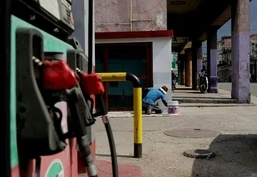
AMNA NAWAZ: We sit down with Cuba's deputy foreign minister to discuss rising tensions with the U.S., including President Trump's threats to invade.
CARLOS FERNANDEZ DE COSSIO, Cuban Deputy Minister of Foreign Affairs: A country like Cuba, looking at what's what's in the world and our own history, we would be naive if we don't take that seriously.
GEOFF BENNETT: And after decades of restoration, a medieval Greek palace reopens to the public.
(BREAK) AMNA NAWAZ: Welcome to the "News Hour."
The Federal Reserve today raised interest rates by a quarter-of-a-point, the first hike in three years.
It comes as the war in Iran continues to put pressure on prices.
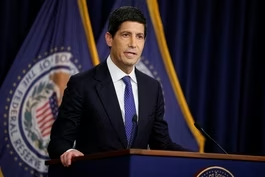
GEOFF BENNETT: It's the first major move by Fed Chair Kevin Warsh to combat elevated inflation.
President Trump has long pressured the Central Bank and Warsh's predecessor to lower interest rates.
But, Warsh, who is four months into the job after being handpicked by Mr.
Trump to lead the Fed, explained why the committee voted unanimously to raise rates today.
KEVIN WARSH, Federal Reserve Chairman: The least well-off are the ones who have the most to gain from stable prices.
The decision we made today was the right decision to deliver on the remit that Congress gave us to ensure stable prices.
Moreover, I would say, because of the underlying strength of the economy, because we are, as I mentioned, largely acting consistent with full employment, we can be focused on stable prices.
Some months ago, I said we will deliver stable prices.
Today's action is consistent with that.
GEOFF BENNETT: And for more, we're joined now by Julia Coronado, an economist at the University of Texas at Austin, who runs her own firm called MacroPolicy Perspectives.
Welcome back to the program.
JULIA CORONADO, MacroPolicy Perspectives: Thank you for having me.
GEOFF BENNETT: So what does this first decision by the Fed under Warsh's leadership tell us about Warsh as a Fed chair committed to fighting inflation and as a Fed chair who is willing to operate independently of the president who appointed him?
JULIA CORONADO: Yes, it's it's a pretty quick turnaround for an official who was nominated presumably to bring rates down to turn around and hike rates by September.
And I think that reflects the data he's facing and the committee he has to manage.
So the committee is looking at the data, and as Warsh, Chair Warsh, described, unemployment is low, inflation is high.
That's a pretty simple formula for Central Bankers.
There was a lot of support.
It was a unanimous decision, and most officials think that it's not the last of the rate hikes.
So more lie ahead.
GEOFF BENNETT: So bring this down to the household level.
What gets more expensive and how quickly?
JULIA CORONADO: Well, we've already seen longer-term interest rates back up.
Over the last month or so, we've seen a tremendous rise in borrowing costs, reflecting expectations that the Fed would need to raise rates, reflecting some of the geopolitical tensions we're seeing ripple through the commodities markets, and the inflation data itself just showing a lot of persistence.
So, in a sense, the borrowing costs consumers face have already increased.
Mortgage rates are a lot higher.
Auto loan rates are likely going to rise as well.
So it's really -- I think you mentioned this is really about the Fed following through and the new Fed chair demonstrating that he is independent of politics and will do what the data, what the economy says is necessary.
And I think that's -- in a sense, that's reassuring that the Fed is acting independently.
GEOFF BENNETT: On those borrowing costs that you mentioned, the 10-year Treasury has now passed 5 percent.
How much does that complicate what the Fed is trying to do here?
JULIA CORONADO: Well, it actually is a reflection of what the Fed is trying to do, which is to slow the economy down, in a sense.
It's an unusual picture because the economy is being driven by this enormous A.I.
build-out, rather than the typical hot labor market, hot consumer spending.
We're in the middle of a huge CapEx boom, and that demand for capital is part of the reason interest rates are higher.
And so it sort of sows the seeds of its own slowdown.
They -- there's a lot of borrowing being done by the tech companies, the hyperscalers.
That's putting a lot of demand for money, and that's driving up the price of money, and that in turn could slow down that build-out.
GEOFF BENNETT: Returning to what you said a minute ago, how most Fed policy watchers expect another rate hike, what would have to change for that not to happen?
JULIA CORONADO: I think we'd have to see.
I mean, one of the reasons that Chair Warsh cited for moving today was the resilience in the economy.
The economy just has absorbed blow after blow from tariffs and wars and a lot of disruption, and the unemployment rate is at 4.1 percent, which is very low.
So I think what we would have to see are signs of wobbles in the economy, signs of vulnerability, a labor market where unemployment is on the rise again, or some pretty noticeable cooling off in geopolitical tensions and pipeline inflation pressures and in the inflation data itself.
And neither of those is the most likely scenario in the near future.
So most of the officials who wrote down a forecast today, the vast majority think that we will see another rate hike before year end, likely at the December meeting.
GEOFF BENNETT: Yes.
And Warsh has promised a different approach to how the Fed communicates.
What did you hear from him today in terms of his language, his tone, or what he chose not to say that tells us how he intends to run the Fed differently?
JULIA CORONADO: Yes, so there was a couple of differences.
One, he sort of noted that, while decisions have sometimes been made down to the last minute on high-frequency data, that the Fed is waiting and then they make a decision based on sort of one month of data, or that's the perception, that he is going to be stepping back and looking at underlying trends more.
So that's one difference.
A second difference is that, in the past, when we the Fed thought it was embarking on maybe a sequence of rate hikes, they would kind of telegraph that at the press conference.
Prior chairs would say that they think a sequence of moves is likely.
Chair Warsh steered clear of that specific kind of guidance, although he did say -- it's very hard not to provide any forward guidance.
He did say that today's action is the start of the Fed demonstrating that they're going to make good on their inflation target.
So the start of something suggests that, yes, more rate hikes probably lie ahead.
GEOFF BENNETT: Julia Coronado, always great to speak with you.
Thanks for making time for us.
JULIA CORONADO: My pleasure.
AMNA NAWAZ: Late last night, for the third time, the U.S.
House of Representatives voted to end the war with Iran.
That war powers resolution would stop President Trump from continuing military action against Iran without congressional approval, but it still needs to pass the Senate, and it comes more than six months into a conflict that president said would last weeks.
For a view from inside Iran.
I spoke earlier with "News Hour"'s Tehran-based special correspondent Reza Sayah on a rare trip home to the U.S.
Reza, welcome back to the "News Hour."
It's good to see you here in person.
REZA SAYAH: Great to be here.
Good to see you, Amna.
AMNA NAWAZ: So you are there on the ground reporting for us and others.
With the war now approaching seven months, what has daily life become for people in Tehran and across Iran?
REZA SAYAH: It's very difficult.
I mean, life in war is difficult.
Initially, they had to deal with being bombed on a daily basis, then the economic pressure, the uncertainty, and now you have additional sanctions.
So war is difficult, and the ones who feel it the most are the average, average people.
At the same time, you see a lot of pride in Iranians.
You see a lot of confidence.
You see in a lot of Iranians they know that this moment could be defining for the future of their sovereignty and independence.
So you have all these emotions together.
But definitely, when you're at war, it's difficult and painful.
AMNA NAWAZ: Let's talk about the leadership and the sort of strength of the regime.
As you have been covering, we know the U.S.
and Israel have killed dozens of Iran's top military commanders and senior officials, ramping up the economic pressure as well, hit a number of Iran's military installations.
And yet the regime seems to still be standing, new supreme leader, of course, but the same ideological regime.
Has that surprised you to see that strength of the regime?
Do you know how weakened they have been by the U.S.?
REZA SAYAH: Well, this was a defining moment for them.
They took a very hard punch from the world's lone superpower, the United States, two nuclear powers.
And despite their senior political leaders, military leaders, and the supreme leader being assassinated, the leadership is still there.
They have different names, different identities, but they are still there.
And to many observers, this was an indication that Iran has very powerful, entrenched, well-rooted institutions that can take a punch like this and still survive.
And not only, in their view, have they survived.
Now indications are that they're getting more aggressive, that they believe that the United States does not want a fair diplomatic solution, that they want to destabilize the United States.
In their view, Israel wants Iran to be a failed state.
And they believe that diplomatic solution, negotiations has not worked.
They haven't gotten anything tangible.
So they're considering and carrying out measures that indicate that they're being more aggressive.
AMNA NAWAZ: There were, as you well know, mass protests, millions of Iranians who took to the streets before the war.
We saw the Iranian government respond with a brutal crackdown, which we have seen before, reports of at least dozens of the protesters who have been executed since then.
Human rights groups say 100 protesters still on death row.
How would you describe the anti-government sentiment right now?
Are people still willing to come out and protest?
REZA SAYAH: Well, they haven't come out and protest.
It's not -- Iran is 90 million people.
There's certainly a significant, considerable segment of the population that at the very least want reform.
There's a segment of the population that wants regime change.
And there's also a big, huge part of the population that doesn't want to be the targets of foreign attacks, foreign wars.
And they see this moment as a moment of survival for Iran.
So the anti-government protesters that we saw in January have not reappeared in the streets.
That doesn't mean that people don't want reform, that don't want change.
But I think the population that has made its presence felt is the Iranian population that sees this as a war of survival and they're outraged that they have been bombed by the United States and Israel.
AMNA NAWAZ: Reza, what is it like for you as a journalist reporting on the ground in Iran for Western outlets?
Do you face repercussions or pressure, intervention from government officials?
REZA SAYAH: Repeatedly, there's this narrative that American citizens are in danger there, that the Iran -- the Iranian government systematically goes after dual citizens and American -- and citizens in order to use them as pawns in negotiations.
There have been some arrests of dual citizens, and those have been unjustified.
They have been crimes.
But I have not seen any systematic effort by the Iranian government over these 20 years that I have reported there to go after dual citizens, and I'm an example.
I'm an American citizen.
I have an American passport.
I'm able to report freely over there.
They have criticized many of my reports, especially in 2009 during the Green Movement.
They have been -- they were very critical of my reports, where they didn't grant me press credentials.
But my experience with them has been, if my reports are fair and balanced, and if, in their view, I'm presenting both sides, they're willing to welcome international journalists, including American journalists.
AMNA NAWAZ: Reza Sayah, special correspondent for us on the ground in Iran, it's good to have you here.
Thank you very much.
REZA SAYAH: Good to be here.
You're welcome.
GEOFF BENNETT: We start today's other headlines on Capitol Hill.
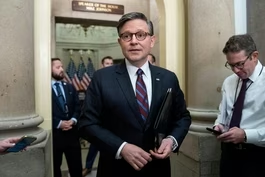
House members are heading home a full day early and won't be back until after November's midterm elections.
Their departure leaves a number of matters on the table, including an effort to impeach Defense Secretary Pete Hegseth and a push by Democrats to address the risks posed by artificial intelligence.
But lawmakers did approve a resolution to hold billionaire Leon Black in contempt of Congress after he defied subpoenas related to an investigation into the late sex offender Jeffrey Epstein.
It's now up to the Justice Department whether to seek criminal prosecution.
Also in Washington, D.C., fencing has gone up around the Kennedy Center one day after President Trump's handpicked board voted to close it for repairs.
But President Trump has said renovations will not begin until the courts allow the center to bear his name.
Today, Democratic Congresswoman Joyce Beatty requested an emergency hearing over the closure.
She's been leading efforts to keep the president's name off the building.
Also, today the White House posted this video appearing to show the building in decay, though these images have not been independently verified.
Federal safety officials are investigating the cause of a news helicopter crash in Los Angeles that killed three people.
The helicopter was reporting on a bus collision for NBC4 Los Angeles when it went down around 7:00 p.m.
last night.
Fire officials say both the pilot, George Marciniw, and reporter Eliana Moreno were killed.
Their colleagues paid tribute to them today, calling it a terrible loss; 29-year-old Edy Gutierrez Mejia was on the ground, and he also died.
And a motorist has been arrested for causing the crash the news crew was covering.
Authorities say she slammed her SUV into a city bus, killing at least two people.
European Commission President Ursula von der Leyen says she wants Canada to be the first associate member of the European Union.
(APPLAUSE) GEOFF BENNETT: Prime Minister Mark Carney was on hand for the announcement in France, where he received a standing ovation from European lawmakers.
The proposal comes as Carney navigates Canada's ongoing trade war with the U.S.
Von der Leyen said Canada and Europe should take their partnership to, as she put it, the highest level possible.
URSULA VON DER LEYEN, President, European Commission: But above all, dear Mark, Europe and Canada believe in democracy.
That power does not belong to the strongest, richest, and loudest, but to all of us, that democracies have the freedom to choose with whom to work.
GEOFF BENNETT: Experts say it's unclear exactly how such a relationship would work since the E.U.
has never had an associate member.
The idea has been floated before for Ukraine and for Britain after Brexit, but never moved forward.
In Gaza City, search-and-rescue efforts are under way after a building collapsed early today, killing at least 21 people, including 11 children.
Aid workers used excavators to sort through the debris, while others dug through the rubble with their bare hands.
The structure had been damaged by Israeli airstrikes earlier in the war and was known to be unstable.
Tens of thousands of displaced Palestinians are living in such buildings, while Israel has refused to allow rebuilding efforts until Hamas disarms.
Neighbors living in tents nearby described what happened.
TALAL AL-HARAZIN, Displaced Palestinian (through translator): The building collapsed in less than 10 seconds.
The residents here were good people.
They did not cause harm.
They were respectful.
All the buildings were full of children and women and the elderly.
They were struggling because there was no shelter for them.
They had nothing.
GEOFF BENNETT: This comes amid reports that the Trump administration is planning a $2.8 billion sale of powerful bombs to Israel.
The Biden administration paused delivery of similar weapons two years ago, citing concerns about the risk of mass casualties in Gaza.
Saudi Arabia and the Iran-backed Houthi rebels both claimed new attacks today, as the fighting between the two sides intensifies.
Saudi Arabia says it intercepted a drone heading toward the city of Mecca, calling the attempted attack a red line.
The Houthis deny targeting the city.
Hours later, the group released video claiming to be the downing of a Saudi fighter jet over Yemen's territory.
The remains of the jet can be seen burning on the ground with a Saudi flag visible on its tail.
On Wall Street today, stocks ended lower after the Fed raised interest rates.
The Dow Jones industrial average fell more than 600 points.
The Nasdaq gave back three points, so basically flat.
The S&P 500 lost nearly half-a-percent.
And we mark the passing of two award-winning authors.
British American writer and commentator Bonnie Greer has died.
She was a prominent voice on both sides of the Atlantic, advocating for greater racial and gender representation through her books, plays, and public appearances.
BONNIE GREER, Author: Therefore, diversity and democracy are, to my mind, the same thing.
They're exactly the same thing.
And diversity creates democracy itself.
GEOFF BENNETT: For her contributions to the arts, she was made an Order of the British Empire in 2010.
Bonnie Greer was 77 years old.
And Pulitzer Prize-winning author Annie Dillard has died.
Her 1974 work, "Pilgrim at Tinker Creek," drew comparisons to Henry David Thoreau, as a nonfiction meditation on nature, religion, and the meaning of life itself.
In 2014, then-President Barack Obama awarded her the National Humanities Medal.
Annie Dillard was 81.
Still to come on the "News Hour": primaries come to an end, a look at the political landscape heading into the November midterms; the fallout grows after Macklemore is dropped from Ed Sheeran's tour over his pro-Palestinian remarks; and a reopened Greek Byzantine palace sets an example for what's possible with restoration.
AMNA NAWAZ: For months, the Trump administration has ramped up economic pressure and military threats against the island nation of Cuba.
A de facto oil blockade means blackouts, food and water shortages for millions have worsened.
Cuban officials say they're willing to talk, but, publicly, there's been no progress.
I spoke earlier today with Cuba's Deputy Foreign Minister Carlos Fernandez de Cossio as he visits the U.S.
Deputy Foreign Minister de Cossio, welcome to the "News Hour."
Thank you for being here.
CARLOS FERNANDEZ DE COSSIO, Cuban Deputy Minister of Foreign Affairs: Thank you for having me.
AMNA NAWAZ: So, this month, the foreign minister of Cuba said that there are no talks happening between the U.S.
and Cuba, but that the Cuban government would continue reaching out to its contacts.
Is that happening?
Is that part of why you're here in Washington?
CARLOS FERNANDEZ DE COSSIO: It's not the reason why I'm in Washington.
I'm here because I'm attending the U.N.
General Assembly.
We have a major embassy in Washington, and it's normal for us, for senior officials to visit and engage with our diplomatic missions.
What our position on contacts with the U.S.
is that first we have diplomatic relations.
So we have official channels of communication.
And we have had several contacts and meetings with the U.S., that what we claim is that they had no progress.
And we say that because you only have to look at the fact that practically every week or every 10 days or 15 days, there's a new announcement by the U.S.
government of sanctions and coercive measures that punish the people of Cuba.
So you could not claim that there's progress in any dialogue or any type of communication if hostility continues to happen.
And that's our main point.
But we continue to be ready to engage with the United States when they are ready to try to solve our political differences, our bilateral political differences, which are many.
But we are firm believers that, through dialogue, through respect between the two governments, some common ground could be found.
AMNA NAWAZ: When was the last time... CARLOS FERNANDEZ DE COSSIO: And that is our aspiration.
AMNA NAWAZ: I apologize.
When was the last time there were any direct talks between your two governments?
CARLOS FERNANDEZ DE COSSIO: I prefer not to go into details.
We try to treat this discreetly.
We truly reject the leaks that have been occurring.
But I can assure you there's -- meetings have occurred, and we would be ready to engage again.
AMNA NAWAZ: Are you saying that... CARLOS FERNANDEZ DE COSSIO: In other words, they are not closed, they're not suspended, they're not shut down.
Simply, there's no progress to this moment.
AMNA NAWAZ: And by your definition, progress would mean the U.S.
would stop with additional sanctions?
CARLOS FERNANDEZ DE COSSIO: That could be, but, in a broader sense, there will have to - - we would have to identify a common goal that we want to reach that implies progress in the bilateral relationship.
Up to now, if you look at the claims of the U.S.
publicly, they want to take over Cuba.
That is quite an ambitious goal.
That certainly is unacceptable for Cuba.
Cuba's a sovereign nation.
AMNA NAWAZ: Do you take that as a real threat?
Are you worried about a U.S.
invasion?
CARLOS FERNANDEZ DE COSSIO: We would be naive if we do not take that into account.
It is constantly repeated.
U.S.
senior officials are asked constantly if that is on the table, and they claim that nothing is off the table.
So, a country like Cuba, looking what to what's happened in the world and our own history, we will be naive if we don't take that seriously.
AMNA NAWAZ: Can I ask you about what's happening on the ground in Cuba right now?
Because we have seen blackouts amid the oil blockade.
We have seen life gotten so much worse for Cubans.
Food is expensive.
It spoils without electricity.
We know there are water shortages as well.
What is your message to Cubans about what you and other leaders are doing to alleviate that pain?
CARLOS FERNANDEZ DE COSSIO: First of all, it is very clear that the policy of the United States is to produce collective punishment, which is an international crime, to try to induce a humanitarian crisis in Cuba, meaning that is to use the pain of each and every Cuban to try to achieve a political goal.
That, again, is an international crime.
The people of Cuba understand that.
And when you see in the media normally the reports of what's happening in Cuba, they speak about the lack of energy, the blackouts and people being irritated, naturally, people being uncomfortable, naturally.
But that's only the surface.
They don't take into account what it implies for a family that has a sick person at home and then doesn't know how to transport them to the hospital.
They don't take into account what implies for a person who needs an urgent surgery and has to wait in line because of, as a result of lack of energy, surgery has to be postponed, what it implies for a family that has a newborn whose life depends on a machine not stopping because of lack of power, what it implies for people having to take children to school, to do homework at night.
So it has a human face.
We use statistics many times of what it implies, but this has a human face.
And the main problem is that it's not collateral damage.
It is the aim of the policy.
So the people of Cuba understand that.
And the government has -- says, claims, and we're doing, trying to introduce in Cuba the transformations and to take the steps that allow us to cope with this situation.
That does not depend on us.
AMNA NAWAZ: I mean, as you say, these are the most significant privatization steps the nation has taken in over six decades.
If this does lead towards an alleviation of suffering for Cubans, if opening up the economy does help, would you continue to do so?
CARLOS FERNANDEZ DE COSSIO: Yes.
It is our aim.
AMNA NAWAZ: You have no problem doing that?
CARLOS FERNANDEZ DE COSSIO: Our aim is -- the main priority here is, how do we satisfy, how do we respond to the needs of the people of Cuba?
And that is the driving goal here.
AMNA NAWAZ: That is an enormous shift for a communist nation to say you will continue to open up your economy.
CARLOS FERNANDEZ DE COSSIO: We will continue to go down this path, but we will retain the role of the state to respond to basic needs of the population and the economic capacity to do that.
AMNA NAWAZ: I have to ask you about the allegations from U.S.
officials as well about the gap between Cuban leaders and what they're experiencing and everyday Cubans.
They say the leaders aren't feeling the pain as evenly.
I want to put to you what the U.S.
ambassador to the U.N., Mike Waltz, said back in July.
He said: "There's no food or fuel for hospitals.
How is there fuel for the Castro private family jet?
How does President Diaz-Canel afford his Hermes tie, his Rolex watch?
How does the Castro family afford their 17 homes, their trips to Madrid and Moscow?"
What would you say to that?
CARLOS FERNANDEZ DE COSSIO: First of all, this is claimed by the representative of one of the countries with the most inequality in the world today, an inequality that has grown dramatically in the past 20 years, and above all under the current government.
AMNA NAWAZ: People here are not experiencing 20 hours a day of blackouts, though, in all due respect.
CARLOS FERNANDEZ DE COSSIO: Secondly, there are no private jets within -- of the Castro family.
It's totally untrue.
There are no 17 homes of the Castro family.
Totally untrue.
But he can claim whatever he wants when he has a microphone in front of him.
All Cubans of any type -- senior officials in the government are suffering the same situation of Cubans.
I'm not saying that all Cubans are on equal footing.
Depends on the neighborhood where you live, the amount of hours it takes, the conditions of your home.
But the level of inequality, the level of differences in Cuba is dramatically different than the ones you have in the United States.
The pain is on the Cuban population as a whole, in ways that no other country perhaps has suffered, unless you put the example of Gaza in Palestine.
It's warfare against a population of a whole country.
And for an American official to claim that there are differences from the United States, a country where you have a minuscule elite in which a few people have more money than the whole population of the richest country in the world is quite hypocritical.
AMNA NAWAZ: Mr.
Minister, this survey says some 54 percent of people surveyed in Cuba say they ran out of food in the prior three months.
There's reports of up to 20 hours a day without power.
Are you saying that Cuban officials are experiencing that same level of pain?
CARLOS FERNANDEZ DE COSSIO: I can tell you that my colleagues and myself, we have two 2.5, three hours of power a day, that our refrigerator is closed, that you can't cool food, that we don't have running water.
And I'm talking about Cuban officials in general.
And anyone who knows me can go and check or who knows any one of my colleagues.
Now there are people which are not government officials, which are simple private citizens that might live across the street from a hospital.
And they don't suffer blackouts because hospitals are protected.
Clinics are protected.
And that's just, look, where they live.
And some of us have to take our food and our products and ask them, can you refrigerate this for some time?
That is normal life in Cuba for everybody.
The claim in the United States that there's a difference between an elite and the people, it's totally, totally untrue, and they can't prove it.
AMNA NAWAZ: The U.S.
has claimed, this administration has claimed that Cuba is a national security threat.
It's been deemed a state sponsor of terrorism.
The White House has said that the Cuban regime aligns itself with nations hostile to the U.S., that Cuba maintains close ties to other state sponsors of terrorism.
What is your response to those claims?
CARLOS FERNANDEZ DE COSSIO: Most of the countries that the U.S.
claims Cuba is close to, the United States has a more comprehensive and broader relationship with those countries than Cuba does.
AMNA NAWAZ: We're talking about nations like Russia, Iran.
CARLOS FERNANDEZ DE COSSIO: Russia.
The U.S.
has a much broader relationship with China, at least, and with Russia than we do, with trade, with the exchange of different types, than we do.
AMNA NAWAZ: It is an adversarial relationship with Russia, though.
You would not call Russia an ally.
CARLOS FERNANDEZ DE COSSIO: But they have more trade still today with Russia than we do, more contacts, more high-level meetings and visits than they have with Cuba, than Russia has with Cuba.
With China, it's the same.
They claim it's adversarial, but it's a claim.
But they have more relationship than we do.
AMNA NAWAZ: Well, what does happen next then?
How do you see this ending with the pressure, with the military threats, with additional U.S.
sanctions?
How does this end?
CARLOS FERNANDEZ DE COSSIO: We will have to cope with ourselves.
And to some extent, the international community perhaps would say, this is unacceptable for one superpower to be dictating everybody having to do.
But what cannot occur and what would be treason is for the Cuban government to tell our people, look, there's nothing else we can do.
Let's ask the U.S.
government what they want us to do and how they want to organize our country and how they want to organize the Cuban economy, the Cuban political system, Cuban property, and Cuban business.
That would be treason by the Cuban government and the Cuban authorities.
AMNA NAWAZ: Deputy Foreign Minister of Cuba Carlos Fernandez de Cossio, thank you very much for being here.
CARLOS FERNANDEZ DE COSSIO: You're welcome.
AMNA NAWAZ: We appreciate your time.
CARLOS FERNANDEZ DE COSSIO: You're welcome.
AMNA NAWAZ: For more of that conversation with the deputy foreign minister, you can watch our full interview online on our PBS News YouTube page.
GEOFF BENNETT: Well, the 2026 primary season is officially over.
Voters in Delaware cast the final ballots yesterday.
And, no surprises, they set up a U.S.
Senate race between incumbent Democrat Chris Coons and Republican Michael Katz.
Now the general election is finally under way.
Mail-in ballots have gone out in several states.
And with just seven weeks left until Election Day, Lisa Desjardins takes a closer look at the increasingly competitive match for the U.S.
Senate.
LISA DESJARDINS: Democrats are looking to North Carolina as one of their best chances to flip a Republican Senate seat.
And President Trump is taking a firsthand look.
He's there today to try to help his handpicked candidate, former Republican Party Chairman Michael Whatley.
A recent Elon University poll shows the Democrat, former Governor Roy Cooper, with a double-digit lead over Whatley.
For an on-the-ground report, I'm joined by Colin Campbell of public media station WUNC.
Colin, just take us there.
Where does this race stand?
COLIN CAMPBELL, WUNC: Yes, so this is a race where we were expecting it to be a lot tighter than it has been, at least in the polls that we have seen.
That lead that Governor Roy Cooper had hasn't really changed a whole lot over the last few months, and we sort of expected it to tighten up.
But this is the first we're seeing of President Trump and really any of the high-ranking members of his administration actually coming to North Carolina to campaign with Whatley.
So we will certainly see if that helps boost him among Republicans.
But the president's approval ratings in North Carolina are kind of the worst that they have been, and this is the case for many other states as well.
So whether this helps him with swing voters sort of remains to be seen, but certainly energizes the Republican base to have Trump here in North Carolina.
LISA DESJARDINS: How is Whatley handling Trump specifically?
Not every Republican candidate wants Trump to fly into their state or district right now.
COLIN CAMPBELL: Yes, and for a while we were wondering whether we would see the president in the state, and certainly this seems like a conscious choice on Whatley's part.
As a former chairman of the Republican National Committee, there's not a whole lot of daylight between Whatley and Trump.
He really hasn't made much of an effort to distance himself from anything the president or his administration has been doing.
He talks about Trump less on the campaign trail than he did earlier on, which seems to be a strategic choice to focus more on attacking his opponent than he is praising the president's administration.
But, certainly, you don't see a whole lot of difference between Whatley's campaign and his position on a lot of these national issues and the president's.
LISA DESJARDINS: If you had to pick one or two key issues in this Senate race in North Carolina, what would they be?
COLIN CAMPBELL: I think affordability is probably the top one.
I mean, the economy here is an issue.
And Governor Roy -- former Governor Roy Cooper has been making that his signature issue.
He does these Make Stuff Cost Less Tour events, he calls them, across the state, promoting his plans for that.
Whatley has been more focused on a crime -- tough-on-crime message, trying to tie Governor Cooper to people who've been let out of jail or certain criminal instances and policies that he's had.
And then you have also got a lot of discussion about A.I.
and data centers that have been popping up around the state, but less by the candidates in this race.
The candidates really have sort of picked their lanes, whether it be crime or affordability, and are sticking to that, and that seems to be the theme of most of the campaign events we have seen in this state so far.
LISA DESJARDINS: Colin Campbell of WUNC, a state to watch.
We appreciate your reporting.
COLIN CAMPBELL: Thanks, Lisa.
LISA DESJARDINS: Democrats may have an advantage in North Carolina, but that's just one of a dozen competitive Senate races this year, according to The Cook Political Report.
They rate which party is favored currently, and you can see that in shades of Republican red, Democratic blue, or the toss-ups there in yellow.
These 12 seats will likely determine the future of the Senate.
And of them, Republicans are on defense in the majority, or eight of those seats.
But to regain control of the Senate, Democrats need to pick up four seats overall.
It's a rugged political map, and to help us navigate, I'm joined by Jessica Taylor of The Cook Political Report.
Jessica, let's just start off right now, 48 days to go, would you rather be a Senate Democrat or a Senate Republican?
JESSICA TAYLOR, The Cook Political Report: The map still is tilted toward Republicans because they -- Democrats are trying to target seats in states that Trump won by double digits.
But if you look at the political momentum, it's on Democrats' side, and that's why they are so competitive in these seats.
So, again, I think I'd rather be a Democrat in this environment right now, but the math still favors Republicans.
LISA DESJARDINS: As you're saying, Trump won in most of these states in 2024, yet his disapproval rating right now hovers right around 60 percent.
It's getting very close to that.
How do you see the ways that he helps Republicans versus the ways he may be hurting them?
JESSICA TAYLOR: When I watched that midterm convention last week and he said pretend, I'm on the ballot, I think Democrats were just rejoicing, because that's the message they want.
We see in polling there was the CNN poll last week in Maine, where Susan Collins is on the -- is in the political fight of her life, which she survived before.
But 45 percent of voters said their vote is a reflection on President Trump, is trying to send a message to President Trump.
If you're Susan Collins, those are numbers you don't want to hear.
The only way that voters can send a message of being unhappy with this current White House and the president's policies is to vote against his party.
And that's why we're seeing states like Iowa and Texas that are so competitive, Alaska, Ohio, states that Trump won by double digits are now at the crux of the competitive Senate map.
LISA DESJARDINS: And Republicans are spending in some weird places.
You mentioned Texas, for example.
I'm having conversations in the U.S.
Senate with MAGA Republicans who are worried about Kansas.
JESSICA TAYLOR: Yes.
LISA DESJARDINS: My question for you is, how much is the map expanding for Democrats right now?
And do they have the muscle, do they have the money to take advantage of that?
JESSICA TAYLOR: Well, Republican -- well, Democrats also can't overlook the places that they're on defense.
Michigan is central.
They -- again they want to be adding seats.
They need to net four seats.
You can't be subtracting Senate seats.
This week, we just moved New Hampshire into the toss-up column.
That's a state that Kamala Harris carried by a less than three points, but it's one where Republicans have a unique recruit there in former Senator John E. Sununu, who is from the state's most famous political family.
And so that's a seat -- that's a state... LISA DESJARDINS: He's going up against a Democratic congressman also with a well-known name, Chris Pappas.
JESSICA TAYLOR: Right.
But that's a state where we see MAGA Inc.
money coming in.
They -- it's one of their top reservations.
Michigan, they feel like they have a real chance because Abdul El-Sayed, Democrats -- or Republicans are really demonizing him and making him the central -- central to their attacks.
So, that's a much closer race than both -- than Democrats would like right now.
So you still have places where Democrats are on defense, so they can't take their eye off the ball.
LISA DESJARDINS: But is the map expanding now for Democrats?
We're going to come back to that.
So we know Democrats, they have something that they have got to protect.
But is the map expanding and do they have the resources to make -- take advantage of that?
JESSICA TAYLOR: I mean, the Republican money edge is real, but it's coming from super PAC money, and so candidates like James Talarico in Texas, even though we have seen the main Senate super PACs and a leadership fund, their Texas PAC has put over more than 60 million in reservations.
I'm looking at what the candidates are spending there.
They get cheaper ad rates.
LISA DESJARDINS: Right.
JESSICA TAYLOR: So I think the map, it has expanded certainly since last year, when I would not have said that Democrats were in contention for the majority at all, and they are right now.
LISA DESJARDINS: How worried are Republicans, do you think, about losing the majority?
We still have some time before the election.
But ballots are have gone out in some states.
JESSICA TAYLOR: I think they are very worried just when you would look at the trajectory of the environment and when you would look at -- they did not think in the spring when I was talking with strategists that the war would still be going on, that they would still have gas prices that are this high, diesel prices at record high.
You mentioned Kansas.
It's similar to me in a lot of ways like Iowa, where you have agriculture prices that are really hurting Republican voters there.
And so you see Republican voters on the defense -- or Republican lawmakers on the defense over beef, over fertilizer prices.
So it's a really sort of unique environment that is harming Republicans, and it all ties back to the Iran war, really.
LISA DESJARDINS: In our last few seconds, what are you watching in the next month or so to determine the final shape of these races?
JESSICA TAYLOR: Does the money that Republicans are pouring in, is it moving it?
Is it the money or the message that is going to determine this?
If it's the message, Democrats have that on their side.
But Democrats also -- they might need to narrow that money advantage.
Are -- is there enough enthusiasm on their side that their donors kick in enough?
LISA DESJARDINS: Jessica Taylor of The Cook Political Report, thank you for having your head completely in the game and helping us with it.
JESSICA TAYLOR: Thanks, Lisa.
GEOFF BENNETT: The debate over the war in Gaza continues to reverberate throughout politics and pop culture.
And, this week, it erupted once again, leading to tough criticism of two musical artists and blowing up plans for a concert tour.
Anger erupted after the rapper Macklemore was kicked off musician Ed Sheeran's stadium tour.
Sheeran, one of the most streamed artists in the world, said Macklemore had to be dropped as an opening act because venue owners objected to Macklemore's recent pro-Palestinian comments on stage.
MACKLEMORE, Musician: One of the reasons why I wanted to come on this tour was because I wanted to stand up here on stages in stadiums across America and say two words that are very near and dear to my heart: Free Palestine.
To all of my Jewish brothers and sisters, criticism of Israel, criticism of apartheid, being against genocide in no way is a criticism of you.
GEOFF BENNETT: In a statement, Sheeran said the decision was made not because of his own personal politics.
Instead, he laid the blame on his tour promoter after upcoming venues threatened to cancel shows if Macklemore continued to play.
Yesterday, all four of Ed Sheeran's other supporting acts dropped out of the tour in protest.
For more, we're joined now by Ben Sisario.
He's a reporter at The New York Times covering the music industry.
Ben, thanks for being with us.
Help us understand what happened here.
BEN SISARIO, The New York Times: Well, I mean, as you said, just in politics and a lot of other parts of culture, positions on the war in Gaza have really been a third rail in a lot of ways.
But this flared up in a big way in music because of this tour, because Ed Sheeran, one of the most popular artists in the world, and because of the apparent pressure that was put on him by the owners of stadiums around the country.
They were apparently the ones that objected so strongly to Macklemore's comments.
He also he has a protest song that he released a couple of years ago, again about the war, and in it he accuses Israel of genocide, and he shows his solidarity with student protesters in the U.S.
and in New York.
So his position has been widely known.
I mean, this was not a surprise.
But the idea that the owners of stadiums, including Robert Kraft, the owner of the New England Patriots, apparently demanded that he be removed from the tour, and Ed Sheeran did not object.
GEOFF BENNETT: And Robert Kraft said that this wasn't just about Macklemore's support for the Palestinian issue, but what he calls a broader history of antisemitic rhetoric and imagery.
Macklemore says he's being punished for political speech.
Where do you see this line being drawn?
BEN SISARIO: Well, I mean, it certainly is about speech.
And it's interesting that some of the venues, at least some of the venues that he was planning to go to on the tour are publicly owned.
The next stop on the tour is in Philadelphia, and I believe the stadium there is owned by the city of Philadelphia.
But this is a rare example of the owners of these venues and of the teams, which most of them are billionaire businessmen, putting their foot down so strongly.
And the reaction on social media and around the world has been very strong about this, some in support.
I mean, some agree with Mr.
Kraft fully.
But I think there's a -- there's an even stronger objection, especially among music fans and in the music industry, that a venue owner could dictate this, and that Ed Sheeran is perceived as caving into that pressure, rather than standing up for the artist that he chose to have on his tour.
And once Sheeran made his statement on Tuesday where he said, it wasn't me, it was the promoters and the venues, that is when you saw every other artist on his tour, the other opening acts, and even the Irish traditional band that backs Sheeran up for part of his show, they all bailed within a couple of hours.
GEOFF BENNETT: So there's also this question of consistency.
Kanye West has an extensive, well-documented history of making antisemitic statements, and yet he continues to find venues and audiences.
So where's where's the line in the sand?
BEN SISARIO: Well, I mean, lots of people on social media have been calling this total hypocrisy.
And it may indeed be.
But if there is a line in the sand, it seems to be Gaza.
It seems to be that is the issue that was intolerable to venue owners like Robert Kraft.
A lot of other stadium venue owners around the country didn't seem to have a problem with Kanye West being there.
He has a song called "Heil Hitler," although I don't think it was on the set list for those shows.
But, I mean, as you said, he has been absolutely outrageous in the past with antisemitism, with truly offensive comments, and he's been able to book a success -- he's been able to book a successful tour.
GEOFF BENNETT: So is the line now not what you say, but how much leverage you have and commercial success you have when you say it?
BEN SISARIO: That may be the case, but I also think it is specifically about the political issue of the war in Gaza, and whether criticism of Israel's stance and Israel's actions in that war is considered allowable.
GEOFF BENNETT: Ben Sisario of The New York Times, thanks again for being with us this evening.
BEN SISARIO: Thank you.
AMNA NAWAZ: History buffs heading to Greece are mostly drawn to the country's wealth of classical temples and amphitheaters.
But now the Culture Ministry has opened a stunning restored palace from the Byzantine era in the 1300s.
Greeks claim the UNESCO World Heritage Site is a model of bringing ancient treasures back to life.
From Mystras in Southern Greece, special correspondent Malcolm Brabant reports.
MALCOLM BRABANT: Situated in the Taygetus Mountains high above ancient Sparta lies the ruined walled city of Mystras.
Its golden years were during the Middle Ages, when Mystras was a center for art and culture, and a key outpost of the Christian Byzantine Empire ruled from what is now Istanbul.
There are two ways to see this ancient treasure.
One is by going uphill, the other downhill.
There are 900 steps between, and the gradient is really steep.
So I think we will be going downhill.
For decades, the palace at the heart of the complex has been closed to the public.
But now, after renovation work lasting 40 years, this UNESCO World Heritage Site is open for all to see.
DIMITRIS VLACHAKOS, Tour Guide: It's something unbelievable.
And, of course, when we first entered, because even myself could not enter the palace earlier, it was something amazing, something taking you back to another world, to "Game of Thrones" or "Lord of the Rings" or something, as you're going to find out.
It's just amazing, and the work that they did is also great.
MALCOLM BRABANT: Dimitris Vlachakos has been a tour guide for 12 years and is an expert on this, the only remaining Byzantine palace in Greece.
DIMITRIS VLACHAKOS: The Byzantine Empire actually was the continuation of the Roman Empire to the east and became a Greek Roman Christian empire.
So when everything was collapsed in the western part of the Roman Empire, here, they were flourishing.
MALCOLM BRABANT: One of the priorities of the Greek authorities here has been to try to future-proof this side against the dangers of climate change, in particular wildfires.
And that's because the Greeks had a really narrow escape about 20 years ago, when a terrible wildfire got to the perimeter of ancient Olympia, where the Olympics started.
And it was just by pure luck and skill of the firefighters that they managed to stop it before it got inside.
Surrounded by forests, Mystras is a potential tinderbox.
DIMITRIS VLACHAKOS: This area is very similar to California, the wildfires, the earthquakes, the flora, and such other issues, the temperatures, of course.
So we have a big issue and a fear, a constant fear of a possible wildfire to break out.
MALCOLM BRABANT: And so the archaeological site has been kitted out with water tanks and the latest fire suppressant systems, which pleased Prime Minister Kyriakos Mitsotakis.
KYRIAKOS MITSOTAKIS, Greek Prime Minister (through translator): How can we talk about preserving our cultural identity if we do not protect it from the modern threats of the climate crisis?
Something that sits at the center of our priorities is the Ministry of Culture.
MALCOLM BRABANT: At the heart of the renovations is the Palace of the Despots.
In the Byzantine language, the word despot meant a prince, not a tyrant.
KYRIAKOS MITSOTAKIS (through translator): I also want to speak about the future.
When we talk about the future, our minds automatically go to technology.
All of our archaeological sites now, all of our monuments are incorporating technology so as to enrich the visitor experience and enable us to create personalized roots.
MALCOLM BRABANT: The palace transports visitors back in time by projecting ghostly images onto the stone walls.
A lady in waiting combs her mistress' hair, while a page is chastised by a cook in the kitchen.
Overseeing Greece's heritage is Culture Minister Lina Mendoni.
LINA MENDONI, Greek Culture Minister (through translator): Cultural heritage plays a crucial role both for collective self-awareness and for sustainable development and social cohesion.
With this strategic concept, we have been implementing in the last seven years the largest and most comprehensive investment policy in culture that the country has ever known.
MALCOLM BRABANT: Avatars of minstrels in the throne room provide a soundtrack as a Byzantine prince returns to the palace, to the acclamation of his subjects.
LINA MENDONI (through translator): It's proven in practice that when there's a plan, consistency, cooperation, and faith in the power of culture, we can give back to society with a substantial historical, cultural and developmental footprint.
MALCOLM BRABANT: As part of that promise, Greece has launched an initiative to protect 19 ancient monuments at high risk from climate change.
They include the Knossos in Crete, which is getting a fire suppression network and lightning protection system, because ever more powerful heat waves help to generate more wildfires.
Christos Zerefos heads the Academy of Athens Climatology Research Center.
CHRISTOS ZEREFOS, Research Center for Atmospheric Physics and Climatology, Academy of Athens: People in the past, they would say, OK, it's only a heat wave, it will pass in a few days.
Unfortunately, we see that the period of instability in weather becomes prolonged and becomes longer.
MALCOLM BRABANT: Scientists are also monitoring coastal erosion and rising sea levels around the island of Delos, where, according to Greek mythology, the sun god Apollo was born.
CHRISTOS ZEREFOS: We need to know the rate of deterioration and the extent of changes in the quality of the sea, like the pH of the waters.
The heat wave is maintained by the increase of the sea surface temperatures also, which follow the heating of the atmosphere by the greenhouse gases.
MALCOLM BRABANT: Visitors to Mystras cannot fail to feel the weight of history.
Protecting such irreplaceable treasures is not just a Greek responsibility.
According to UNESCO's abiding principles, it is the duty of all humanity.
For the "PBS News Hour," I'm Malcolm Brabant in Mystras, Southern Greece.
GEOFF BENNETT: Remember, there's a lot more online, including a look at why more than one million children have lost SNAP benefits since last July.
That's at PBS.org/NewsHour.
AMNA NAWAZ: And that is the "News Hour" for tonight.
I'm Amna Nawaz.
GEOFF BENNETT: And I'm Geoff Bennett.
For all of us here at the "News Hour," thanks for spending part of your evening with us.
Cuban official on Trump's threats as tensions with U.S. rise
Video has Closed Captions
Cuban official on Trump's threats as tensions with U.S. rise (11m 8s)
Economist: Rate hike a reassuring sign Fed is independent
Video has Closed Captions
Interest rate hike a ‘reassuring’ sign Fed is acting independently, economist says (6m 54s)

The fallout over Macklemore's exit from Ed Sheeran’s tour
Video has Closed Captions
The growing fallout over Macklemore's exit from Ed Sheeran’s tour (6m 1s)
How nearly 7 months of war have changed daily life in Iran
Video has Closed Captions
How nearly 7 months of war have changed daily life in Iran (6m 19s)
News Wrap: Johnson recesses House early
Video has Closed Captions
News Wrap: Johnson recesses House early (6m 4s)

North Carolina gives Dems' chance to flip GOP Senate seat
Video has Closed Captions
North Carolina Senate race emerges as Dems' best chance to flip GOP seat (3m 7s)

Restored Greek palace offers blueprint for preserving sites
Video has Closed Captions
Restored Greek Byzantine palace offers blueprint for preserving cultural heritage (6m 22s)
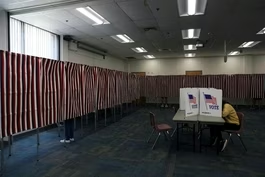
Where things stand in the battle for control of the Senate
Video has Closed Captions
Where things stand in the battle for control of the Senate (5m 24s)
Providing Support for PBS.org
Learn Moreabout PBS online sponsorship
- News and Public Affairs

FRONTLINE is investigative journalism that questions, explains and changes our world.
 New Episode
- News and Public Affairs

Today's top journalists discuss Washington's current political events and public affairs.
 New Episode
 New Episode
 New Episode
 New Episode
 New Episode


 New Episode
 New Episode
 New Episode
Support for PBS provided by:
Major corporate funding for the PBS News Hour is provided by BDO, BNSF, Consumer Cellular, American Cruise Lines, and Raymond James. Funding for the PBS NewsHour Weekend is provided by...