
Unexpected Finds
Season 23 Episode 17 | 26m 46sVideo has Closed Captions
Discover hidden treasures and unique experiences across the state.
Discover hidden treasures and unique experiences across the state. Plus, explore a North Carolina landmark connected to the American Revolution.
Problems playing video? | Closed Captioning Feedback
Problems playing video? | Closed Captioning Feedback
North Carolina Weekend is a local public television program presented by PBS NC
Unexpected Finds
Season 23 Episode 17 | 26m 46sVideo has Closed Captions
Discover hidden treasures and unique experiences across the state. Plus, explore a North Carolina landmark connected to the American Revolution.
Problems playing video? | Closed Captioning Feedback
Where to Watch North Carolina Weekend
North Carolina Weekend is available to stream on pbs.org and the PBS app.
Providing Support for PBS.org
Learn Moreabout PBS online sponsorship- This program is made possible in part by generous support from the American Battlefield Trust, connecting you to the places where our nation was forged.
Visit battlefields.org today.
[upbeat music] - Next on North Carolina Weekend, we discover some unexpected finds.
We dig into history with fossils in Aurora, discover heirloom seeds with deep cultural roots in Bertie County, and browse one of a kind treasures at Whitehall Exchange in Southern Pines.
Coming up next.
- Funding for North Carolina Weekend is provided in part by VisitNC, dedicated to highlighting our state's natural scenic beauty, unique history, and diverse cultural attractions.
From the Blue Ridge and the Great Smoky Mountains across the Piedmont to 300 miles of Barrier Island beaches, you're invited to experience all the adventure and charm our state has to offer.
[upbeat music] - Welcome to North Carolina Weekend.
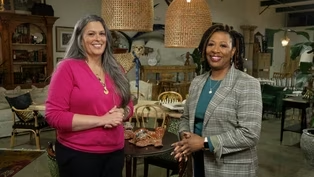
I'm Deborah Holt-Noel, and this week, we're discovering unexpected finds around the state.
I'm at the Whitehall Exchange in Southern Pines, where there's something unexpected around every corner.
This massive space is packed with vintage treasures, antiques, and creative pieces from a community of vendors all under one roof.
We'll explore it a little later in the show.
- Let's head east to Bertie County, where a new storefront is helping preserve something deeply rooted in culture and history, seeds.
Let's find out how Bertie County Seeds is helping to connect growers of all kinds.
In the riverside town of Colerain, something extraordinary is taking root.
It looks like a seed store, and it is, but it's also a living seed depository intent on promoting food security.
- So of course, we have a lot of different gardening necessities, but also have a lot of pantry items, dry good items, where most items are from different small businesses in North Carolina.
- Gold rice.
- The gold rice, that's a big one out from Oriental.
- The variety and value here is staggering.
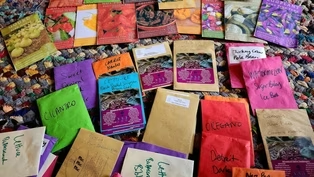
Bertie County Seeds has nearly 1,000 varieties, which have been lovingly cultivated to thrive.
You can buy a little or a lot.
It gives people the opportunity to come in and see the seed that they're buying, price by the ounce, but we'll sell them a half ounce, quarter ounce, whatever they want.
- I'm really enjoying seeing all of the different medicinal herbs that are in the seed packets, and I really like getting a bunch of the Jerusalem artichoke tubers, so that I can have some perennial vegetables in my garden.
- Native chefs like Adassa Patterson host cooking demonstrations to share culinary technique and to celebrate delicious indigenous foods.
Beth and Frank have preserved ancestral seeds for nearly two decades.
- I've been working with the seeds since the 2010s as part of a program to reconnect people to our seed work, and we're talking about ancestral seeds that's been passed down for thousands of years from different people, not even just our tribal community.
Some of these things were given to us, you know, with writing on the package, last known sample, so no pressure at all to keep these things going.
And when COVID happened, all the major seed companies across the United States shut down, so after the toilet paper ran out, the seeds were the thing.
Overnight, we had over 30,000 people just come to all of our social media, reach out, we're making orders nonstop.
That's kind of like where we get the world's biggest little seed store, 'cause even from our start, and operating out of a cardboard box, people treated us like we were this massive seed store.
- Incredibly, this little seed store sells nearly 9,000 packets of seed a week.
Their mission focuses on ensuring food security and environmental sustainability for indigenous people and their community.
- We're still passing on these ancestral seed techniques and traditions, but we're doing so in a modern cultural context, so we're doing it together.
- Colerain used to be the largest freshwater fishery in the world.
They used to fish and can a lot of herring out of the Chowan River, which is just about a mile and a half down the road from us.
- The residents have great hope that the seed store will help Colerain blossom.
- A lot of people just have pride in and around Colerain and that history and the economy that once was.
And there's still plenty of people that are hopeful this economy can kind of revitalize itself here.
They're starting to adopt our vision and see what can come from the work that we are bringing to this town.
- Yeah, it's just been so fun to have what we are calling that third space for folks to come in and talk seeds and talk story.
And so often, they have just the most amazing things to tell us, and there are so many indigenous folks out there that are hungry for this, and are just ready to take on this charge.
And so we are looking to work more closely with indigenous growers, but also open that up to folks who are willing to grow with us while creating really great, healthy seed and supporting different communities all over the country.
- I can't wait to plant these seeds.
I don't know about you, but I've never seen orange okra before, and I now know where to get more beautiful varieties, right here at Bertie County Seeds in Colerain.
- Bertie County Seeds is located in Colerain at 124 South Main Street.
For a detailed listing of their hours, visit them online at allianceofnativeseedkeepers.com.
I'm here with Jessica Yockey, the owner of the Whitehall Exchange, and this place is really amazing.
How would you describe it?
- It's a 8,400 square foot building.
It's a group of 10 vendors from woodworkers to antique dealers to designers.
I've been doing this a long time.
My grandfather, he kind of always picked up stuff along the way, which then taught my father to do that as well.
We started going to yard sales and flea markets from a very young age.
He has a great eye.
I think I probably picked that up from him.
He's pretty much taught me everything I know.
I think this area needed something like this, a little bit less antique store, home decor, design-oriented.
There are pieces in here that we take and make new again.
We add current upholstery, kind of update heirloom pieces.
We exchange ideas.
That's why I kind of wanted to do the exchange situation.
- You have a collection of vendors here.
Tell me about those different styles and how you chose them.
- I chose each vendor because I've known them over the years.
We've all kind of worked together on different projects.
We all have a different style, but it all meshes well, so I do love that.
It's just a big group of people that love what we do.
I'm Danielle Dana.
I have Camellia Cottage, and my style is more traditional.
Traditional china, silver, things that you serve with, things that your grandmother probably had that a lot of people put in their cabinets.
And I want it to be in a condition that you can take it home and use it.
I want the fabric to be in a style and a pattern that would blend with anything that you might have at home.
So this cabinet, it's just a beautiful representation of English antiques.
So another piece is this pair of Staffordshire dogs.
I actually found these, and on the bottom, it showed who had owned them, and then they had willed them throughout their family.
So they are a reproduction, but probably from, you know, dated back like '50s or '60s.
- Our shop is called One Rooster Farm.
We live on Connecticut Avenue in Southern Pines.
The house is 1851, and so Union troops were right down the road, and they came to this farm during a skirmish, and they took all the chickens and left one rooster.
This particular quilt, when you hold it up to the light, you see the cotton batten, but you see all the little brim specks of the cotton seeds that weren't ginned out, which I find an indication of an early quilt.
This cupboard is early 1840.
Pegged doors, has the spoon racks on the front of the shelves where they stored their spoons.
A cabinet that has pegged doors where the tenon is mortised all the way through.
You know, square nails, handmade nails is an indication of an earlier cabinet that might not have those details.
So that in itself, instant indication of age.
It tells a story, you just have to look.
- So I'm Max, and this is Charlie, my daughter.
And we have a, and my wife, Mindy, we have a company called Stubby K Studio, and we do custom woodworking.
We have some leftover pieces, and that's, we make these cutting boards and bourbon smokers with offcuts from that.
And then, of course, we make stuff like this desk, this adjustable height desk.
- This adjustable height desk is made from monkey pod.
It's incredibly beautiful, and it's got a lot of little cool characteristics to it.
This, with the North Carolina inlay, is leopard wood.
Got some wormy maple and then black walnut.
So we have different styles of wood we work with, just 'cause it's fun to have different characters.
- Bourbon smoker, interesting story.
I, you've seen bourbon smokers before, most of them have you put the torch on the top and you blow smoke down into it.
Has a little fixture here that you put wood chips in, and it puts fire to it, and you turn this pump on.
It's a backpacker's pump, and it will draw air through there up into here and smoke your cocktail.
(upbeat music) - We offer something for everyone.
Not everyone is gonna come in and want a leopard game table, but they may want a traditional dining table, so.
- You just gotta come look.
- Yeah.
We have a great community response, and I'm excited about what the future holds.
- Well, I've already seen a lot of exciting things here, so I look forward to looking around a little bit more.
(upbeat music) - The Whitehall Exchange is located at 5496 US 1 in Southern Pines.
They're open from 10 a.m.
to 5p.m.
Tuesday through Saturday.
For more information, you can call them at 910-684-7025.
Or visit them online at thewhitehall-exchange.com.
Another place where you might find something with a story to tell is the Aurora Fossil Museum.
Inside, visitors will learn about North Carolina's prehistoric past.
But just across the street, you can sift through a big fossil pit and might discover bones and teeth from ancient marine life that once swam in the region.
Producer Clay Johnson shows us what he learned from his expedition.
(birds chirping) (fossils crunching) - Oh, look at that one.
- That's a really good one.
- That one's cool.
[birds crowing] - Melanie Derham and a friend are digging for fossils at the Aurora Fossil Museum.
- Came here to find some shark teeth, hopefully.
- The museum's two fossil pits are one of the most interactive components of its educational mission.
- I think it just helps people who are visual learners.
I'm one of those.
And just to be able to put your hands on it, and it keeps you excited.
You know, every time you find a shark tooth, you just get really excited.
And then you wanna know, well, where did this come from?
How did it get here?
- The material Derham and other visitors are digging through is delivered regularly by the nearby nutrient phosphate mine.
Phosphate was discovered here on the northern shore of the Pamlico River in the 1950s.
In 1965, the Texas Gulf Sulphur Company began mining it.
- And they were coming across some corals and different things, and they sent it to the Smithsonian, some of these samples, thinking, "What, why do we have coral here in eastern North Carolina?"
So the Smithsonian came down and realized and identified this as one of the rich fossil locations on the eastern seaboard for this type and age of fossils.
- The mining company partnered with the town of Aurora and local fossil lovers to create a museum in 1976.
- So the idea of opening a museum was to help with bringing people here and showcasing what Aurora has, which is now known all over the world as one of the places to visit if they wanna see this age and the fossils, especially megalodon teeth.
- Locals who found fossils at the mine when it was open to the public were inspired by them to create the museum's collections.
- It was founded and built by hobbyists, by people who love fossils, who love collecting fossils, and wanted to share it with the public.
- The museum is across the street from the fossil pits in the heart of Aurora's tiny downtown.
You enter through a gift shop filled with fun fossil merch.
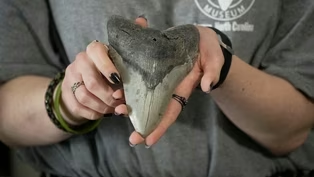
- These are our megalodon teeth.
They are roughly 23 to 17 million years old, and they're for sale here in our gift shop.
- A mock megalodon shark greets you in the hallway leading to the exhibit rooms.
There are lots of fossilized shark's teeth and fossils from whales, dolphins, and walruses.
- They're about six to 16 million years old, mostly marine animals.
- There are Native American artifacts on display and an exhibit that shows how the phosphate mining process works, uncovering different layers of soil.
- You can see some of the fossil areas within those layers, and that's where these fossils were found and discovered within the depth of this section.
- But the star of the show is a replica set of megalodon jaws.
- Where you can get up into the jaw and get your picture taken and actually connect with a large shark and think, "Oh my gosh, I'm inside a shark's mouth."
It was the apex predator of its time.
- Some of the fossilized sharks, the teeth from the megalodon can reach up to six inches, making it about a 60-foot long shark.
- Candy Corner from the museum is its learning center.
Inside, there are fossils from around the world, including some of the earliest on record.
There are rocks and minerals from all over the world too, and a multi-purpose room that serves as a classroom and event space.
The museum hosts the North Carolina Fossil Festival every Memorial Day weekend, its biggest fundraiser, but year-round, the biggest draw is the fossil pit.
- I would love to find a mag.
You know, most people are looking for the big ones.
I love snaggletooth ones too, just knowing that finding any extinct shark tooth is just, it's exciting.
- Kids love it, families love it, it's free.
It's a way for people to engage with science.
You just don't see a lot of phones or electronics out there.
You just see people out there having fun and enjoying themselves.
- Oh, here's another one!
- The Aurora Fossil Museum is located at 400 Main Street in Aurora.
For their days and hours of operation, visit them online at aurorafossilmuseum.org.
Sometimes the most unexpected finds are growing right beneath our feet.
For thousands of years, functional mushrooms have been used for their healing properties.
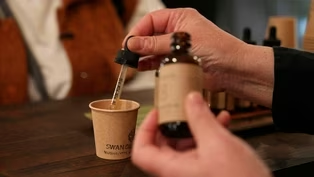
Today at Swan Creek Farm, Catherine Brown is cultivating mushrooms to create wellness products using ancient methods in a modern setting.
Producer Teresa Litsky has the story.
[lute music] - I'm a DAOM, which is a doctor of acupuncture and oriental medicine.
- Dr.
Brown began growing herbs in the 1980s.
Today, she's a mushroom farmer.
- I really loved farming.
And so the idea of mushroom farming and having an agritourism is exactly what I wanna do.
- She cultivates over 30 varieties of mushrooms for tinctures, plasters, and extracts.
She also makes coffees, teas, even jerky from her mushrooms, all from her lab and store in Hamptonville.
- We grow on wood, typically hard woods, not manure.
And we're growing these indoors.
So they don't have pests, they need no pesticides.
And functional mushrooms have been a part of Chinese medicine for thousands of years.
And I have actually worked with them for a couple of decades.
- One of the most popular mushrooms is lion's mane.
- And what they discovered is hundreds of compounds in these lion's mane mushrooms, including hirisiums.
- While reishi mushrooms have their own claim to fame.
- It is called the mushroom of immortality.
And what we call in Chinese medicine, calm the shin.
Which if you calm the shin, you can sleep at night.
So our mushroom farm actually produces mushrooms from the very beginning.
- Capturing all those wonderful benefits from each mushroom is an art unto itself.
- We process using alcohol and then water extraction.
And when you do this, you get the full spectrum of all the compounds from the mushrooms.
- Oh, hi.
- Dr.
Brown opened her lab and store to the public in 2024.
- And they can come here and they can actually see us growing the mushrooms organically.
- From that point forward, we were sold.
'Cause I'm a believer in holistic medicines, if you will, homeopathic type of things.
- Including new takes on popular foods.
- I come for the coffees.
It's got a different flavor to it.
And then, you know, people may think, "Oh, mushroom coffee."
There is the influence of mushroom flavor is minimal in there with the different things, herbs and stuff like that that get put into there.
It's just the health benefits.
- And we've got six different varieties and we have six different flavors of mushroom jerky - Oh, wow.
Got a little kick.
- It's got a little kick.
If you've never had mushroom jerky, hands down, this is phenomenal.
You would not know you were eating a mushroom and the flavors, the textures is awesome.
- Just as sought after are the medicinal herbs in her apothecary.
- Where she's leaning into her doctor of acupuncture and Chinese medicine.
- You back for some of your herbs?
- Yes, ma'am.
- Our apothecary has almost 100 remedies that are used in Chinese medicine, but for self-care.
- I am a brain tumor survivor.
- Kidney Qi helps to bring up your energy.
- You experience a lot of fatigue, a lot of cognition problems, brain fog.
I would sleep a lot.
But when I take these, I actually have energy to do my day-to-day chores.
It helps me to stay healthy.
I've actually mentioned this to my oncologist and they are fine with me taking this.
- Which is important for customers to have access to, especially right in their own backyard.
- Honestly, to have this in Yakon County is a goldmine.
(upbeat music) - Swan Creek Farm is located at 1736 Swan Creek Road in Hamptonville.
They're open Friday and Saturday from 10 to two.
For more information, give them a call at 336-448-3371.
Next, we continue our celebration of America 250 in Kings Mountain, where a local museum is preserving local stories of this community and its ties to our nation's past.
This is Kings Mountain, North Carolina, a small city in the foothills where you'll find a downtown with shops, historic buildings, local restaurants, and a museum.
Kings Mountain was named after the famous Revolutionary War battle that took place just south of where the city stands today.
The Battle of Kings Mountain was so important to the Patriot cause that Thomas Jefferson once called the battle a turn of the tide of success, which terminated the Revolutionary War.
But when we talk about the Battle of Kings Mountain, we often talk about the militiamen, but there was another presence there that is sometimes overlooked.
They're often called camp followers, mostly women and children from both sides of the conflict who had followed their husbands and fathers into the war.
In fact, at Kings Mountain, a loyalist lieutenant recorded in his diary that some of their wives were with them in the days leading up to the battle.
And when it was over, families trailed the prisoner column for days through the Carolina foothills, walking on foot, hoping for word about their loved ones.
But the camp followers were eager to help how they could, cooking meals, washing clothes, and in the hardest moments, burying their dead.
But just up the road, the city that bears the battle's name is still telling that story.
And the Kings Mountain Historical Museum is where it comes to life.
The museum's current exhibit, Women at the Edge of War, runs through May 30th and highlights the often overlooked role of women on the North Carolina frontier, keeping families together, supplying armies, and in some cases, gathering intelligence.
- We are the connection to the community when it comes to their history here.
So we provide many programs, events, as well as school programs, so that we can educate people not only on the Battle of Kings Mountain, but also the rich history that comes with the town of Kings Mountain as well as Cleveland County.
- Their next exhibit, Catawba Nation and the Fight for Independence, opens June 30th.
After the museum, if you want to stretch your legs, the nature trails of nearby Kings Mountain National Military Park connect you to miles of scenic backcountry, the same land those camp followers once crossed.
Some cities are named for famous people, some for geography.
This one was named for a battle that helped save a revolution.
- On top of us having the history of the Battle of Kings Mountain, we are just a very loving, outgoing community.
- Personally, I love being in downtown Kings Mountain.
We've got great boutiques.
We have good restaurants in town.
We have a winery nearby.
We have a lot of hiking in our area.
- Each fall, the city of Kings Mountain brings its revolutionary history to life through the Liberty Mountain Theatrical Production, immersing audiences in the story of the Battle of Kings Mountain.
- We do have many citizens who have ancestors at the Battle of Kings Mountain, but even if you don't have a patriot at Kings Mountain, you can still be very proud of our town's history.
I look at it as something that we as a community should be proud of.
We should be glad that they took that risk, and it makes me feel more confident in the things I do, because if they can get through that, I can get through anything.
(birds chirping) - Kings Mountain Historical Museum is located at 100 East Mountain Street in the heart of Kings Mountain.
Hours are Tuesday through Saturday from 10 a.m.
to 4 p.m.
For more information, you can give them a call at 704-739-1019, or go online to kingsmountainmuseum.org Well, that's it for tonight's show.
There's something unexpected to be found in just about every corner of our state.
You just have to know where to look.
The Whitehall Exchange here in Southern Pines is a great place to start.
And if you've missed anything in tonight's show, just remember you can always watch us again online at pbsnc.org, and you can find all of our stories on our YouTube channel.
Have a great North Carolina weekend, everyone.
(upbeat music) ♪ - Funding for North Carolina Weekend is provided in part by Visit NC, dedicated to highlighting our state's natural scenic beauty, unique history, and diverse cultural attractions.
From the Blue Ridge and the Great Smoky Mountains across the Piedmont to 300 miles of Barrier Island beaches, you're invited to experience all the adventure and charm our state has to offer.
- This program is made possible in part by generous support from the American Battlefield Trust, connecting you to the places where our nation was forged.
Visit battlefields.org today.
Video has Closed Captions
Clip: S23 Ep17 | 4m 58s | Dig into the past at Aurora Fossil Museum and uncover North Carolina’s prehistoric history. (4m 58s)
Video has Closed Captions
Clip: S23 Ep17 | 4m 39s | Discover heirloom seeds and rich agricultural history at Bertie County Seeds in eastern NC. (4m 39s)
Kings Mountain Historical Museum
Video has Closed Captions
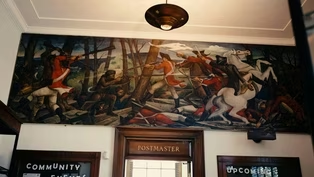
Clip: S23 Ep17 | 4m 6s | Explore Revolutionary War history at Kings Mountain Historical Museum. (4m 6s)
Video has Closed Captions
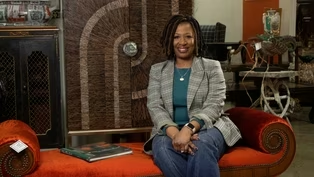
Preview: S23 Ep17 | 20s | Discover hidden treasures and unique experiences across the state. (20s)
Video has Closed Captions
Clip: S23 Ep17 | 4m 29s | Learn about functional mushrooms and wellness products at Swan Creek Farm in Hamptonville. (4m 29s)
Video has Closed Captions
Clip: S23 Ep17 | 4m 58s | Browse vintage finds and unique treasures at the Whitehall Exchange in Southern Pines. (4m 58s)
Providing Support for PBS.org
Learn Moreabout PBS online sponsorship













Support for PBS provided by:
North Carolina Weekend is a local public television program presented by PBS NC