
Vintage First Finds, Hour 5
Season 30 Episode 20 | 52m 45sVideo has Closed Captions
Discover today’s values for ROADSHOW’s first finds, including one with a whopping update!
Discover today’s values for ROADSHOW’s first finds including a 1933 Duck Soup movie poster, an 1867 Carl Haag watercolor, and an Edward Gilpin watch, ca. 1670. One item purchased at a house sale has a whopping value increase to $50K-$75K!
Problems playing video? | Closed Captioning Feedback
Problems playing video? | Closed Captioning Feedback
Funding for ANTIQUES ROADSHOW is provided by American Cruise Lines and Ancestry. Additional funding is provided by public television viewers.
Support provided by:


Vintage First Finds, Hour 5
Season 30 Episode 20 | 52m 45sVideo has Closed Captions
Discover today’s values for ROADSHOW’s first finds including a 1933 Duck Soup movie poster, an 1867 Carl Haag watercolor, and an Edward Gilpin watch, ca. 1670. One item purchased at a house sale has a whopping value increase to $50K-$75K!
Problems playing video? | Closed Captioning Feedback
Where to Watch Antiques Roadshow
Antiques Roadshow is available to stream on pbs.org and the PBS app.
Buy Now

ANTIQUES ROADSHOW's 2026 Production Tour
Enter now for a chance to win a pair of free tickets to one of the three stops on ANTIQUES ROADSHOW's 2026 Tour. Sweepstakes entry deadline is April 6.Providing Support for PBS.org
Learn Moreabout PBS online sponsorship♪ ♪ GUEST: I went to a house sale and this baseball was in the back, so I bought it for probably a quarter.
There's a letter in here which I, quite frankly, is one of the most poignant letters I've ever read.
Amazing.
Absolutely amazing.
♪ ♪ CORAL PEÑA: In 1996, our very first season, "Antiques Roadshow" traveled to 13 different states.
In this episode, we're revisiting the hidden treasures we unearthed in the heartland.
Crowds in Illinois, Michigan, Missouri and Minnesota rolled in for free evaluations of their most cherished heirlooms, not realizing they were about to become part of a cultural phenomenon.
But how has time treated these first finds?
Let's look back at the Midwestern stops of that maiden voyage to see how the market has shifted over the last 30 years.
GUEST: My mother was born and raised in New Zealand, and she was a war bride when she came over from New Zealand to live here in the States.
This was a piece she brought with her.
It was hanging on our wall in our living room for a number of years.
It didn't belong to her family, somebody gave it to her.
APPRAISER: And was it kept in a, in a cherished place (chuckles) or was it just left in a drawer or...?
We... I was told it was a fertility symbol.
We didn't have a lot of children, (chuckling): so I don't know if that... Ah.
No, I kept it in a drawer for the last 20 years in a box.
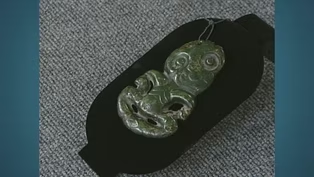
Well, it is, in fact, a, uh, fertility object, uh, from the Maori of New Zealand.
This is a very beautiful example.
Many of these today that you see are actually, have been made as copies, fakes, in the last, uh, 30, 40, 50 years.
Uh, I am quite certain, 100% certain, that this is actually... a-a-a real tiki, as they're called, Maori tiki, um, made from greenstone or jade.
It is, in my opinion, that it dates to certainly before 1850 or the first part of the 19th century, and it possibly is 18th century.
I've been able to ascertain its date based on a couple of things.
The amount of wear here around this hole.
These were worn strung around the neck, and over time, the-the neck cord would actually wear away the jade, giving you this sort of rounded impression.
One of the things we look for, uh... ...or specialists in this area and collectors in this area look for is, uh, the, the sculptural quality of these.
Uh, some of them are flat, uh, much flatter.
This one has nice size and volume to it.
It's rounded area in the belly.
In terms of valuing objects like this, larger examples tend to be worth a little more.
The record price for a tiki of this type is in excess of $60,000 American dollars.
Excuse me?
That is the record, uh, in... Was that 6-0?
$60,000.
$60,000 American dollars.
It is, in my opinion, that your example here has a fair market value of somewhere between $10,000 and $15,000 American dollars.
Amazing.
Absolutely amazing.
To think it was hanging on the wall.
By this cord.
(chuckling): By that cord!
Hi, thanks for coming in today.
GUEST: Thank you.
You brought us a wonderful object here.
Tell me a little bit about how this came to be in your possession.
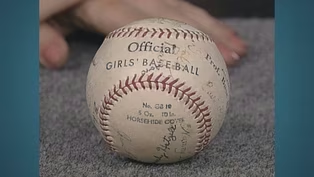
Well, probably somewhere between 15 and 20 years ago, I went to a house sale and this baseball was in the, in the box, and it had all these, uh, wonderful signatures on it.
But what intrigued me was it was from a girls league, so I bought it for probably a quarter.
Wow.
Took it home, put it in a drawer, and when the, uh, movie "A League of Their Own" came out, I said, "Where is that baseball?"
(laughs) And I went and dug it out and sure enough, it's from the All-American Girls Professional Baseball League.
Your story is just absolutely wonderful about it.
Um, you have, of course, as you say, a signed baseball from the official professional girls league.
And it's signed from the team in the year 1950.
And then everyone who was on the team as well.
Um, you have the wonderful signatures here of-of some of the great stars.
Beverly Hatzell.
When you think of sports memorabilia, 90% of the market is, of course, baseball.
But it's all Babe Ruth and Lou Gehrig... Yeah.
...and all the great stars that we know who are men.
Um, and this is, this is terrific-- do you, um, have any idea, did you try to find out what this was worth?
I've been to, uh, some of the sports memorabilia shows and they look at it and then they, they can't give me any idea, because they've never seen one either.
(chuckles) Well, certainly the women's leagues were a very important event in baseball.
Um, hotly contested, as you would imagine, by the men, um, to have them enter, and, um, they often started by hitting to the minor league teams as well... Mm-hmm.
... um, pitching for them.
Um, I have only actually seen a ball like this come up once before at auction, and it was not as good as this.
It was, in fact, shellacked.
Um, very often balls have a yellowish appearance to them... Mm-hmm.
...and that's because the balls were shellacked, and the shellac actually, over time pulls the, um... ...the different autographs and signatures off... The signatures, oh... ...onto the varnish, and they in fact, begin to discolor tremendously.
And so this would be in really, really very, very nice shape with all the anecdotes, and, uh, all the signatures on them.
Do you yourself have any idea of what it might be worth?
I have no idea.
Well, I-I have to say I think you did a little better than a quarter.
Um, I... (chuckling): Okay.
...the ball that was sold at auction about three years ago, um, had a pre-sale estimate of $2,000 to $3,000 on it.
Oh, my God.
And it actually sold for $4,200.
Oh!
That's astounding!
So you have, um, a very rare collectible here... Oh, my God.
...and, um, I... something that certainly is very valuable and something that's worth holding onto.
Well, it's going into the vault now!
Thank you!
Thank you very much!
I'm-I'm looking at certainly the oldest item that I've had a chance to look at today.
Huh.
And it's-it's-it's great to be here with you and-and to look at this chair.
Tell me, how did you come across the, the chair?
It came out of an estate sale in a small town not too far from here, and it was kind of a parlor game to figure out what it was.
People who were interested in furniture kind of enjoy looking at it, so.
So you've had people, people that have visited you have come over and-and you've said, "Come on.
You- you take a guess at where it was made and how old."
You think, you know, stylistically, furniture and so on, tell me about it.
And what have they, what have you come up with so far?
Have you had some people say that it's Czechoslovakian or Russian or...?
(chuckles) Well, uh, no, typically English, I've heard, and, um, early 17th century to Arts and Crafts in the 19th century.
Right.
Right.
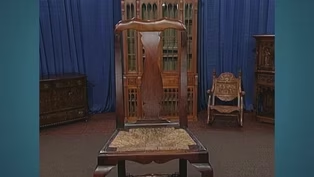
Believe it or not, the chair was made in Bermuda.
Ah.
And when it was a British colony, which it still is a British colony, I understand, but probably in the, uh, the 1730s or 1740s.
Hm.
And Bermuda was actually a source of a lot of English furniture.
The mother country would send these Queen Anne chairs to Bermuda.
By the 1730s, Bermuda was making its own works of art like this, just as furniture to export, and furniture for their own use.
Mm-hmm.
So it's come a long ways from Bermuda.
Um, I, you-you love... wouldn't you love to know how it came all the way from, uh, Bermuda to... To Missouri?
To Missouri.
Well, it's a Queen Anne chair, okay?
And the great thing about it is that you-you-you see this, uh, S-curve.
And this curve really started first in China, but then in England in the late 17th century.
And it's really known as Hogarth's Curve.
Hogarth wrote a book in 1753 called "The Analysis of Beauty."
And in the book he says that the most beautiful line in nature is this S-curve, and it's based on the line in a woman's back, that wonderful line.
That's why I kind of like that, uh, that line a lot.
Yeah.
That's why Queen Anne's my favorite style.
But it also fits the back very well because your shoulders are up here, the lower back is down here, and it supports the back and fits the curve.
Right, it fits very nicely.
So here you have that nice S-curve, that kind of sexy curve, uh, on this leg.
And very nice peak knee coming down to really what is, what is known in the trade as a Flemish foot.
Ah.
And it's joined by these, these stretchers, which I-I love the way that it's, they're worn.
Isn't that great?
This is from over 250 years of feet, probably 18th century shoes at one time, and now 20th century.
Nate, did you ever put your shoes there?
Yes, I did.
Softly did, okay.
You probably are wondering, how do we know Bermuda?
Right.
I mean, the one big giveaway is that it's made of cedar.
Oh, is that right?
It's actually cedar wood.
That's why no one could guess the wood then.
No one was looking for cedar.
It's... exactly.
It's, and it's distinctive of, uh, for Bermuda furniture, they had this native wood there.
So they made these chairs in the English style in the wood that they had locally, which is, which is cedar.
And there are people that collect only Bermuda furniture, so this is, really makes it quite a rare, really a rare item.
Mm-hmm.
But I'm going to tell you, there's one thing about it that's happened.
Well, first of all, the crest rail broke off at one time.
It might have fallen backwards.
Mm-hmm.
Some kind of a brawl, and you can see these repairs, do you see how graceful this is?
But then you get up here, and it's kind of clunky.
Right.
What they also did... And is this cedar?
Still up here though?
This is, this looks like a-a hardwood, and I'm not sure it's cedar.
It-it could be a maple-- what they did, though, is they put the splat back on upside down.
(laughs) So that's why the curve is a bit funny.
You see, this kind of should be out here and, and so that your shoulders would go back.
Oh, right.
So they kind of said, it probably broke.
Somebody stuck it on and said, how does this damn thing go?
(laughs) You know, and they kind of, they finally got it upside down.
That's great in profile.
So-- isn't that neat?
Isn't that a neat profile?
So that's really the, the way the splat would have been originally.
Ah.
And it would have made these kind of little Tweety bird heads at the top up in this area.
These little-- I always think of it as a, like, a little bird's beak.
Does it look like that?
A little bit.
Yes.
Right.
So if the chair hadn't been repaired, its value would be probably about $4,000 or $5,000 as a rare Bermuda chair.
Because of the crest rail being replaced, it's probably worth still, to a collector, around $1,500 to $2,000.
Hm.
Well, we're standing here right now with something very exciting for everyone from Kansas City to see.
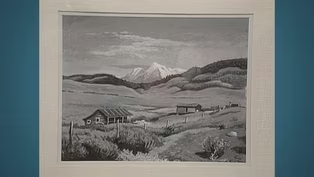
It's an original Thomas Hart Benton, who's a local artist, and I'd like you to tell me a little bit about your history with the artist.
Tom Benton was, uh, an outdoorsman.
My father was a great duck hunter and fisherman, and he and Tom Benton went out and-and, uh, spent a lot of time fishing and hunting together.
So basically, uh, this picture reflects Tom Benton's love of the outdoors.
And this is Wyoming.
This particular picture is, uh, the Grand Tetons, and it reflects the kind of feeling he had for the western part of the United States.
Right, well, it's, it's nice that you have this history with the artist, that you knew him and that you got the picture directly from him.
It has a nice clear signature here with the date '55.
So for anybody who might have a Thomas Hart Benton at home and they want to compare the signature, that's a pretty good one to take a look at.
It's also great that you know that this is the Grand Tetons, uh, from Wyoming.
It always helps when you know the actual location of the landscape.
This is a work that's done in egg tempera, which is a water-based paint that the egg yolk has been added to, which, which Benton used a lot.
And it's, we have a French term that we use when we're talking about a work like this, which is called en grisaille, which means that the work is done in black, white and gray.
So we would call this tempera en grisaille.
And I think that maybe if we were to sell this at auction, it might bring between $10,000 and $20,000.
Thank you very much.
GUEST: My mother was an antique hound, and she bought it at a small antique dealer that she was friends with.
She told us it was old.
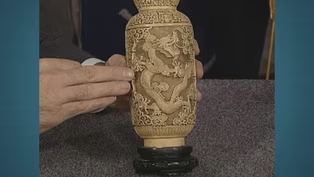
One of the things that caught my attention was the dragon... Mm-hmm.
...which most people associate instantly with Chinese or Japanese art.
Mm-hmm.
Often you hear the mythology about a five claw dragon denotes that the object was made for imperial use, for the imperial household.
Ooh, interesting.
And if you had four claws, that means it wasn't.
Mm-hmm.
But this happens to have five claws.
Oh, this is getting interesting.
As one looks at it more and more, you start to look up here at the top.
And as ivory, ivory always has sort of a grain to it.
Okay.
It's like a tree ring.
If you look on this, you notice that there isn't any tree rings.
And in fact, what we've got is a piece of plastic.
Is it really?
(laughs) It's plastic.
That's funny.
And it has, it has a value of probably not more than about $5 or $10.
(sucks teeth) Interesting-- well, I guess Which is a great shame.
that antique dealer didn't pa-pass on such a great find, did she?
(laughs) Well, adds to the story, so that's good.
You're a hardy soul to lug such a big piece.
Oh, sure, I got my workout today doing this.
I think it's the biggest piece I've seen yet on the, on the "Roadshow."
(chuckles) Um, so what can you tell me about your carpet?
Well, uh, I inherited this from my grandmother, actually.
Uh, as far as I know, she purchased it probably in the 1920s.
Mm-hmm.
Had it in the dining room of her house.
And she had a companion rug to this in the living room.
It was larger, probably about 12 by 15.
Um, in the '50s when they put wall-to-wall carpeting in, she moved it upstairs to an upstairs bedroom.
And, uh, I always absolutely loved this rug.
I just thought it was one of the most beautiful things I'd ever seen.
It's quite a nice carpet and it's also in wonderful condition, which is nice to see in a carpet like this.
It was probably new in the 1920s when your grandmother acquired it, 'cause that's where it dates from.
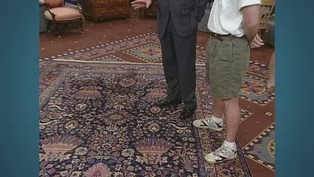
It's a carpet from Persia.
It's an Iranian carpet from the city of Mashhad, which is in eastern Persia.
Um, and I want to point out one thing about how you can identify that.
Mashhads are great.
The Mashhadi weavers were great in that... area.
Mm-hmm.
So whenever you see this multicolored finish here on the edge of a carpet, you can be pretty much assured that it's been woven in Mashhad.
For the rest of the carpet... ...the design is picked up.
It's really a derivation of a 17th century design that you would see used throughout Persia.
Mm-hmm.
Primarily, uh, in the cities of Isfahan and also around Mashhad and Khorasan.
Mm-hmm.
And it's just a nice representation of the Persian version of paradise, which is a lush, plentiful garden.
Do you use the carpet?
Actually, no, I don't.
I don't really have a place to display it properly right now.
So it's been rolled up in a spare bedroom (chuckling): in my mother's house.
Oh, okay.
Have you ever had it appraised?
Never.
Do you have any sense of its value?
None whatsoever.
Well, I would say because it's a great design with wonderful color and in just immaculate condition, if you're going out to buy this rug today, you'd be looking at a price of around $15,000 to $20,000.
Not bad for a little inherited piece here.
Yeah, yeah, well it's worthwhile taking care of as well.
All right.
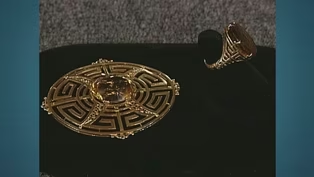
GUEST: My great aunt lived in North Hollywood, California, and she had a friend there who gave these to her.
Uh, that woman, when she was very young, married a European count or some royal personage and when he died, they were childless.
The state was en... the estate was entailed.
This jewelry is all she had.
It is my understanding that this originally contained either emeralds or sapphires, and including the family crest on the ring.
She fell on hard times.
She sold the stones and replaced it with these stones and had the crest carved into the stone on the ring.
And didn't you tell me as well that she worked on films in Hollywood?
She was a historical advisor to the films?
That's right.
Fo-- they went through a period in the '40s with, um, Essex and Elizabeth and, and those kinds of films, and she gave them court protocol and stuff from... So she really knew... ...yes.
...what she was doing... Right.
...when she was, um, putting the costumes together or the jewelry together for a show.
Right.
Right.
Well, she showed her knowledge in terms of these pieces of jewelry, because when she replaced the stones, um, she copied the crest that was on the original stone, as you had originally indicated, and she kept the integrity of the piece by replicating the crest that would have been on the original piece.
Sideways you see the, uh, beautiful openwork gallery.
That was done at the beginning of the 19th century.
And this was done by hand, and it's beautifully crafted.
Uh, this was obviously made, uh, by someone who was a fine jeweler because the workmanship is so good, and it would have been in keeping with the stone and the valuable stone that you were talking about that was in here originally.
And when you look at the brooch, if you hold the brooch up, you will see that the motifs that are in the ring, the little floral motifs, are repeated in the brooch, and the geometric quality, uh, is repeated in the brooch again, so that everything about this shows that the pieces were made at the same time.
Do you have any idea of how much this is worth?
No, I know that the stones are not valuable.
Well, they're a pretty color for a citrine.
They're a, a nicer color than is usually on the market.
What do you think that they're worth?
Maybe $500 for the pair.
$500 for the pair, well, it's, it's my, uh, pleasure to tell you that a pair, uh, this ring and this brooch together are probably worth about $3,000.
No kidding?
Yeah.
Because of this beautiful workmanship that I pointed out to you, because of how finely crafted this is, the integrity of the piece, and how uncommon it is to find jewelry that hasn't been damaged.
So you're very lucky to have this set.
Yes, I am.
And I'm so pleased that you brought this today to show it to me and to share it with me.
Me too.
(laughs) Uh, because I've seen a little bit of history.
My grandmother, um, and grandfather were missionaries to Japan in 1910.
Really?
And they were invited to the emperor's palace for tea one day, and the emperor served um, tea on this tray, and my grandfather happened to, um, be so impressed with it, that he commented on how beautiful it was, and the next day, the emperor sent a messenger out to his home with it, so.
Really?
That's really interesting.
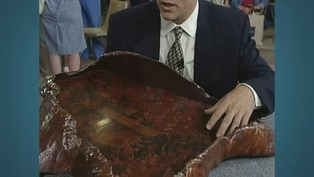
Now, I-I think that, you, you know that this is a Japanese lacquer tray.
Right.
And that they originally used lacquer as a way to protect wood to keep it from splitting and cracking as the seasons changed.
And as that lacquer protection became more and more prominent and proper, then they be-began to use the lacquer as actually an art form.
So that actually, layer after layer of lacquer were put on the piece to make these interesting designs.
And one of the most popular designs in all of Japan were, uh, scenes from nature, beautiful things.
And here we have a few birds in an idyllic garden setting.
You can see the details with gold highlights and lacquer, as well as your dark black lacquer, a lot of brown lacquer.
And then you have this kind of burgundy lacquer ground on it.
What's unusual about this tray and what I really like about it is this built up tree trunk, kind of, effect along the edges.
It's very unusual to find a tea tray like this just because mostly they're very utilitarian, in other words, just flat with double handles.
But this gives it a real kind of slice of the tree and hollowed-out feel that, uh, I think makes it very unusual.
Now, one of the things that affects value on something is condition.
And I noticed that we do have some, some damage here.
Right.
Which is common with older lacquer-- where were the damaged areas?
Uh, right down in... Okay.
...in the ba-- uh, bottom area.
Right down in here.
So we're going to show you the bottom corner.
So it really doesn't show that much visually.
So you see here in the repair... ...that really no effort was made to continue this design.
It was just kind of repaired and they tried to match color.
Right.
Unfortunately, that, that will affect your value of the piece.
Sure.
Uh, still, the rarity of the piece, um, and also the story behind it, which I think is a great story, uh, would make this something very desirable to a collector today.
And we would imagine a piece like this, even with the damage, would be between, like, $3,000 and $5,000 at an auction.
Pretty good.
It would be worth a lot more than that if we did not have the damage.
Right.
Um, do you have any kind of paperwork or things that, uh, back this up?
No, I don't.
No, uh, other than it is, um, I do have a photograph at home, and I tried to find it before I came, with, uh, the house that my grandparents were in, and this was setting in the house at the time, so.
That's a great photograph, a photograph of the piece... So I have to find it.
...in the period is something very important to have.
Mm-hmm.
Right.
Right, right.
I'd find it and keep it with it.
As well as anything that documents their experience in Japan, and this piece in Japan.
Right.
It can only add to the value of it.
APPRAISER: What can you tell me about the painting?
Well, it was purchased by my father, uh, shortly after World, World War II.
Mm-hmm.
And, uh, it's been in the family ever since then.
It, uh, hung in my grandmother's house and then in my father's house, and it's just always been in the family.
Mm-hmm.
The, the folklore behind the painting, and I-I don't know if there's any truth to it, is that it once hung in Windsor Castle.
Huh.
This is an example of Orientalist painting.
And basically what the Orientalist movement was about was 19th century armchair adventurism.
Uh, you know, we sometimes think of that as a 20th century idea.
But even back in the 19th century in Europe and in the United States as well, um.
The people back home were just fascinated with what was going on in the Orient.
Uh, sometimes the artists actually traveled to Egypt or to the Middle East, but other times they would do fanciful ideas, very romanticized, with beautiful people in beautiful situations, with richly detailed animals and figures that really spoke to the high drama of what people's imagination that the Middle East was about during that time.
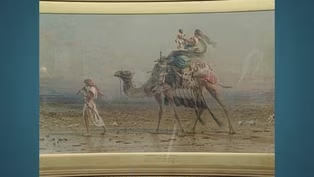
Uh, the, the painting is by Carl Haag-- H-A-A-G, who was a Swedish artist.
Uh, he was born in the 19th century and died in 1915.
Uh, you can see that the painting, uh, the, the watercolor is signed and dated lower right.
"Carl Haag, 1867."
So we're looking at a piece that really speaks to the top, top, uh... period for him.
When he was at the full, uh, flower of his Orientalist style.
And I think you can see this very well in, in the beautiful watercolor handling of this figure.
Uh, we see that the piece is called "Happiness in the Desert," which is a pretty romantic title for the piece.
(chuckles) It's a wonderful watercolor, a great example of Orientalist style, a great example of the artist's work, and something that, uh, is also a large format example of his work.
I would value it between $50,000 and $75,000.
Really?
Yes.
Wow, I didn't expect that.
You got it.
Uh... uh... Well, thank you very much.
Well, you're welcome.
Uh, I appreciate it.
I received this as a gift about ten years ago from a friend who lived at the time in the U.S.
Virgin Islands.
She was told that it probably was, uh, salvaged from a wreck in that vicinity.
What you've got here is a bottle made of stoneware, and it was designed exclusively for holding a particular type of soft drink popular in Victorian Britain, which we call ginger beer.
I see.
They're made of stoneware because ginger beer was very effervescent and if it was held in glass, it was found, it may tend to explode.
Ah.
Uh, particularly, you can imagine if it was on a rolling sea... Yes.
...and this would have been enjoyed by a sailor, I suspect, in the second quarter of the 19th century.
Stone ginger beers like this, even a nice interesting one, uh, have a value of not much more than $40 or $50.
Yes.
I thought it was probably an item of curiosity rather than value.
Okay, well, thanks for bringing it in.
You're welcome, thank you.
GUEST: A neighbor next door had purchased the picture and their child was afraid of the picture.
It scared her.
APPRAISER: Right.
So they gave it to my parents and it... (chuckles) And you ended up with it, right?
...we ended up with it.
And it was hanging, has been hanging around in the house, so.
Around, right.
So, and do you have any idea of what the value might be for this piece?
I have no idea.
No idea.
No.
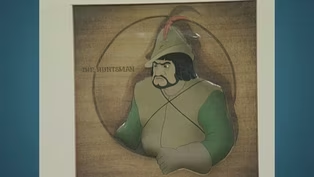
Okay, good-- this is, it's a wonderful animation piece-- animation cell.
And the background you can see here is a wood veneer background.
And that was very typical of the Courvoisier Galleries, which was an animation art gallery in San Francisco that was actually the first licensee for Disney to distribute these animation cells.
Now, what's nice about this is that what's very important is that his eyes are open.
And that makes a very big difference in the price of what a piece is worth.
Collectors look for animation art cels with characters with their eyes open and that have, um, a discernible expression, which you said it scared the little girl who lived next door.
Yes.
So this obviously has a very stern expression.
The other thing is, is, as I stated, the background, Courvoisier Galleries, very collectible for certain collectors that are looking for cells that don't have production backgrounds-- if it had a production background that was actually used in the film, then that would be much more valuable.
But the Courvoisier background is very important to collectors because it's the next best thing.
Mm-hmm.
And the size of the piece also affects the value of what it's worth.
This piece, at auction by itself, would probably bring in upwards of $1,500 to $2,000.
Okay.
Um, are you still going to hang it in your bedroom or, uh...?
Uh, well, I don't know.
I'm going to think about it.
Yeah.
Good, good, but it's a wonderful piece.
Yeah, it is.
Thanks for coming in.
It... it's... we've gotten to love it.
About, uh, three, four years ago, I was antiquing and found a estate sale, and in the backyard there was a bird bath.
And in the bird bath, this statue was sitting.
It had paint from one end to the other.
I couldn't tell what the material was.
I picked it up and knew that it was heavy.
I liked the shape of it, and I thought it'd be interesting.
So I bought it for around $30.
And after about two weeks in the kitchen of trying to get the paint off and steaming it and chipping away, I got down to where, basically, what you see now.
So it sits on the coffee table now, and it's a, uh, conversation piece.
APPRAISER: Well, great.
It looks like, it looks like you did a great job of cleaning it up.
And it appears that the, uh, paint might have preserved and protected it, certainly, from the elements, but, uh, it looks in great condition.
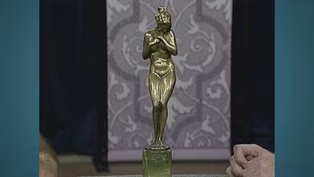
Uh, the material is actually bronze.
I don't know if you knew this or not, but it is signed.
The signature is rather difficult to detect.
But here on the back, Uh, you can see on, on the base of the sculpture, the name, um, Zach, Z-A-C-H.
And it's, uh, Bruno Zach, who was a, um, a sculptor working in the, uh, early part of the 20th century.
And there are a lot of collectors looking for the work of Bruno Zach.
So, then I think, uh, uh, your garage sale buy of about $30, uh, uh, I think, has a considerable more value.
And I would think that, uh, uh, currently, this would have a value of about $2,500.
And it's, it's a very good buy.
$2,500?
$2,500, exactly.
So you made a very good investment... This is fantastic.
...with your $30 pink, uh... fountain piece.
I-I found a treasure here in the backyard in the bird bath, so.
Exactly.
(chuckles) Thank you very much.
Great.
Thank you.
I got the watch from my husband's grandfather, after he passed away.
He, uh... He came from where?
He came from... Glasgow, Scotland, mm-hmm.
Glasgow, Scotland.
And what was it that he did?
He was a... He worked on watches as a sideline... He was a watchmaker.
...and, and clocks also; did clocks.
So... he probably got this watch many, many years ago.
He died when?
19... Back in the early '60s.
Early '60s.
Mm-hmm.
So... he might've had this watch early, as early as the turn of the century.
Right.
Mm-hmm.
But, um, in fact, this is actually much earlier than the turn of the century.
Um, and, like many early watches, it's fun to go exploring.
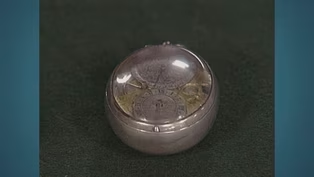
Now, this watch was as much of a precision instrument, so they would have protected it with an outer case.
So the first thing you do to look at this thing is to pick up the case and open it.
Fingernails help.
It opens up, and then the whole watch actually comes out of the case.
And we can leave this part right here.
Now, the curious thing about this is that the case is round, but the watch... is oval.
Now, watches, when they were first made, weren't worn in pockets.
Do you know why that is?
No.
Well, people didn't have pockets.
Oh.
(chuckles) And this probably was worn as a pendant.
And whenever somebody worked on a watch, they would leave their calling card inside.
So very often, you can tell the history of a watch by opening up the case and taking out the papers that you see inside the watch.
And if we're lucky, we will find out something about the watch.
There we go.
And, not only did this cloth inside the watch keep it from rattling around and protected it, but sometimes it was used as advertising.
Whatever... is in this watch doesn't tell us much about the person who owned it, except this has to do with, um, the Catholic Church.
Now, you told me something else about the watch.
Uh... my husband's elderly cousin had told me that the watch came from a cardinal of the church.
Came from a cardinal of the church.
Mm-hmm.
That makes a lot of sense, because when watches like this were made, only the very, very educated people would have wanted to own it.
So let's take a look at this watch.
Now, I think it's quite different from the kind of watch that we're used to seeing today.
You'll see that it has lots and lots of dials.
If we look at the top of the watch, we can see here not something that tells us the time.
It's a calendar, and it's engraved with the signs of the zodiac.
If we look down here, actually, there is the time.
Unfortunately, it's missing its hand.
But when it was new, it probably only had one hand.
So we haven't really lost very much.
Over here, we see a little aperture, and that tells us the day of the week.
Over here, you'll see the phases of the moon, a little aperture, and just so you don't miss anything, you see the little angels engraved on it to show you where to look.
Now let's open it up... And we look at the inside of it, and we'll see that the watchmaker has signed it.
His name was Edmund Gilpin and he was working in London.
Do you have any idea of its age?
I think you do.
In the 1600s, yes.
Right, in the 1600s.
Um, and it's an English watch.
At that time, the English were making very, very few watches.
Over the years, it's been changed a little bit, but really very, very few watches of this type survive.
I never expected to see anything like this when I came here.
And in fact, I didn't even bring my book of early English clockmakers.
So I can't tell you Mr.
Gilpin's dates, but I can tell you he was working in the 17th century.
Um, the other thing I can tell you is, is that when I first saw this watch, I had to contain my excitement.
Um, in the years that I've been doing this, about 20, um, I have seen a handful of these watches.
Um, it's an English calendar watch in an oval case, very plain.
Um, extremely rare.
Only a handful of these survive.
Most of them are in museums.
And if I were to put on my thinking cap to say, "Well, what, what is this watch worth?
I might say I'm not really sure.
But if I wanted to hazard a guess, maybe $15,000.
(chuckling): Wow.
Maybe $20,000.
Wow.
(chuckles) Um, I don't know.
Mm-hmm.
Um... I've only sold a couple of these in my life.
And with the family history, I think it makes it just that much more special.
Mm-hmm.
And I'm just delighted to have seen it.
Thank you so much.
Thank you.
What do you think it is?
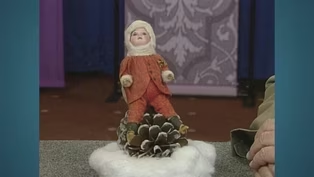
Um, it looks like a doll mounted on an... (laughing): on an acorn.
Well, let me tell you, the name of this game is you tell me what you know about it, and I'll tell you.
Well, actually, I don't know too much about it, um... I just happened to come across it one day while cleaning.
We were getting ready to move.
It was in a closet.
I'm assuming it came from, um, my aunt, who is a collector of many things.
She must have bought it at a garage sale or an estate sale of some sort.
But other than that, I don't know anything about it.
So just sort of magically appeared one day when you're cleaning house.
Right.
Right.
It's what we call a candy container, um... because on-on the back here, you'll see this little snowball, which actually is a little cardboard box that could be filled with candy or a little present or a little prize.
And then this could be used as like a party favor, or as, or as a little gift box.
Uh, often it was candy that was put in there.
So generically we call these kinds of containers-- kind of containers, candy containers.
This is a particularly nice one, because it's... basically built around a bisque-headed doll.
And it's probably a Heubach doll.
It's a German doll maker.
They made dolls like this, usually dressed in white suits, that they call snow babies.
And they were favors for holiday parties.
Or, like this, with a string attached, could be hung from a Christmas tree with a little gift in it.
What makes this one a little extra special is, it's a snow baby, but he's dressed in a Santa Claus suit.
He's a child baby in a, uh, in a s-- dressed as Santa Claus, with his little container.
And I'm, I'm not sure whether this pine cone is really original to the piece or not, but it makes a wonderful place for him to sit, to hang on the Christmas tree with a little present in his-- in the snowball on his back.
It's really just exquisite.
I've never seen anything exactly like this.
That's one of the real joys of, uh, candy containers, is they made such a proliferation, such a variety of them, that, you know, you're always finding new ones.
Uh, this one had some damage at some point on his feet, and somebody touched him up, but that's really minor, as to the value of it.
The detail is exquisite.
The condition is phenomenal.
For a, a piece of this age and this delicacy.
It dates from, I'd say... 1900, 1920.
In that period.
It's always fun to find out some history about something like this.
It's very hard to put a value on these things, because there's... a lot of them are just virtually like one of a kind, almost.
I would have to guess... I would say somewhere in the range of $1,200 to $1,500, would be the retail value.
It was a nice find.
Yes, I think it was a nice find to find in the closet and... (laughs) ...and take home.
You have a real treasure there, and you want to keep it in, in, uh, under that glass dome you brought it in.
Mm-hmm.
Because, uh, a-as I say, it's exquisite and a, a real gem.
This, um, scrapbook you brought in is very interesting.
I mean, other than the fact that it's a nice history of a woman's life and travel around the world.
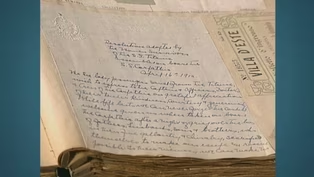
There's a letter in here which, I, quite frankly, is one of the most poignant letters I've ever read about the Titanic.
Um, can you give me a history of how you obtained the letter?
GUEST: Well, the history that I have is my grandmother bought this scrapbook at an auction, and then when she passed on, she inherited it to me, and that's all that I actually know of it.
I'd like to read this letter.
It's a very sad letter, but, uh, I think it's highly valuable.
It's a resolution adopted by the women survivors of the S.S.
Titanic, assembled on board the S.S.
Carpathia, April 16, 1912.
"We, the lady passengers, wish to express "to the captain and officers, "doctors and crew of the Carpathia "our grateful appreciation "of their tender kindness, "courtesy and generosity, "after a night of grief "over the loss of fathers, "husbands, sons, and brothers, "who in their fine gallantry and chivalry, "sacrificed themselves "to make our escape and rescue possible.
"To their memory, "we can only make too fitting tribute.
"For the women survivors, Margaret Brown, Mrs.
William Blanchett, Mrs.
George W.
Stone."
This letter could be worth over $5,000.
Anybody who collects anything on the Titanic would just... go-- be head over heels with it.
I mean, it's one of the finest source letters I've ever seen.
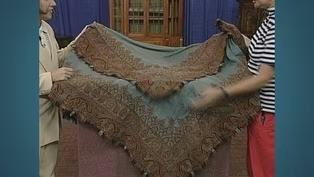
I bought it at an estate sale, and I know that the design work's pretty, but I don't know what it is.
APPRAISER: This is a cashmere shawl which was made in India in the early 19th century.
These shawls were bought by, uh, Englishmen during the colonial period, when they were traveling to India, and were brought back.
Used to decorate pianos, used to wear in the cold, uh, English winters.
It's really a marvelous piece.
It has a great colorful field in it, this blue field, which sets it apart from many of the other cashmere shawls that we see from this period, which are often black and quite dark.
Do you mind me asking what you paid for it?
I gave $15 for it.
You got a great deal.
Uh... (laughs) (laughing): How great a deal did I get?
Well, I think if this were uh, placed, uh, in a, in an antique shop, perhaps, uh, with textiles, or at auction with textiles, you might expect $1,000.
Oh, wow!
Great, great.
For a shawl like this.
Let's put it on.
(both laugh) APPRAISER: You brought a very elaborate piece with you today.
GUEST: It is elaborate.
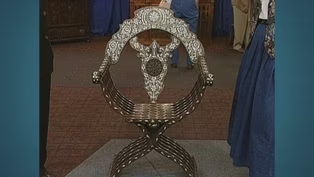
We call it the throne.
(laughs) How did you come by this piece?
Well, Bob's grandmother had it, and he says she's had it for every bit as long as he can remember.
And, uh, that's a long time.
(laughs) And she left it to him, and... Well, yeah, she... ...because he liked it?
Or... It sort of evolved that he got it.
Mm-hmm.
And, uh, we've been sort of protecting it.
We had it stored in our home, and then we got-- started getting grandchildren, and we sent it to our daughter's house.
Well, it does look like a throne, um.
It does.
It's interesting the way it's constructed with this X form, that, uh, folds up.
You know, I wondered about that, if these little businesses come out.
So it should fold up?
Well, I think that they-- they technically could be undone and the piece could fold up for moving.
Oh, yes.
Right.
Now, this makes sense when we realize where this piece was made.
But it's a nice example of a Syrian chair made in the Middle East... Wow, really?
And it's all inlaid with brass and mother of pearl.
This is a type of thing that would have been sold to people on a... on a trip.
Prob-- Like a caravan?
Not a caravan, but someone who's on a kind of a grand tour, seeing the sights.
Okay, okay.
Okay, okay.
Might bring this back probably in the 1890s.
It's got very elaborate inlay.
Sometimes it's only bone inlay, and that would have been less expensive than a nice mother of pearl inlaid one.
Okay.
And it's got this nice, uh, turned wheel form inside here, which is also something you typically see on Syrian furniture.
It's also that it's the taste of the times as well.
The 1890s, 1900, people were interested in exotic things.
And they had kind of, what-- what's called Moorish corners.
Okay.
They would take a little part of the drawing room and put their carpets and get their, their Middle Eastern furniture, maybe some hanging brass lamps and a palm, and they'd have this exotic interior.
(laughs) Had they used that or sat-- and sat there, or was it more for show?
Well, it was kind of for show.
They would also sort of entertain there.
Yeah.
It was ex-exotic, and you'd have your souvenirs there, and it was a... Okay.
It was elegant.
So it was sort of a brag corner, too.
It was, exactly.
I mean, if you went to this place and brought this home, then... This shows that, one, we've been around the world... Right.
...and two, we have "taste."
(laughing): So... Okay, yes.
(laughs) Had you had any, any idea of what it might be worth?
I have absolutely no idea.
I could probably say, if this were coming up for auction, I would estimate it at about $800 to $1,200.
So about $1,000.
(deep breath) Okay.
Okay.
Well, I have-- you know, that-- it's not a surprise, because I had absolutely no idea what we, what we had.
But I do know that I don't want my grandchildren sitting on it.
(laughs) Right.
Well, I think it's great that you've kept it in such good shape in the family... Yeah.
...all this time.
Okay.
GUEST: I went to a church rummage sale, and it was just about over, but in the corner, there was some boxes with some books.
I decided to look through and see what I could find.
And on the bottom of these books, was this piece-- cruddy, dirty, and I thought I'd buy it.
And I went up to the desk and I said, "how much?"
And they said, oh, a dollar.
So I bought it for a dollar.
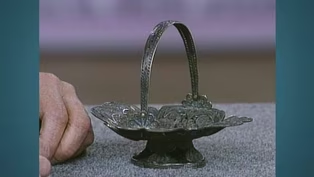
APPRAISER: Well... what you have got here, uh, for your information, is a, a Russian-- czarist Russian silver plique-à-jour, it's, which is a French word, uh, little candy basket.
Plique-à-jour is glass, multicolored glass.
It's all set in, in this pattern between little bands of sterling silver.
It's very colorful when there's light behind it.
It was made in the last quarter of the 19th century in Moscow and in Russia.
And your dollar that you spent at that church fair, uh, was a very fine investment, because this would easily sell, uh, at auction, in the range of $2,500 to $3,500.
Interesting.
What do you think about that?
Sounds good.
Sounds good.
Candy ought to taste pretty good in there.
It seems like you've got a little treasure in this box.
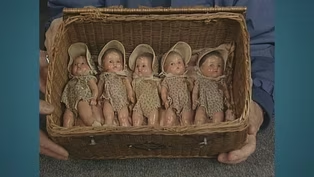
So what I'd like to do is open it up... And we're going to tilt it a bit... Now, it looks like to me what we have in here are the Dionne quintuplets.
Am I right there?
That's right.
Mm-hmm.
Can you tell me a little bit?
It sounds like you had some, uh, fun childhood play with this?
Oh, yes.
I got these, um... I think around 1940.
Mm-hmm.
I-I must've been about eight.
Mm-hmm.
And I really enjoyed playing with them for-- Well, it doesn't seem like you played with them too often, because I notice here that they all have their original clothing on.
Mm-hmm.
And every doll has its original button, which is extremely rare.
Of course, everybody is familiar with the Dionne quintuplets.
Um, these dolls were actually made after 1935, and they all have their little original name tags.
What I also noticed, as you pointed out to me be-- earlier, is that underneath here... ...there's some additional little surprises.
Mm-hmm.
Can you tell me about these?
What is, what is this little, uh, object right here?
Well, that's the little party dress that they came in.
Uh-huh.
And also under there, under the pillow, is the, uh, little slip that goes under the dress.
Their name tag under.
Well, I have to say, you were obviously very meticulous, um, as a child.
You must've not had any, uh, brothers and sisters, is that right?
That's right.
I, I... didn't have to share.
You didn't have to share.
Well... Being an only child.
...you're actually very fortunate, because, most of these type of dolls, at least what I've seen, have been very incomplete.
They usually don't have the name tags.
The clothing has been torn.
And I also noticed this looks like it's the original box, uh, or basket.
Yes, it-- yes.
So you received it like this as a, as a child?
Yes, it was a Christmas present from my aunt and uncle.
Aw.
Well, it certainly is really quite lovely.
They were made by Madame Alexander... Right, mm-hmm.
...which you're probably familiar with, who is still making dolls today.
And as I say, these were made after 1935.
So, 1940 would make sense.
Um, as a value on these, because they're so complete and because you have the original box and all the accessories, um, I would say it's going to be worth probably at auction, about $1,500 to $2,000.
(laughing): Wow.
Wow.
(chuckles) Does that surprise you, a little bit?
Yes.
Sure does.
Yeah, well, that's what they're worth.
This is a... And, um, I think you should go home now and take care of them.
(laughs) Just as you've continued to do all these years.
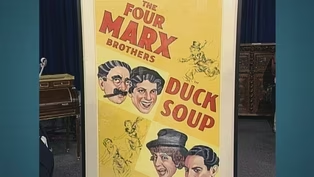
APPRAISER: Most movie posters are folded.
GUEST: That's what I understand.
Pre-pre-1988, almost every movie poster was sent to movie theaters folded, because they traveled with the film from theater to theater in between the film cans, and they would fold them.
One of the exceptions to that was a size called 30 by 40.
There's 30 by 40 and a bigger one called 40 by 60.
These were printed on light cardboard and rolled-- they were silk screened, and they were meant to be put on an easel outside the movie theater.
I mean, outside in the weather.
So very few survived, unless they were never used at all.
Where did you find this piece?
At a house sale, like, you know, just... amongst a, lots of things, you know... Now, when you framed it... Is-- was anything covered up that you remember?
Maybe a number, like a Roman numeral or something at the bottom.
Yeah.
There-there would most likely have been a series of numbers down here that's called the National Screen number.
That's possible, that's possible.
It would've been the year... which is 1933, and then a slash and three numbers.
National Screen, which distributed these posters to all the movie theaters in the United States, used to assign a, a number to every film as it came out during the course of the year.
So the first film was 001, and it went up from there.
So this is a 30-by-40 silkscreen of "Duck Soup," original from 1933.
Mm-hmm.
How much did you pay for this thing?
Very little.
(laughing): I'll tell you-- How much is very little?
To tell you the truth, I really don't remember.
How much did you pay to frame it?
Uh, that was pretty expensive.
Yeah?
That was about $350.
$350.
This poster, in an auction would sell conservatively at $15,000.
Okay.
(laughs) Really glad you brought it in, it's a masterpiece.
PEÑA: You're watching "Antiques Roadshow: Vintage First Finds."
Enjoy "Roadshow" wherever you are.
Stream full episodes, follow @RoadshowPBS on social, and sign up for our newsletter at pbs.org/antiques.
More vintage "Roadshow" right after this.
♪ ♪ (indistinct chatter) (wires shifting) (clattering) ♪ ♪ MAN: There we go.
♪ ♪ I don't think so.
♪ ♪ (grunts) PEÑA: Thanks for watching.
See you next time on "Antiques Roadshow."
 New
Appraisal: 1867 Carl Haag Watercolor
Video has Closed Captions
Clip: S30 Ep20 | 2m 27s | Appraisal: 1867 Carl Haag Watercolor (2m 27s)
 New
Appraisal: 1912 Titanic Survivors Letter
Video has Closed Captions
Clip: S30 Ep20 | 1m 36s | Appraisal: 1912 Titanic Survivors Letter (1m 36s)
 New
Appraisal: 1933 Duck Soup Movie Poster
Video has Closed Captions
Clip: S30 Ep20 | 2m 2s | Appraisal: 1933 Duck Soup Movie Poster (2m 2s)
 New
Appraisal: 1937 Snow White Animation Cel
Video has Closed Captions
Clip: S30 Ep20 | 2m 7s | Appraisal: 1937 Snow White Animation Cel (2m 7s)
 New
Appraisal: 1950 Women's Pro League-signed Baseball
Video has Closed Captions
Clip: S30 Ep20 | 3m 16s | Appraisal: 1950 Women's Pro League-signed Baseball (3m 16s)
 New
Appraisal: 1955 Thomas Hart Benton Painting
Video has Closed Captions
Clip: S30 Ep20 | 1m 52s | Appraisal: 1955 Thomas Hart Benton Painting (1m 52s)
 New
Appraisal: Bruno Zach Bronze, ca. 1925
Video has Closed Captions
Clip: S30 Ep20 | 1m 54s | Appraisal: Bruno Zach Bronze, ca. 1925 (1m 54s)
 New
Appraisal: Chinese-style Imitation Ivory Vase, ca. 1950
Video has Closed Captions
Clip: S30 Ep20 | 1m 10s | Appraisal: Chinese-style Imitation Ivory Vase, ca. 1950 (1m 10s)
 New
Appraisal: Citrine Brooch & Ring, ca. 1915
Video has Closed Captions
Clip: S30 Ep20 | 3m 30s | Appraisal: Citrine Brooch & Ring, ca. 1915 (3m 30s)
 New
Appraisal: Dionne Quintuplets Dolls, ca. 1940
Video has Closed Captions
Clip: S30 Ep20 | 3m 1s | Appraisal: Dionne Quintuplets Dolls, ca. 1940 (3m 1s)
 New
Appraisal: Edmund Gilpin Watch, ca. 1670
Video has Closed Captions
Clip: S30 Ep20 | 4m 55s | Appraisal: Edmund Gilpin Watch, ca. 1670 (4m 55s)
 New
Appraisal: Heubach Snow Baby Container, ca. 1910
Video has Closed Captions
Clip: S30 Ep20 | 3m 31s | Appraisal: Heubach Snow Baby Container, ca. 1910 (3m 31s)
 New
Appraisal: Indian Kashmiri Shawl, ca. 1850
Video has Closed Captions
Clip: S30 Ep20 | 1m 14s | Appraisal: Indian Kashmiri Shawl, ca. 1850 (1m 14s)
 New
Appraisal: Japanese Lacquer Tray, ca. 1910
Video has Closed Captions
Clip: S30 Ep20 | 3m 21s | Appraisal: Japanese Lacquer Tray, ca. 1910 (3m 21s)
 New
Appraisal: Māori Jade Tiki, ca. 1800
Video has Closed Captions
Clip: S30 Ep20 | 2m 40s | Appraisal: Māori Jade Tiki, ca. 1800 (2m 40s)
 New
Appraisal: Mashhad Carpet, ca. 1925
Video has Closed Captions
Clip: S30 Ep20 | 2m 21s | Appraisal: Mashhad Carpet, ca. 1925 (2m 21s)
 New
Appraisal: Russian Plique-à-jour Candy Basket, ca. 1885
Video has Closed Captions
Clip: S30 Ep20 | 1m 39s | Appraisal: Russian Plique-à-jour Candy Basket, ca. 1885 (1m 39s)
 New
Appraisal: Syrian Savonarola Chair, ca. 1895
Video has Closed Captions
Clip: S30 Ep20 | 3m 16s | Appraisal: Syrian Savonarola Chair, ca. 1895 (3m 16s)
Preview: Vintage First Finds, Hour 5
Video has Closed Captions
Preview: S30 Ep20 | 30s | Discover today’s values for ROADSHOW’s first finds, including one with a whopping update! (30s)
Appraisal: Bermudian Queen Anne Chair, ca. 1735
Video has Closed Captions
Clip: S30 Ep20 | 4m 10s | Appraisal: Bermudian Queen Anne Chair, ca. 1735 (4m 10s)
Providing Support for PBS.org
Learn Moreabout PBS online sponsorship New Episode

- Home and How To

Hit the road in a classic car for a tour through Great Britain with two antiques experts.
 New Episode
 New Episode







Support for PBS provided by:
Funding for ANTIQUES ROADSHOW is provided by American Cruise Lines and Ancestry. Additional funding is provided by public television viewers.