
How Kharkiv preserves faith and culture under Russia's siege
Clip: 12/30/2025 | 4m 49sVideo has Closed Captions
How Kharkiv keeps faith and culture alive as Russia's siege continues
Less than 20 miles from the Russian border is the Ukrainian city of Kharkiv, which has faced great trauma in the course of Russia's four-year onslaught. Despite the great personal losses of many of its soldiers and citizens, the city has not only survived, but it has also found a way for its Christian cultural life to live on, even underground. Special Correspondent Jack Hewson reports.
Problems playing video? | Closed Captioning Feedback
Problems playing video? | Closed Captioning Feedback
Major corporate funding for the PBS News Hour is provided by BDO, BNSF, Consumer Cellular, American Cruise Lines, and Raymond James. Funding for the PBS NewsHour Weekend is provided by...
How Kharkiv preserves faith and culture under Russia's siege
Clip: 12/30/2025 | 4m 49sVideo has Closed Captions
Less than 20 miles from the Russian border is the Ukrainian city of Kharkiv, which has faced great trauma in the course of Russia's four-year onslaught. Despite the great personal losses of many of its soldiers and citizens, the city has not only survived, but it has also found a way for its Christian cultural life to live on, even underground. Special Correspondent Jack Hewson reports.
Problems playing video? | Closed Captioning Feedback
How to Watch PBS News Hour
PBS News Hour is available to stream on pbs.org and the free PBS App, available on iPhone, Apple TV, Android TV, Android smartphones, Amazon Fire TV, Amazon Fire Tablet, Roku, Samsung Smart TV, and Vizio.
Providing Support for PBS.org
Learn Moreabout PBS online sponsorshipNICK SCHIFRIN: Less than 20 miles from the Russian border is Kharkiv.
It is Ukraine's most bombarded city and has suffered great trauma from Russia's four-year onslaught.
Special correspondent Jack Hewson was one of the few international reporters inside the city at the beginning of the full-scale invasion.
And he reports now that, despite great loss among the city's soldiers and citizens, its holiday culture lives on.
JACK HEWSON: Now enduring its fourth Christmas at war, Kharkiv has learned to live with its scars.
Some are obvious, shattered buildings, the strike points of missiles, shells and drones.
Others are carried on the bodies and in the minds of its people.
We first met Nikita Rozhenko in the first weeks of the war, a formerly pro-Russian city councillor whose politics flipped in an instant when Russia invaded and he signed up to fight for Ukraine.
NIKITA ROZHENKO, Kharkiv City Councillor (through translator): Russians, please come here if you dare.
We will send you back in plastic bags.
JACK HEWSON: Later, he was deployed across Donetsk and Kharkiv provinces, working in logistics, ferrying ammunition and equipment to the front.
But on a fateful day in 2023, the car he was travelling in en route to a position near Izium was hit.
NIKITA ROZHENKO (through translator): They found me crawling along the road.
My car was wrecked somewhere in the bushes.
At that moment, it seems I recognized everyone and reported to them that I had no eye.
A local doctor there said: "Why did you even bring him here?
He's practically a corpse.
There's nothing we can do."
JACK HEWSON: Nikita remembers none of this.
It was only two weeks later, when he woke up in a Kharkiv hospital, that he was told what had happened.
He had lost an eye, he had suffered a fractured skull, bleeding on the brain and broken vertebrae in his neck and back.
Doctors warned it was unclear whether he would regain his faculties or be paralyzed.
It was a harrowing time.
NIKITA ROZHENKO (through translator): In the hospital, there were wounded people everywhere.
Someone wakes up and realizes he has no leg or no arm.
Someone screams from pain.
I had thoughts of self-pity, asking why this happened to me, why I survived, why I couldn't just die easily and not endure this suffering.
JACK HEWSON: Despite losing nearly 60 pounds and unable to eat solid food for more than a month, Nikita knew he had to leave hospital and start building himself back up.
He dedicated himself to gaining weight, rebuilding atrophied muscle and returning to the gym as soon as he could.
NIKITA ROZHENKO (through translator): I thought, OK, it is what it is.
You survived.
Now you have to reclaim your life.
JACK HEWSON: Nikita has had to relearn how to live in a body changed by war.
Under near daily bombardment, less than 20 miles from the Russian border, Kharkiv has been forced to do the same.
Celebrating Christmas here has become an act of civic resistance, not just to survive, but to insist on living.
Kharkiv is Ukraine's most bombarded city.
In November, there were more than 40 strikes on this place, which is why they are holding this Christmas concert down here in the metro station, so people can enjoy themselves and the festivities in some degree of safety.
The meaning of these gatherings has changed.
After years of loss and constant trauma, public moments of culture and togetherness carry a new weight.
They are moments of release and of hope.
LYUDMILA, Kharkiv Resident (through translator): For the first time in years of war, I attended this concert.
I was in Kharkiv the whole time.
These are tears of happiness.
I wish everyone peace and to never know explosions.
JACK HEWSON: The war has taken many things from Nikita and Kharkiv, but the city and its people have found their own ways to endure.
We asked Nikita if he had a Christmas message.
NIKITA ROZHENKO: You need to find faith, maybe, if you believe in God, if you don't believe in God, just to believe in yourself.
Keep yourself kind in your heart, no matter what around you.
JACK HEWSON: Is there anything that you would say to anyone going through a difficult time like Kharkiv is going through?
NIKITA ROZHENKO (through translator): I want to say that just one message.
It will not be always like that.
You just need to move forward.
JACK HEWSON: For the "PBS News Hour," I'm Jack Hewson in Kharkiv, Ukraine.
Artists hope to preserve, rebuild Gaza’s cultural heritage
Video has Closed Captions
Clip: 12/30/2025 | 9m 40s | Artists hope to preserve and rebuild Gaza’s cultural heritage (9m 40s)
Federal agents probe Minnesota child care fund allegations
Video has Closed Captions
Clip: 12/30/2025 | 6m 46s | Federal agents probe fraud allegations targeting Somali child care providers in Minnesota (6m 46s)

How retirements and redistricting could impact the midterms
Video has Closed Captions
Clip: 12/30/2025 | 5m 5s | How retirements and redistricting could impact the 2026 midterms (5m 5s)
Inside Rocket Lab's effort to outpace larger space rivals
Video has Closed Captions
Clip: 12/30/2025 | 8m 39s | Inside Rocket Lab's effort to outpace larger space rivals (8m 39s)
News Wrap: More artists cancel Kennedy Center shows
Video has Closed Captions
Clip: 12/30/2025 | 5m 39s | News Wrap: More artists cancel Kennedy Center shows after Trump's name added to building (5m 39s)
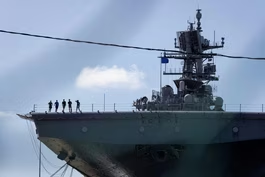
U.S. increases pressure on Maduro with Venezuela strike
Video has Closed Captions
Clip: 12/30/2025 | 5m 1s | With strike inside Venezuela, U.S. increases pressure on Maduro regime (5m 1s)
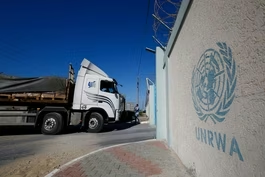
U.S. unveils new plan for delivering humanitarian aid
Video has Closed Captions
Clip: 12/30/2025 | 7m 1s | U.S. unveils new plan for humanitarian aid after pausing contributions earlier this year (7m 1s)
Providing Support for PBS.org
Learn Moreabout PBS online sponsorship
- News and Public Affairs

FRONTLINE is investigative journalism that questions, explains and changes our world.

- News and Public Affairs

Today's top journalists discuss Washington's current political events and public affairs.









WHYY Series
Support for PBS provided by:
Major corporate funding for the PBS News Hour is provided by BDO, BNSF, Consumer Cellular, American Cruise Lines, and Raymond James. Funding for the PBS NewsHour Weekend is provided by...