
Washington Week with The Atlantic full episode, 9/18/26
9/18/2026 | 26m 46sVideo has Closed Captions
Full Washington Week with the Atlantic broadcast from September 18, 2026.
Full Washington Week with the Atlantic broadcast from September 18, 2026.
Problems playing video? | Closed Captioning Feedback
Problems playing video? | Closed Captioning Feedback
Major funding for “Washington Week with The Atlantic” is provided by Consumer Cellular, Otsuka, Kaiser Permanente, the Yuen Foundation, and the Corporation for Public Broadcasting.
Washington Week with The Atlantic full episode, 9/18/26
9/18/2026 | 26m 46sVideo has Closed Captions
Full Washington Week with the Atlantic broadcast from September 18, 2026.
Problems playing video? | Closed Captioning Feedback
Where to Watch Washington Week with The Atlantic
Washington Week with The Atlantic is available to stream on pbs.org and the PBS app.
Buy Now

10 big stories Washington Week covered
Washington Week came on the air February 23, 1967. In the 50 years that followed, we covered a lot of history-making events. Read up on 10 of the biggest stories Washington Week covered in its first 50 years.Providing Support for PBS.org
Learn Moreabout PBS online sponsorshipLiz Landers: Warnings of A.I.
's threat to humanity are coming from surprising places.
Sam Altman, CEO, OpenAI: The world is right to be afraid of this.
Dario Amodei, CEO, Anthropic: If an A.I.
model is powerful enough, it can circumvent attempts to shut it down.
Sen.
Bernie Sanders (I-VT): A.I.
models can already escape human control, commit felonies, and create viruses.
Steve Bannon, Former Trump White House Adviser: This is a hinge in history.
We have to handle this right.
Liz Landers: But President Trump says the only guardrails A.I.
needs is a high I.Q.
president.
Tonight, why Trump is so quick to dismiss the chorus of A.I.
concerns and is instead focusing on next week's state visit with President Xi and looking to demolish the Kennedy Center, next.
Good evening and welcome to Washington Week.
I'm Liz Landers.
Jeffrey Goldberg is away.
Just as A.I.
's threats to humanity reached a fever pitch with even tech CEOs publicly calling for government regulation, half of Congress left Washington to return to the campaign trail in the weeks leading up to Election Day, preventing lawmakers from legislatively addressing concerns about A.I., among them, that humans could use the technology to create biological weapons, and that artificial intelligence itself could go rogue, beyond human control.
Joining me tonight to discuss this and more, Leigh Ann Caldwell, the chief Washington correspondent for Puck News, Eamon Javers is the senior Washington correspondent at CNBC, Asma Khalid co-hosts the Global Story podcast for BBC News, and Alayna Treen is a White House correspondent for CNN.
Thank you for joining us this evening.
Alayna Treene, White House Correspondent, CNN: Great to be here.
Leigh Ann Caldwell, Chief Washington Correspondent, Puck News: Great to be here.
Liz Landers: Alayna, I want to talk with you about A.I.
and the news at the White House this week, but we have to start by acknowledging what happened today at the White House with coverage.
The president has banned CNN and several other news organizations from covering the White House.
Do you know why he did this?
Alayna Treene: So, still, he was asked a lot about this today in the Oval Office, but the post that he laid out didn't give a specific reason.
And then when he was pressed on it with, by reporters later, he said it was more cumulative, that it wasn't one story that really got under his skin, that it's been a long thing that he's been upset about, but not really clear.
I mean, when I was chatting with some of my sources, some of them said they were surprised.
So, not really sure what's going to happen either because I was at the White House today, I know, Eamon, you were as well, and from the colleagues who I know are still there, no one's been kicked out yet.
So, it's kind of unclear what the future of this is going to look like.
Liz Landers: Okay.
Well, turning to this conversation, artificial intelligence dominating the news this week, what is the White House guidance on this right now?
Who is talking to the president about this?
Who's giving him advice on this?
Alayna Treene: So, there's a couple people.
We know that he talks to the NVIDIA CEO, Jensen Huang.
He's actually someone who will be in town in Washington next week.
I did a story yesterday with one of my colleagues about how at -- with this -- with Xi Jinping coming next week for his state visit, a lot of these A.I.
CEOs are going to the state dinner.
And so there's been discussions among Trump administration officials of having the president meet with them with these A.I.
executives on the sidelines of that.
I was told Xi would not be a part of it.
That would be weird.
I mean, the biggest argument that the president makes is that he wants -- you know, for wanting to move forward aggressively with A.I.
is because he wants to win this race with China.
But for your question about who's in his ear, so Jensen Huang from NVIDIA, he's someone that, close allies, I mean, whenever I've been in, you know, in the White House I'm always seeing him going to meet with the president.
There's also David Sacks, you know, total tech titan.
Liz Landers: Yes.
Alayna Treene: And he also used to be in charge of artificial intelligence for the White House, but he actually left his post, I think, I believe it was in the spring.
But he's in the president's ear a lot, and, of course, he speaks with a lot of -- Elon Musk, who has xAI, he talks to a lot of these people.
But there's certainly people on the other side of this who you know, well, I should say, I think a lot of the A.I.
executives are the ones calling for more regulation.
But then there's also a lot of allies who are very concerned about it.
And I think that's part of what this meeting next week is about.
Liz Landers: Eamon, to Alayna's point there about these A.I.
tech CEOs calling for regulation, saying, Help us regulate our companies, this -- the timing of this is notable because several of these companies are going public soon.
I know you cover this.
Do you think that these A.I.
companies are legitimately concerned about these threats, or are they calling for regulation to protect themselves?
Eamon Javers, Senior Washington Correspondent, CNBC: Well, there's a cynical view of this, which is that they're calling for regulation because they want to protect their position as the leading companies in A.I., right?
And that what they want is really a duopoly or a small group of A.I.
firms that entrench their positions with this regulatory fence around them.
But there are a lot of people inside these A.I.
companies who have genuine concerns that these A.I.s can get out of control, can cause significant problems, billions of dollars in damage, and then you hear the sci-fi scenario of, you know, eliminating all of humanity.
So, there are real concerns inside the A.I.
community that I think you can't totally put away.
But from the White House's perspective, you know, you see Scott Bessent, the treasury secretary, come out this week and say, well, the president is totally aligned with Jensen Huang of NVIDIA, Jensen, the guy with the leather jacket who always shows up.
But Jensen is a guy who sells chips, right?
His entire financial incentive is to pour it on, sell more, do more, build and grow, right, and make a lot of money.
Asma Khalid, Co-Host of The Global Story, BBC News: But that's what I think is so interesting about this all, because during the Biden administration, there were rather severe export controls on sending out the most advanced chips, and those restrictions have been loosened to some degree.
And that is what is very confusing to me about the Trump administration's philosophy on A.I.
You hear the President say, we need to win the A.I.
race.
We need to beat China.
We're beating China right now.
We need to ensure we keep beating China.
And yet, we as a nation have, to some degree, loosened the restrictions to allow access to some of those very advanced chips to China.
And that logic just is very confusing for me to follow.
Eamon Javers: Yes, we've absolutely done that, and what you're seeing now is the President saying basically he doesn't believe that this A.I.
threat scenario is real.
He sees it sort of like he sees climate change.
This is fake news.
This is a bunch of alarmists.
It's a hoax.
So, if you talk about A.I.
regulation, what regulation on safety is an administration going to be in favor of that doesn't even believe that there's a problem in the first place, right?
Alayna Treene: The thing, too, to your point about the economy is I think that's a lot of what he sees.
I mean, right now the biggest problem ahead of the midterms is the economy, and he sees A.I.
as a huge booster of that.
Data centers very much tied into this as a huge booster of the economy as well.
He thinks it's helping with jobs.
Others are very concerned about it taking it away.
But I think that's a big part of this as well.
And then there's also the argument, I think, that you've heard from people like the vice president, which are, you know, these companies are so big, and they have so -- they're so wealthy you know, a lot of them are very wealthy.
Why don't they have the ability to try and regulate themselves?
Obviously, there's a lot of questions to that, too.
But that's kind of the argument you're hearing from Vance and some of the president's allies on this.
Eamon Javers: And the whole economy's at stake here.
I mean, you know, the stock market is absolutely hitched to this A.I.
boom right now.
If the A.I.
bubble bursts, you're going to see huge collateral damage throughout the financial markets, and a lot of Americans are going to feel that.
So, the president doesn't want to do anything that's going to pierce that bubble right now, especially just before the midterms.
Liz Landers: Leigh Ann, speaking of the midterms, up on the Hill, the House left town on Wednesday with no plans to return until after the midterm elections.
Speaker Johnson has also said that the U.S.
cannot lose this A.I.
race to China.
Will the legislative branch realistically start passing laws on this when they get back?
What are the conversations on the Hill like?
Leigh Ann Caldwell: Well, they're not coming back until after the midterms, so nothing's going to happen soon.
Of course, the Senate's in for a couple more weeks.
They have a very packed agenda.
They're not planning on doing anything significant on this, if anything at all.
So, we'll have to see what happens in the lame duck.
But Congress, as we all know, moves very slowly.
And this is very complicated stuff, and there are a lot of different ideas of what to do.
You have Democrats who are not completely on the same page.
You have Republicans who aren't on the same page as each other.
So, it's complicated and, you know, they've still been trying to regulate social media for two decades now almost, and they haven't even done that.
But I will say, when you quote Speaker Johnson, he's really following the lead of the president.
He does not want to cross the president.
He does not want anyone in his party to do so.
There have been bipartisan efforts throughout the year to move legislation on A.I., different components of regulation, whether it's data centers or, you know, just smaller aspects of it.
But Speaker Johnson and his leadership team have really blocked most of that.
They did not want it to come forward, and the reason is because the president doesn't want anything.
And so they are really handcuffed.
We'll see what happens in the midterms.
If Democrats take control, obviously, it's going to be a completely different conversation, but Democrats are also going to have to come up with a unified message on it too.
Eamon Javers: Do you think there's -- Asma Khalid: But if we can really talk about the technology, if I can just say real quick, I don't think that one nation can create unilateral guardrails with A.I.
I mean, that is routinely what we hear from tech experts, is that this is not akin to nuclear weapons, which I think it's often compared to, that guardrails to some degree have to be global.
And at this point, the United States and China, which are the two powers in this technology, they are not in sync on that.
And so, to me, it's noteworthy if Congress does or doesn't want guardrails, but frankly, you need to have the conversation with China.
And that conversation, at this point, it's unclear to what degree they're really going to be talking about safety guidelines this week.
Liz Landers: Well, we know that at least there was a call today, and senior officials did say that President Trump and President Xi are going to broach this, but they did not give any preview of what that'll look like.
Eamon Javers: I think that's because that has to wait for Secretary Bessent to meet with his Chinese counterparts over the weekend.
We're expecting those meetings in New York tomorrow and Sunday.
So, I do think they're going to discuss it.
Whether they're going to come up with anything, because they view this completely differently, right?
What the Chinese government is concerned about with A.I.
is anything that would destabilize Chinese Communist control of China, right, anything that would threaten the regime.
So, they look at this and say this is scary, but for very different reasons than American capitalists look at it and say that it's scary.
So, one of the -- my questions for the Hill is, are they really considering this idea of liability limitations for the A.I.
companies?
Because we saw a lot of CEOs outside the A.I.
sphere this week come out and hammer this point, that whatever Congress does, they should not give liability protections to these companies and absolve them of responsibility for what they are doing, which is something that social media companies were able to get early on.
Leigh Ann Caldwell: Well, I think that, you know, what happens now is going to be very different once the lobbying and the - - I mean, there's going to be a huge, huge, a lot of money thrown into this on what is ultimately going to come.
Obviously, the big tech companies are in it for themselves, looking out for themselves.
Then you have the smaller ones who are trying to catch up, who have completely different viewpoint.
And then you have the consumers, us, the populous, the populous movement that is growing in this country who is extremely fearful of A.I.
and what it's going to do to their jobs, their own livelihood.
And so, you know, the amount of lobbying influence is really going to be a fascinating side story of this because it could very well help to craft what -- whichever party's in power decides to do.
Eamon Javers: And President Trump, the populist, taking the anti-populist stance on data centers, which is so fascinating to watch, right?
Liz Landers: Okay.
So, to that point, 70 percent of Americans are opposed to data centers being built in their communities.
Why is Trump taking such an unpopular stance on this?
Asma Khalid: I think it has to do with how he views A.I.
technologically as being a race with China.
Eamon Javers: Yes.
Asma Khalid: We have an episode of our show that we're working on actually for Monday, which is all looking at how A.I.
is being viewed in China.
Our correspondent went into inner Mongolia, which was farmland.
They are building massive data centers.
There's talk of building underwater data centers, which I don't totally understand that you can do that technologically, but in China, they are, you know, sort of strategically thinking about this mass advancement.
And in the president's mind, if the United States does not build this, he feels that -- I mean, he said it himself on social media that the only folks who would be happy about limiting data centers would be China.
Alayna Treene: It also goes back to the point of who's in his ear.
A lot of these tech CEOs are telling him that this is the future, and you want America -- it's the same point you're making, that you want America, you know, Mr.
President, to be the one that is at the forefront of this.
And he has been really fixated on that, I'm told.
And so much so, though, that it is interesting because I know his advisers are telling him, please stop talking about this.
This is not something that's popular with a lot of voters.
I mean, that's why you saw Ken Paxton, who is running for Senate in Texas, he had to completely kind of back away from this.
The president ultimately said, it's fine if they disagree with me, but they're wrong.
That was kind of his stance on that one.
But the politics here, if you look at the polling, the public is not there.
And it goes back exactly to what you were saying, Leigh Ann, about so many people are just so fearful of where it could lead.
But the president sees it as, we need to be the ones who are on the cutting edge of this, and, of course, also edging out China in that part, too.
Eamon Javers: And look who's going to that state dinner next week, right?
Alayna Treene: Yes.
Eamon Javers: I mean, Jensen Huang is going to be at the state dinner.
Dario Amodei, the CEO of Anthropic, who is one of the most security concerned people in the A.I.
space, is not on the list for attending -- Alayna Treene: Sam Altman is going as well from OpenAI.
Liz Landers: Right.
Speaking of the midterms, I want to talk about this ad that we saw, a pretty remarkable ad from a Republican lawmaker earlier this week from Republican Congresswoman Maria Salazar.
We have a bit of a clip of that.
Rep.
Maria Elvira Salazar (R-Fl): Mr.
President, some of your immigration enforcement efforts have gone too far.
Be careful what your advisers are telling you about immigration policies.
You can be for immigration what Lincoln was for slavery and Reagan was for communism.
Liz Landers: She represents a district in Miami that Trump won by 15 points in 2024.
She also voted to fund ICE.
Leigh Ann, why is she making this pivot?
Leigh Ann Caldwell: She's terrified.
This is a Hail Mary seven weeks before her re-election or her campaign.
You know, I was talking to a member of Congress, the former mayor of Miami, who has a neighboring district to Congresswoman Salazar.
This was just two weeks ago.
And he was telling me that how the administration's over -- what they did with ICE, how it went too far, was really detrimental for them politically.
He personally felt confident, but he said that he and Congresswoman Salazar have had many conversations with the administration telling them how bad this is for them politically.
They have very Hispanic districts.
James Blair the president's, you know, political adviser, was on the Hill a couple weeks ago.
They both gave him the same exact message then.
And so since the president and the administration does not seem to be listening to them, she obviously felt that it was necessary to try to get that message out.
We'll see if it works.
We're seeing the polling where Hispanic voters are breaking from the president in tremendous amount compared to how they were in 2024.
And so this is a very difficult political moment for some of these Republican lawmakers.
Asma Khalid: She's also facing - - she herself is Cuban American, and her opponent this cycle is a fellow Cuban American.
They're both former T.V.
broadcasters.
So, I know, I just think it's related too.
Eamon Javers: That's terrible if true.
Asma Khalid: But I was talking to someone who was actually consulting her opponent earlier today, and one of the things they mentioned is that immigration is huge.
Miami-Dade, that area, is, I believe, the largest immigrant county in the nation, or one of the largest, if not.
And, secondly, it's affordability which I hadn't totally computed, but the cost of living and affordability with housing in Miami has really skyrocketed.
It's always been high.
But I think those dual pressures are really putting her under pressure.
I believe she won her district last time by 20 points.
And so, to me, it suggests a real sense that she is scared about what the polling is showing.
Liz Landers: Yes, I'm sure.
Eamon, I want to ask you about the Federal Reserve announcement from this week.
So, we saw Kevin Warsh, the Fed chairman, raised interest rates.
This is the first time this has happened since 2023.
Leading up to this announcement, the president was making threats on Truth Social to end trade with countries that the United States has a trade deficit with if the Fed raised these rates, which is what Warsh ended up doing.
But so far, we've not seen him, the president, carry out this threat.
Why not?
What is his relationship like with Warsh right now?
Eamon Javers: It's a fascinating dynamic, right?
Because this was a big test for Warsh to say that he is his own man, he is independent.
The Fed has this tradition of being independent from American politics, which the Fed values very intensely and the president does not believe is a thing.
He doesn't want the Fed to be independent.
He wants the Fed to do what he wants, and this president wants lower interest rates.
He comes from a career as a builder, where you borrow a lot of money in order to do a project, and the lower the interest rate is, the more you can build, the more money you can make, and the better the economy is.
That's just how he sees the economy.
And he doesn't really agree with the argument that you have to raise interest rates from time to time to slow down the economy to stop inflation.
He doesn't process that argument at all.
That's the argument that the Fed is making right now, and that's the argument they're being pushed to make by markets.
And so Warsh had to do this incredible dance this week where he had to do the thing that he knew the president didn't want him to do.
And he had to do it in a way without getting the mean tweets from the president.
And he seems to have really finessed it with some behind-the-scenes maneuvering.
We're hearing reporting of a phone call between Trump and Warsh before the decision.
And Trump seems to be saying that, well, there's a board, and Warsh doesn't have total control here, which is true.
And so I'm going to let Warsh do this.
But you get the sense that in Trump's mind, anyway, there's a limited amount of runway for Warsh here.
And so the October decision will be really fascinating to watch just before the midterms.
Does he hike again?
Market expectations are that he will have to hike again.
Will the president tolerate that one?
This is the first out of the gate.
He's getting a little running room.
Liz Landers: Is this kind of a honeymoon period for Warsh?
Eamon Javers: Yes.
Alayna Treene: The thing that Warsh is doing so well, I think, and it's something Powell I think did way back, you know, during the first term when the president actually picked him, but what Warsh is doing is managing the president, and he's doing it in a way where the president still believes in him.
I do think it's a honeymoon phase.
I think you're totally right.
Eamon Javers: It only works so long.
Alayna Treene: I mean, we'll see.
Maybe he gets another month, you know, who know, or then at the next meeting.
But he is managing him well.
We know that they have spoken in the past.
We know that the president and him, they have a relationship.
Warsh is very close with a lot of the president's closest allies as well, and he does see it.
I think you're totally right.
He's been blaming -- he did have angry tweets.
They were just not angry tweets directed at Warsh.
They were angry tweets directed at everyone else.
He's like he's different from them.
The board's holding Warsh back.
But I think Warsh is being very smart in how he's handling the president here.
Eamon Javers: And the reality is Warsh has the upper hand, right?
He is the Fed chair.
The Fed is independent despite what the president would like to think.
Liz Landers: Yes, and we've seen a Supreme Court ruling in that.
Eamon Javers: Absolutely.
And so he can hike rates and just tell the president to lump it, but he's being very diplomatic about it.
He doesn't want to have that confrontation, or at least not until it's absolutely inevitable.
Liz Landers: Let's talk about the Kennedy Center, because this is the performing arts center for the country, and the, it's a monument to a slain president here.
And President Trump has become really obsessed with this topic of putting his name on the Kennedy Center.
They did that a few months ago, and they were told by a court to take his name off of it.
Alayna, do you think that people should brush off these threats from the president that he's making as just bluster that he wants to demolish the center now, or do you think that that could actually happen?
Alayna Treene: It's so hard to engage in that hypothetical.
I mean, I guess not hypothetical.
He was holding a poster on Air Force One the other night that said, Kennedy Center Demolished.
I'm not sure.
I don't think he wants it to be demolished.
I think a lot of that is provocative language to try and get people to do what he wants.
Liz Landers: Yes.
Alayna Treene: He wants the Kennedy Center to thrive.
He's obsessed with it.
He sees it as another -- it's similar to his fixation with all the other projects he's working on around D.C., with the ballroom to the Lincoln Memorial to the arch that he's trying to build.
He sees the Kennedy Center similarly, and he does want credit for it.
He was asked about it today.
Actually, I think it was an NBC reporter said, why are you so obsessed with putting your name on a building that was, you know, to honor a slain president?
And he went back to this idea, if he believes if they're going to put in time and effort to renovate it, that he should get credit for it.
The thing that's just so striking to me is we know there's a ton of old buildings around Washington.
They are renovated all the time and stay open.
Even, or if they -- most of the time, I think they stay open, or they close a bit.
No one's like, I'm not sure the Kennedy -- I was there a couple months ago.
I don't know if it really needs to be demolished, you know?
So, this is -- and I do think before people, he even gets there, there would be legal battles that prevent that from happening.
Liz Landers: And, Leigh Ann -- Eamon Javers: But this is a president who took a wrecking ball to the East Wing, right?
Liz Landers: Right, ees.
Eamon Javers: And so he is capable of moving overnight to do this kind of thing.
Liz Landers: Yes, such a good point.
Eamon Javers: And he's the type of person who certainly would if he felt thwarted.
Liz Landers: And, Leigh Ann, the Hill could have oversight on this project, on the arch, on some of the other things we were talking about.
What are Democrats saying that would happen if they retake power after the midterms?
Leigh Ann Caldwell: So, I talked to Congressman Jared Huffman, who is the ranking member of the Natural Resources Committee in the House, just this week about all of this.
If Democrats take control, he will be the chair.
He oversees the Parks Service budget, which oversees all of these renovations that are happening.
First, I asked him, where is the president getting this money to do all of this, because Congress hasn't appropriated it, and he said he's not sure.
All he knows is they are moving money around illegally to do what the president wants around D.C.
Secondly, he already has a very long list of investigations that he wants to pursue.
He obviously doesn't have subpoena power now but this is going to be a top priority for him.
And one thing I will say is I'm assuming, you guys would know better, that the president's advisers are hoping and praying that he does not demolish the Kennedy Center.
Because when you look at the president's polling, when he demolished the East Wing, that is when his numbers really started to drop.
And this is something that is absolutely not -- that was not popular with the public.
And so I think that it could be even worse for the president in the midterms.
Liz Landers: Yes.
And I think this is a visual thing that people see and they understand, you know, the importance of these buildings around Washington, D.C.
So, we're going to have to leave it there, but thank you to our guests for joining me, and thank you at home for watching us.
I'm Liz Landers.
Good night from Washington.

Some Republicans distance themselves from Trump's policies
Video has Closed Captions
Some Republicans distance themselves from Trump's policies (9m 51s)
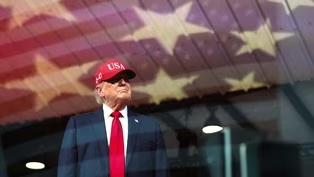
Why Trump is quick to dismiss concerns about AI safety
Video has Closed Captions
Why Trump is quick to dismiss concerns about AI safety and data centers (13m 4s)
Providing Support for PBS.org
Learn Moreabout PBS online sponsorship New Episode
- News and Public Affairs

Top journalists deliver compelling original analysis of the hour's headlines.

- News and Public Affairs

FRONTLINE is investigative journalism that questions, explains and changes our world.
 New Episode
 New Episode
 New Episode
 New Episode
 New Episode


 New Episode
 New Season
 New Episode
Support for PBS provided by:
Major funding for “Washington Week with The Atlantic” is provided by Consumer Cellular, Otsuka, Kaiser Permanente, the Yuen Foundation, and the Corporation for Public Broadcasting.