
Here and Now
Here & Now for July 17, 2026
Season 2500 Episode 2503 | 26m 47sVideo has Closed Captions
Watch the entire episode of Here & Now for July 17.
Watch the entire episode of Here & Now for July 17.
Problems playing video? | Closed Captioning Feedback
Problems playing video? | Closed Captioning Feedback
Here and Now is a local public television program presented by PBS Wisconsin
Here and Now
Here & Now for July 17, 2026
Season 2500 Episode 2503 | 26m 47sVideo has Closed Captions
Watch the entire episode of Here & Now for July 17.
Problems playing video? | Closed Captioning Feedback
Where to Watch Here and Now
Here and Now is available to stream on pbs.org and the PBS app.
Providing Support for PBS.org
Learn Moreabout PBS online sponsorshipThe following program is a PBS Wisconsin Original production.
>> She filed inaccurate and incomplete campaign finance reports.
>> Democratic primary candidate for governor Sarah Rodriguez drops out Falke.
>> Fusion is the energy of the future, and Wisconsin is where fusion research becomes reality.
>> And a significant step forward for energy technology.
I'm Frederica Freyberg tonight on "Here& Now", a leading Democratic candidate for governor drops out after a stunning week of missteps.
We report on the crowded Republican primary for the seventh Congressional District in northern Wisconsin, as well as why Democrats running there want the job.
And we talk with the CEO of an emerging energy company about why and how they're bringing nuclear fusion to Wisconsin.
It's "Here& Now" for Friday, July 17th.
[MUSIC] >> Funding for "Here& Now" is provided by the Focus Fund for Journalism and Friends of PBS Wisconsin.
>> After a Monday news conference where she fired her campaign manager for messing up the financial reports but still vowed to stay in the race, Democratic primary candidate for governor Sarah Rodriguez, today dropped out.
She said the fundraising reporting mess would be too big of a distraction.
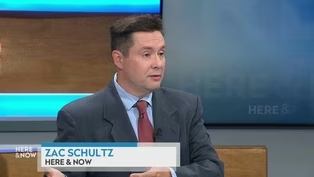
Senior political reporter Zac Schultz is here with details on.
Hi, Zac.
>> Hello, Fred.
>> So this has been almost like a slow motion train wreck.
Exactly what happened.
>> It's been a back and forth all week.
Last week we were talking about all the momentum she had.
The candidates that had dropped out were endorsing her.
I was in touch with the campaign to see where she be out in the field this week.
We were going to touch base with all the Democratic candidates, and said, well, we're still figuring out that schedule.
Well, by Sunday, they'd fired her campaign manager.
By Monday, she has a press conference saying, I'm in the race, but fundraising is a little weaker.
We talked to the other candidates.
They're like, authority.
It says you can run things and you don't have any oversight of your own campaign.
Her campaign finance sheets come and show she's broke and deeply in debt.
Then she makes another press conference to say that she's got all this money and then quickly says, nope, sorry, that was an error as well.
And now she's out.
So it's been back and forth, people really trying to figure out where is the truth.
And when she says it was a distraction, she's 100% most honest thing that's been said about the campaign all week, is this was dominating all the headlines and would have if she would have stayed in this race.
>> She was considered a frontrunner, though.
>> Absolutely.
When you were looking at if you looked at that Democratic primary in terms of lanes, there was clearly Francesca Hong in the more progressive far left lane.
She had owned that for quite a while in this race, and it was a question of who could coalesce more of that centrist moderate candidacy.
And Sara Rodriguez was taking that over.
And now that it's gone, it's a question of who takes advantage of that.
Where do those voters go?
>> So now Governor Evers is reportedly talking about backing an effort to draw David Crowley back into the race.
Why?
What happened there with him?
>> Well, David Crowley dropped out almost a couple of weeks ago, saying it was clear he wasn't going to have a lane it was assumed he was contesting with Rodriguez saw her momentum and knew he couldn't get their fundraising reports that they just were filed so that he actually has plenty of cash on hand, a lot more than her.
Significantly, if her transparent from the beginning, there's a question of whether he would have dropped out because he would have been significantly ahead of her.
There are other centrists that are saying, hey, bring him back.
He's the next best person to take that mantle with Rodriguez out of the race.
And now it's a question of whether he will do that and what will that look like?
>> Yeah.
Who else stands to gain?
>> Well, Joel Brennan clearly says this is his moment to shine and people to hear his name for the first time.
If you're not finely tuned into this race.
Kelda Roys Mandela Barnes.
They all claim that they can benefit from this Francesca Hong to a degree, because there there were people that backed that just want a Democrat who can win.
And now she may have a more open race all the way to winning this primary.
If her main contender from the centrist candidacy falls apart.
>> So meanwhile, Republican candidate Tom Tiffany not only has gobs of money comparatively, but this must be great for the GOP.
>> Oh, they absolutely love this.
Any time you see the other party falling apart on their own mistakes missteps, then it's good news for Tom Tiffany, because he's had this whole opportunity all summer long to run positive ads.
He's got a ton of money in the bank, 2 million cash on hand, pretty much all of that coming from billionaires who have given to the party that have given to him the billionaire loophole that he came on our air and criticized a few months ago he's now taking advantage of.
But that's politics.
He's definitely in a much better position.
I did ask the Democratic candidates this week, can you overcome that after this primary?
And they said, absolutely.
Once we get past August, then we can start contrasting the record that he tries to portray versus his record attached to Trump.
>> Meanwhile, the Republicans are airing ads talking about Francesca Hong.
And what are they doing there?
>> Well, they're technically they are negative ads, but they're airing them in Madison, Milwaukee, 2 Francesca Hong base in an attempt to rile them up.
We've seen groups play in Democratic primaries across the country in an effort to boost what they view as a weaker candidate, a more socialist, progressive candidate.
There are lots of statements in Francesca Hong background that she owns that do not play well according to centrist, or perhaps in a regular contest in November.
>> Have you ever seen anything like this in your coverage of politics in Wisconsin over the years?
>> Not like this.
We've seen campaigns fall apart.
We've seen campaigns run out of money and be deep in debt.
That's not new.
It's the the discord that it all came out and this back and forth throughout the week.
If this had come out in February or March and those statements have been corrected, she probably moved on because she still had support this week.
Just this week, talking to people out in the field, she won the Ozaukee County Democratic straw poll with Francesca Hong in the audience.
So the support was still there, but it was clear that she could not change the message away from her oversight of her own campaign to back to one being about the primary.
>> All right.
Well, Zac, thanks very much for being here.
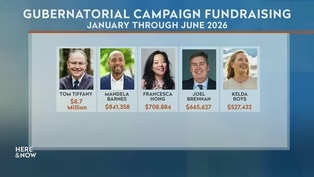
>> As one measure of viability, campaign fundraising reports for the primary candidates, including those still in the race, were released this week.
Republican candidate for governor Tom Tiffany, raised $8.7 million in the first six months of the year, 6.2 million of that from the state Republican Party, according to reports.
Democrat Mandela Barnes raised around $841,000 in the same time period.
Francesca Hong raised Brennan raised over $665,000 and Kelda Roys raised more than 527,000.
Aside from the race for governor, the state's eight seats in the U.S.
House of Representatives are also up for election this year.
One of those races for the deeply red seventh district in far northern Wisconsin has attracted many candidates in the primary election.
Here and now.
Reporter Steven Potter has this story.
>> There's a lot of motivation to elect people in the seventh district that will be Make America Great Again.
Republicans.
>> The Great North Woods of Wisconsin is known for many things vast forests, abundant farmland, and some of the best lakes and rivers that the state has to offer.
It's also known as a very thinly populated region, but there is something that's become far more crowded than usual.
That's the ballot for the upcoming Republican primary for Congress.
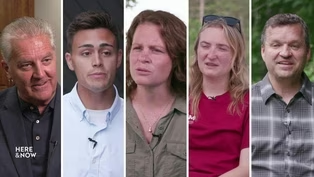
In all, there are five candidates on the ballot for the seventh Congressional District Republican primary election, which takes place on August 11th.
The candidates include a financial planner, an accountant, a public relations executive, a marketing specialist, and a homebuilder.
They're all after the seat being vacated by current U.S.
House representative Tom Tiffany, who's running as the Republican candidate for governor.
While they're all Republicans, each of these congressional candidates has different reasons for why voters should choose them.
Kevin Hermening, the financial planner from Wausau, was one of the Marines taken hostage for more than a year during the Iranian hostage crisis back in 1979.
He's one of the better known candidates in this race.
business owner, a school board member, a community volunteer.
So there are a lot of reasons why that I'm the best qualified to represent the voters here.
>> Another well-known candidate is accountant Michael Alfonso, who lives in Hayward.
He's the son in law of U.S.
Department of Transportation Secretary Shawn Duffy, who held the same congressional seat that Alfonso is running for now.
>> I'm just, you know, an average kid from northern Wisconsin.
I grew up in land o lakes.
I bring the energy of a 26 year old.
I'm at every single county in the in the district.
I'm, you know, representing every voter.
>> Then there's public relations executive and Stanley resident Jesse Ebben, who has farming roots in the district.
>> I am a Christian conservative, a Trump Republican, a proud seventh generation wisconsinite who is committed to getting the government off our back, out of our way of life so that we can flourish and prosper right here in rural Wisconsin.
Rhinelander resident Niina Baum, who owns a marketing agency and was born and raised in the Northwoods.
>> I grew up in the district in Price County on a dairy farm, a small farm with about 25 milking cows.
And there were a lot of small farms in my community when I grew up.
And they all disappeared.
>> And finally, there's Don Rajala, a native and current resident of superior.
He works in home construction I.
>> This is my fourth time running for Congress.
I did it in 2010, 2014, 2016.
I have this time and all this energy Steil.
I'm 58 years old, but I just know I can get out there and represent people.
Congressional District stands out for a few reasons.
First is its size.
As the state's largest congressional district, it stretches across 20 counties and almost 19,000mi!S of northern and central Wisconsin.
The economy here is anchored on agriculture, forestry, manufacturing and tourism.
Politically, however, the area has seen significant change over the last couple of decades, driven largely by redistricting.
The seventh Congressional District is now the most reliably Republican stronghold in the state.
>> They're very Republican.
>> Jacque Weissenburger is the vice chairwoman of the Rusk County Republicans.
>> People here really appreciate the values of hard work, having individual freedoms, being able to live their lives as they see fit.
>> She says.
This race for the seventh Congressional District of Wisconsin has national consequences.
>> There's a very big risk at midterms that the House will turn blue, and I think that it's this particular race itself in the seventh district will be it'll be somewhat of a barrier against that happening.
>> While it's certainly possible that the seventh district could elect a Democrat, and there are three of them on the primary ballot, election experts say that's fairly unlikely.
In the 2024 election, voters of the seventh district chose both Republican Tom Tiffany for U.S.
representative and Donald Trump for president by a 20 point winning margin.
The candidates have been working hard to get voters attention and letting them know that they understand the issues that are important to them, according to recent polling, Michael Alfonso is leading the pack, and Alfonso does have the endorsement of President Trump.
>> We've seen kind of this mortgaging of the middle America, the manufacturing jobs, so that we can benefit the coastal elites.
I don't like that.
When we talk about rising costs, maybe the tariffs contribute to that.
But President Trump understands that this is a short term plan.
We're going to be working to bring back the jobs we lost overseas, right back here to northern Wisconsin.
And then we can start removing the tariffs.
>> Number two in the polls is Kevin Hermening, who has given $1 million of his own money to his campaign.
>> When people decide to call central and northern Wisconsin their home, they're saying to the rest of the state, we'd like you to be involved, but we don't need you to control our lives.
And so it's a big reason that I love living up here because of the individuality and the the willingness of people to pull themselves up by their own bootstraps.
>> Jesse Evans says her priorities center on land, wolves and jobs.
>> A lot of the issues here are a battle of our way of life.
So it's everything we're seeing right now, with solar panels and windmills being targeted to be put on our farmland and the fight that we have to see our rural save, our rural landscape, our family farms from bad energy, bad energy policy.
There's really a big battle to de-list the gray wolf.
We need to make sure that that hunt can be localized right here in our state.
And I work in manufacturing, so making sure that we have good manufacturing jobs, that the government isn't the barrier for keeping those manufacturing jobs, keeping the manufacturers here in the rural communities.
>> For Niina Baum, who's biking around the seventh district to meet voters, she worries about the country's financial future and wants regulation changes.
>> Social Security Trust Fund has been projected to be insolvent in a few years, and if nothing's done about it, it's automatic cuts of about 23%.
That is going to have a huge.
If that happens, that's going to have a huge negative impact on our Northwoods economy.
I'd like to see more zoning deregulation, making it easier, more attainable for people to actually build homes and more cost effective.
And not all of these barriers, like minimum square footage requirements or outdated zoning regulation.
>> Don Raihala Halah wants to make sure local residents maintain local control.
>> I'm a big believer in referendums and referendums.
Stop data centers dead in their tracks.
If.
If a city.
Let's choose Wausau or Superior.
If the citizens want to get together and put out a referendum and stop it, it stops right there because the state has given the power to local municipalities to do that.
>> Just like names on the ballot, there's no shortage of issues in this race.
>> Health insurance.
>> Costs of housing.
>> Loss of a job.
>> Or with Iran.
>> These tariffs.
>> Immigration.
>> Drug pricing.
>> On manufacturing and on agriculture.
>> Tough for small farms.
>> Epstein files.
>> But there's one topic that's on the top of mind for all voters.
The increased cost of everything.
Republicans running for the seventh Congressional District are careful about how they discuss the economy and inflation, and what can be done to bring down costs, Jessi Ebben says it's all about energy.
>> Well, the cost of energy is really the baseline that starts a lot of the inflation.
So the best thing we can do is have good energy policy to really start this.
And that doesn't mean solar or wind.
>> Michael Alfonso blames problems within government programs.
>> So inflation it's a scary one.
It's caused by government overspending.
I think the easiest thing to cut from the federal government is fraud, waste and abuse.
So much fraud in our system, so many people making money off of American taxpayers, scamming them.
If we want to shrink the spending, the easiest place to do it is get rid of the cheats.
>> Kevin Hermening also blames the federal government.
But differently.
>> The government has a spending problem.
Government should not be borrowing for its ongoing costs of operation.
When you do that, you run into, in our case, a $40 trillion debt.
And so the government needs to understand that these are dollars that are intended for our communities.
These are dollars that are best spent by the people who live here, who earn them.
And that could play a big role in bringing down inflation.
>> Niina Baum says pricing problems start with the white House.
>> Something that we've been seeing happen a lot more with the current and past administrations, is that a lot more has been passed through executive order, and I think that creates a lot of volatility, which affects the affordability and the economy.
sure what can be done about inflation, but residents need to do what they can for themselves.
>> If you're going to build a home, be your own contractor, be your own general, you you're going to save 15% right off the bat.
It's going to take a couple of phone calls and maybe a weekend here or there, but be your own contractor.
race.
These candidates will be splitting the Northwoods Republican electorate, and voters here are spread far and wide across the rural district.
That means that it may come down to just a few percent or even a few hundred votes, and each campaign has many miles to cover.
Between now and August 11th.
Reporting from Hayward.
I'm Steven Potter for Here and Now.
>> Three Democratic candidates are also running in the seventh Congressional District primary.
Former state Representative Fred Clark, attorney Ginger Murray and IT company owner Chris Armstrong appeared at a debate this week.
Among the questions in such a solidly red district, why do they think a Democrat has a chance to win the election?
Murray started by noting recent Liberal wins in the state Supreme Court.
>> Most notably, Susan Crawford pushed this district over the 50% mark and showed that counties that haven't voted blue in the longest time voted blue for her.
They are looking for a progressive candidate.
They are tired of the corruption that is happening in Washington, D.C.
they want people who are listening and showing up, talking to the folks here, and who will stand for justice as a lawyer.
That's been my entire career defending the Constitution.
I studied it, I defend it.
It is time to get back to the rule of law, and that is what I do best.
I believe that the voters in this district are absolutely looking for someone to take the reins.
>> I think what people are looking for is just normal people that are going to get up there and advocate for them and really hold this administration accountable and start, you know, advocating for policies that are really going to make a difference in people's lives.
What I've heard across the district, not just in Richmond, is it's not just Democrats, but it's also independents and Republicans that are really sick of the status quo.
You know, they're really frustrated with this administration being, you know, corrupt and criminal, not being held accountable, not following the Constitution.
And I think we just need, you know, a fresh perspective, you know, new people to represent us here in the seventh district.
>> This election is more about character than it is about party on the right, over to farm technology days in the wagon.
Today I ended up speaking with a farmer for about five minutes who told me, are you a Democrat?
And I said, yes, I am.
I'm a proud Democrat.
He said, well, I haven't voted for a Democrat since Jimmy Carter.
I don't know if I'm going to vote for you, but we ended up talking for another four minutes about his dairy herd, about his knee replacements, and about what life is like managing a small farm.
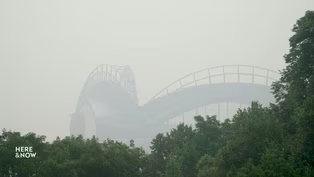
And it's exactly the commitment that I want to bring to everybody in the seventh Congressional District, the representation that works >> Canadian and Minnesota wildfires resulted in the Wisconsin DNR issuing air quality advisories across the state this week, some of which could be extended into the weekend or even beyond in northern parts of Wisconsin and all the way to Milwaukee.
The Azari has reached high into the most severe category of hazardous, meaning the outside air is unhealthy for anyone, as electricity use tips up between staying indoors with air conditioning due to smoky air and heat.
The issue of energy and where to get it is a hot topic here and around the country, and this week it was announced that a massive nuclear fusion research center is coming to Wisconsin.
Realta Fusion, a company spun out from research done at UW-Madison, will build a 200 zero zero zero square foot research and development facility at the long vacant Oscar Mayer plant on the north side of Madison.
The move means the company will be headquartered there, and the workforce is expected to increase from 50 employees to 600, along with $60 million from private investors.
The state of Wisconsin gave nearly $40 million in tax exemptions, with the City of Madison kicking in nearly 3 million in financing.
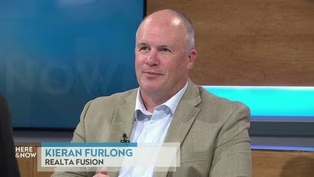
Realtor CEO Kieran Furlong joins us now to explain the project.
And thanks for being here.
>> Thank you very much for having me.
dogs to futuristic generation of energy, what is the promise of nuclear fusion energy in this increasingly kind of electricity hungry world?
>> Yeah.
I mean, I think fusion really is the future for humanity, right?
It's the source of energy that we need if we're going to provide enough food, water, materials, mobility for 10 billion people, we need fusion.
We're not going to dig or drill our way out of this.
And, you know, we can build all the renewables plants we we can manage, but we're still going to need more energy.
And fusion holds that promise.
>> Well, give us kind of the nuclear fusion for dummies description.
>> Sure.
Yeah.
So fusion is another form of nuclear energy as it involves reactions with the nuclei of atoms.
But it's the opposite process from what most people will think of when they think of conventional nuclear fission.
That's where you take a large, heavy atom, like a uranium atom, and split it.
With fusion, we take very small light atoms and fuze them together, basically smooshing them together, and we take different flavors of hydrogen, push those together, and form helium, the same stuff that you would find in party balloons.
But when we do that, you get a small amount of the energy.
Our small amount of the mass gets converted into a massive amount of energy.
>> So I read that researchers have been trying since the 1930s to generate electricity through nuclear fusion, described as the same process that powers the sun.
Why is it so hard?
>> Correct.
So it was first postulated back in the early 20s by researchers looking at what powers the sun.
And so fusion is what powers the sun and all the other stars in the universe.
So in many ways, it's the it's the energy that we have in the universe.
The sun has the advantage of massive, massive scale.
So it's just so large and its density gets us to the conditions that you can have fusion occur.
So infusion, we have something that's known as the, you know, you basically need something called the triple product.
We basically need to get those elements.
We want to fuze together hot enough, dense enough for long enough.
We don't have the advantage of the sun's density.
So we need to get them very, very hot, hotter than the center of the sun.
And that itself is quite challenging.
>> Do you feel as though your scientists have cracked the code to generating electricity through fusion?
>> We're on the way there.
And in fact, just recently we announced an experiment we did where we demonstrated we could pull electricity directly from the plasma that we're operating in the WHAM machine at the University of Wisconsin-Madison.
So plasma is the fourth state of matter.
So you think, you know, ice, water, steam.
And the next step up would be plasma.
So we need to get a plasma.
We can hold that in a magnetic cage essentially, because we temperatures much hotter steel vessel, for example.
But we're making great progress with it.
There's still some work to do, and that's why we'll be doing our R&D in this new facility.
it with all this money and the retrofit involved?
>> So I think the first thing is we're not trying to defy any laws of physics.
So I've got great I'm a great believer in the ingenuity of humans.
We will find a way forward.
There's an old joke about fusion that folks will say, oh, it's 20 years in the future and always will be.
That kind of ignores the effort that's needed to get there.
And now we're making the effort so there's more investment coming into fusion.
We've got more people working on the problem.
I'm 100% convinced humanity will solve fusion.
The question is when.
>> What do you think about when?
>> So we're targeting the 2030s.
So you know, early to mid 2030s is when we intend to have a first commercial operation based on our technology.
>> Does this project put Wisconsin on the map for fusion in a major way?
And why Wisconsin?
>> Yeah, I think so.
In terms of putting it on the map.
And that's really been kind of one of our intentions from the start.
So the University of Wisconsin-Madison is already one of the top institutions for research in this field of plasma physics and fusion.
The state is a, you know, very well placed from a manufacturing standpoint, the ability to, you know, do precision and advanced manufacturing fusion industry is essentially bringing those two things together.
We've got the scientific research to show, well, here's the kind of machine we need to build, and then we need to know how to build those and demonstrate that we can do that cost effectively.
I think Wisconsin is very well placed to do that.
That was one of the factors in deciding to set up our R&D facility and corporate headquarters here.
And I think Wisconsin absolutely will be one of the main hubs for fusion in the 21st century.
>> All right.
Well, we appreciate you being here.
Kieran Furlong.
Thanks.
>> Thank you very much.
>> For more on this and other issues facing Wisconsin, visit our website at PBS Wisconsin Education and then click on the news tab.
That's our program for tonight.
I'm Frederica Freyberg.
Have a good weekend.
>> Funding for "Here& Now" is provided by the Focus is provided by the Focus Fund for Journalism and friends of PBS Wisconsin.
 New
New2026 Candidates For Governor Release Midyear Finance Reports
Video has Closed Captions
Clip: S2500 Ep2503 | 10m 2s | Primary candidates in Wisconsin's 2026 race for governor release campaign funding reports. (10m 2s)
 New
NewHere & Now opening for July 17, 2026
Video has Closed Captions
Clip: S2500 Ep2503 | 1m 15s | The introduction to the July 17, 2026 episode of Here & Now. (1m 15s)
 New
NewIt's a Crowded Republican Race for Wisconsin's 7th in 2026
Video has Closed Captions
Clip: S2500 Ep2503 | 10m 2s | Wisconsin's 7th Congressional District Republican candidates make their cases to voters. (10m 2s)
 New
NewKieran Furlong on Realta Fusion's Energy R&D Deal in Madison
Video has Closed Captions
Clip: S2500 Ep2503 | 5m 46s | Kieran Furlong on a research and development facility focusing on nuclear power tech. (5m 46s)
 New
NewWildfire Smoke from Canada and Minnesota Smothers Wisconsin
Video has Closed Captions
Clip: S2500 Ep2503 | 26s | Smoke from wildfires leads to air quality advisories at the highest alert category. (26s)
 New
NewWisconsin 7th District Democratic Candidates Make Their Case
Video has Closed Captions
Clip: S2500 Ep2503 | 2m 31s | Democratic candidates in the 7th Congressional District debate before the 2026 primary. (2m 31s)
 New
NewZac Schultz on Rodriguez Ending her 2026 Run for Governor
Video has Closed Captions
Clip: S2500 Ep2503 | 5m 9s | Zac Schultz on what Sara Rodrigues dropping out of the 2026 race for governor means. (5m 9s)
Providing Support for PBS.org
Learn Moreabout PBS online sponsorship New Episode
- News and Public Affairs

Top journalists deliver compelling original analysis of the hour's headlines.
 New Episode
- News and Public Affairs

Today's top journalists discuss Washington's current political events and public affairs.

 New Episode
 New Episode
 New Episode
 New Episode

 New Episode
 New Episode
Support for PBS provided by:
Here and Now is a local public television program presented by PBS Wisconsin